Fire Alarm Design
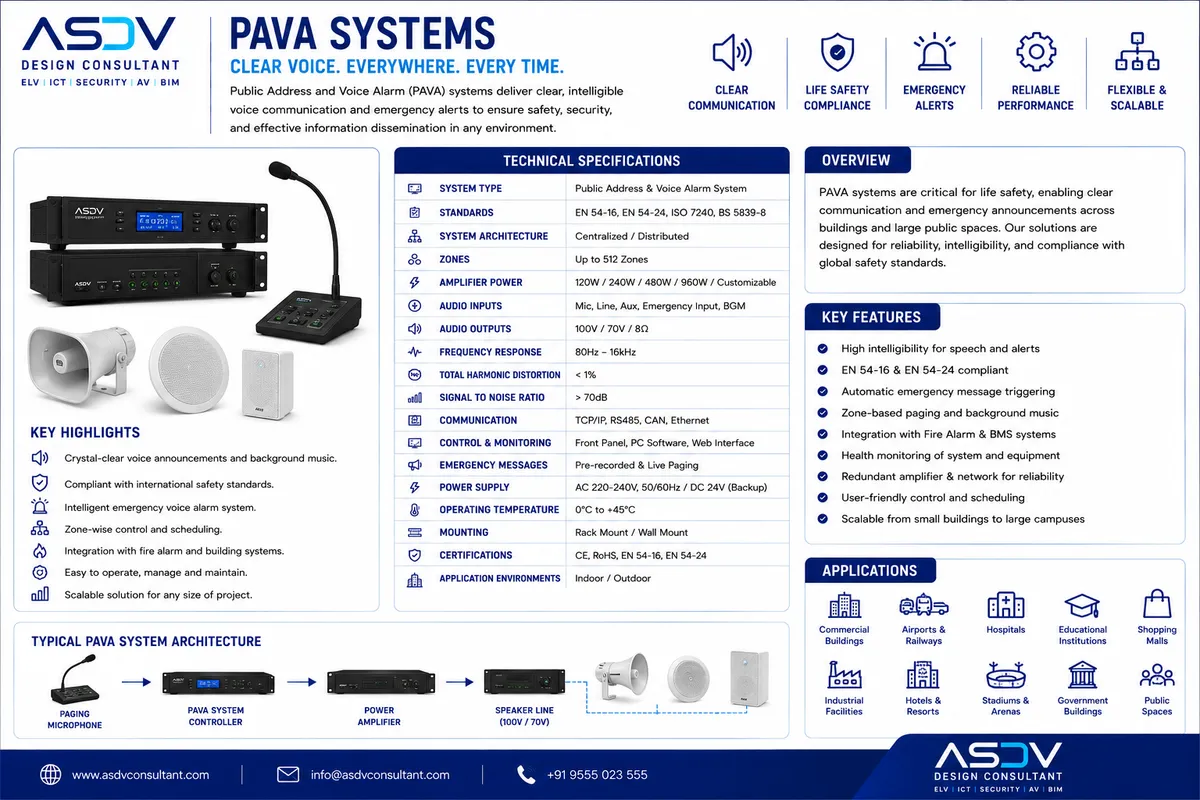
EN 54-Compliant Smart Voice Evacuation: EN 54-16 & EN 54-24
EN 54-16 / EN 54-24 certification guarantees every PAVA component meets stringent life-safety standards for reliability, intelligibility and fire resistance.

188 in-depth technical articles on fire alarm, CCTV, access control, structured cabling, data centre, smart buildings, audio visual and future technologies — plus a 100+ question FAQ library — by ASDV Consultant, serving India, UAE, Saudi Arabia, Qatar, GCC, UK & USA.
How AI-driven energy optimization, IoT sensor fusion, digital twins, and cloud-native platforms are transforming Building Management Systems — 30–40% energy savings, predictive maintenance, and the roadmap to fully autonomous buildings by 2032.
EN 54-16 / EN 54-24 certification guarantees every PAVA component meets stringent life-safety standards for reliability, intelligibility and fire resistance.
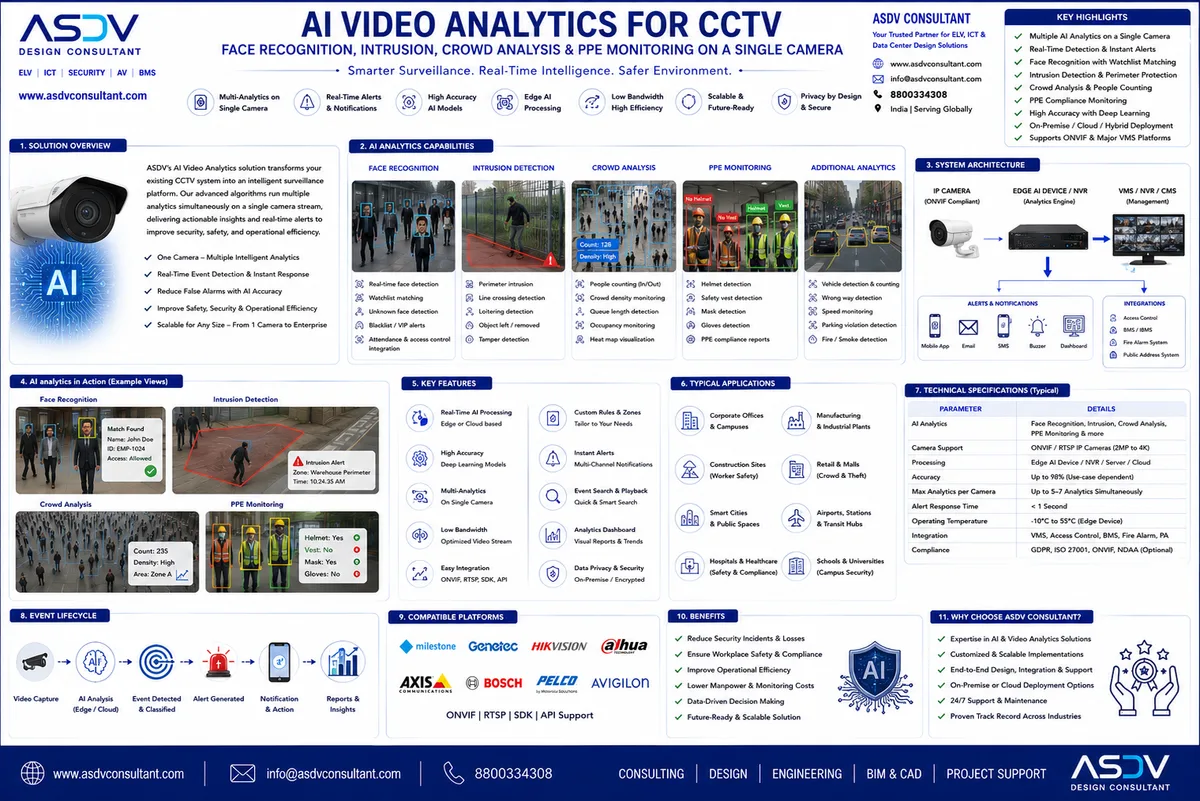
AI video analytics run face recognition, intrusion detection, crowd density analysis and PPE compliance simultaneously on a single edge camera.
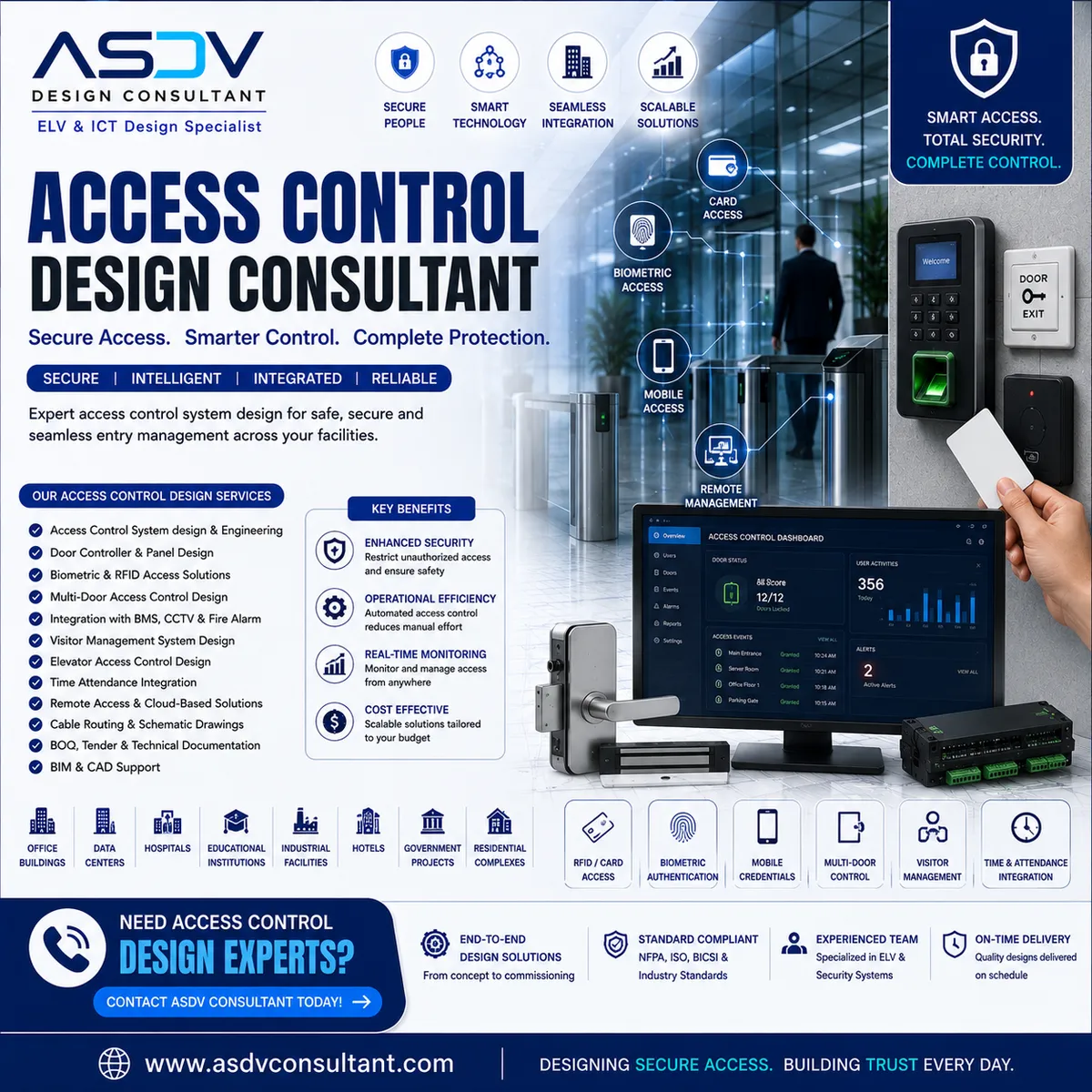
Smartphone NFC and BLE credentials eliminate lost cards and cloning, with hands-free access at 99.9% read reliability and instant cloud revocation.
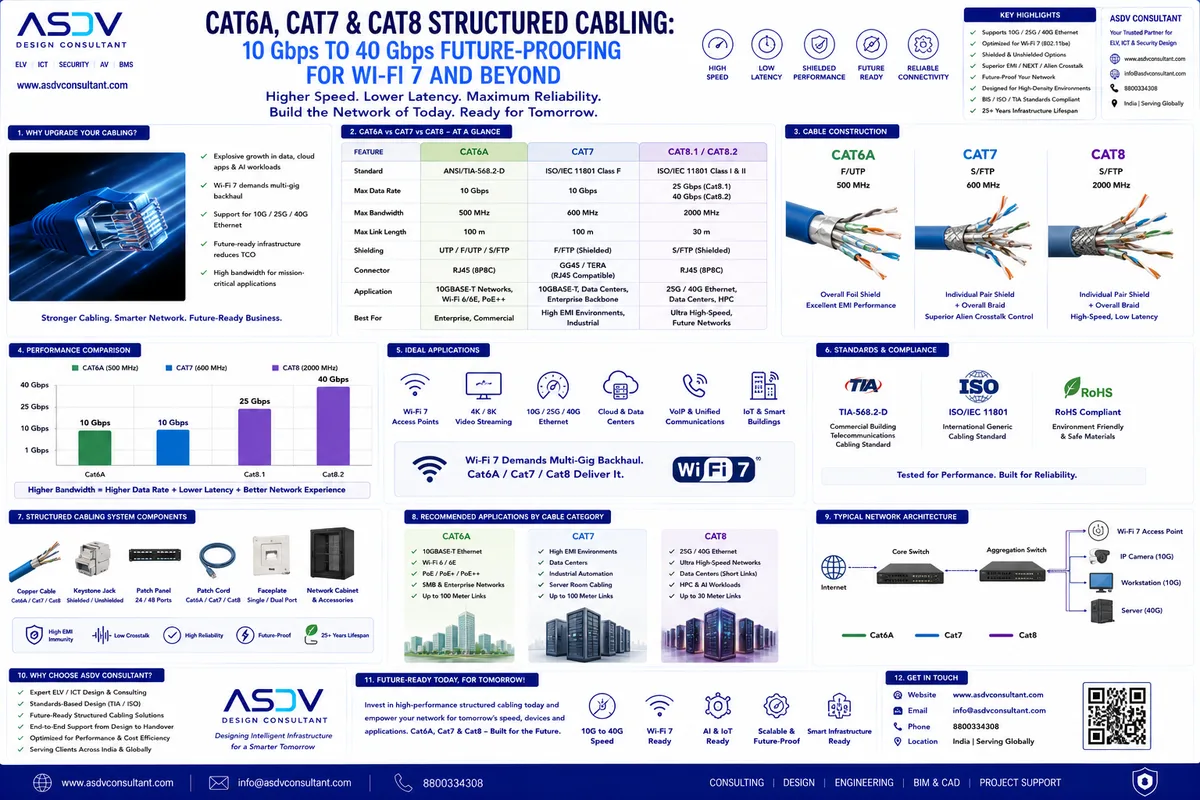
Cat6A (10 Gbps to 100m) is today's commercial standard; Cat8 (40 Gbps to 30m) serves data centre top-of-rack switching.
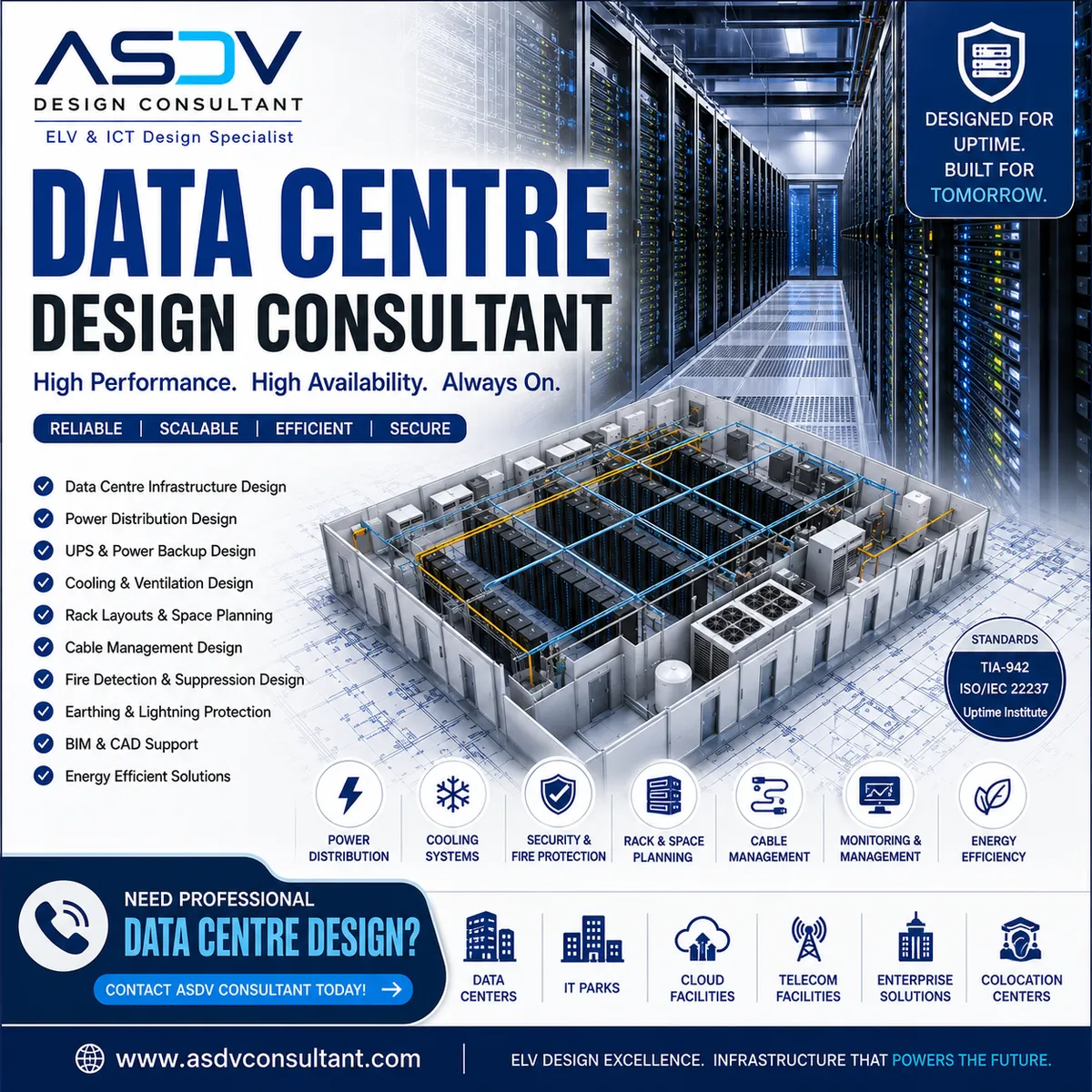
NVIDIA H100/H200 and AMD MI300X GPU clusters generating 700W+ per accelerator demand complete rethinking of power density and cooling strategy.
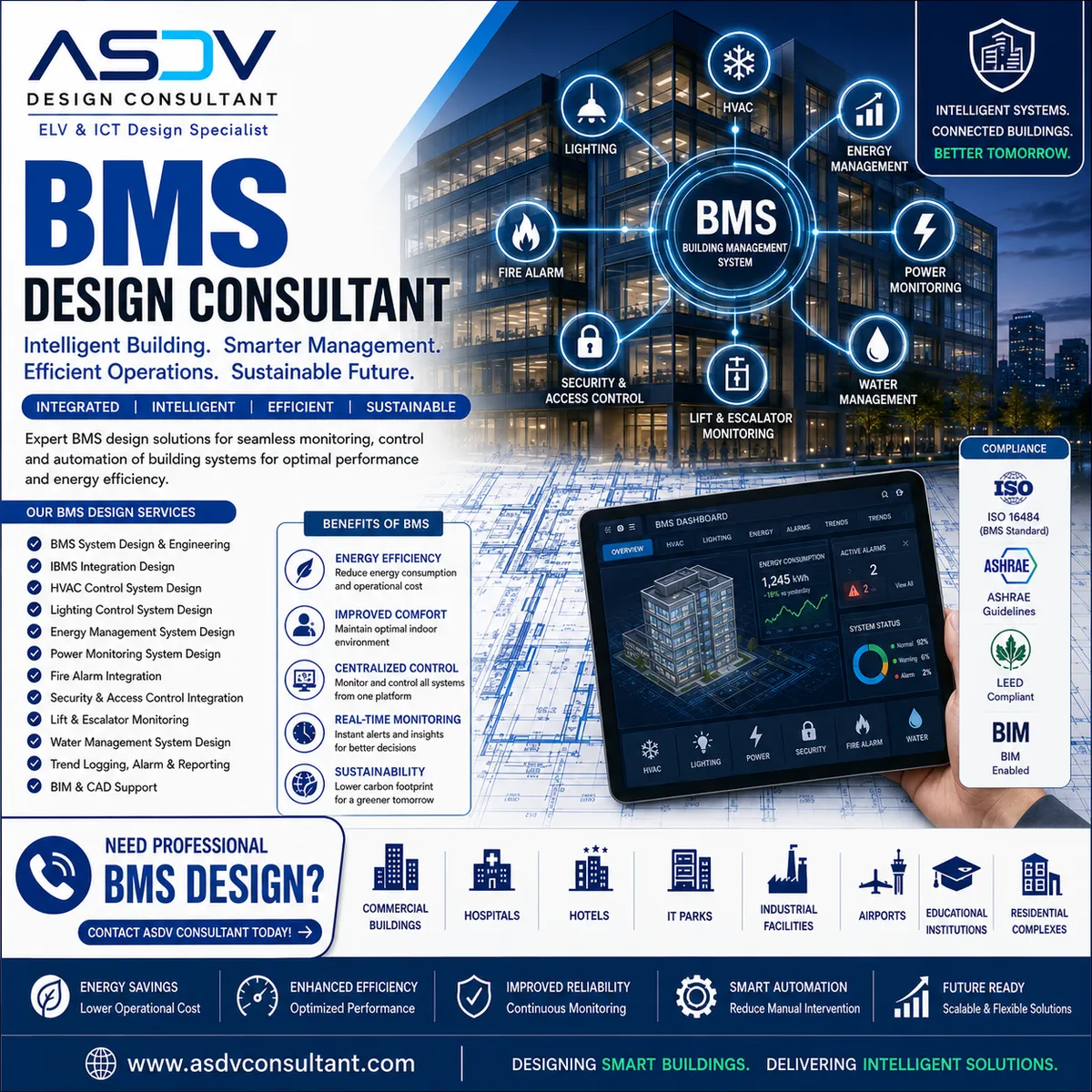
Vendor-neutral BMS architectures integrating every building system on one data fabric, reducing multi-vendor integration costs by 42%.
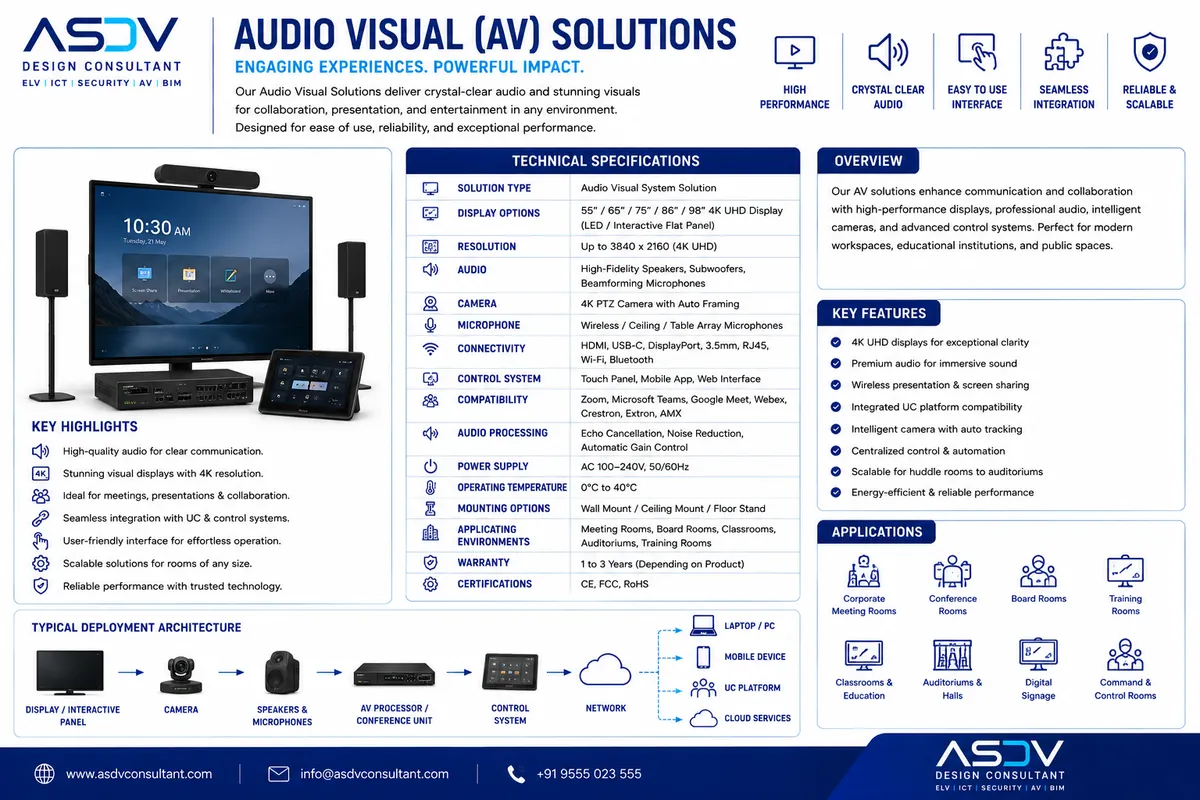
Software-defined 4K signal routing over standard 1/10GbE networks, compared for latency, bandwidth and campus-wide scalability.
AI assigns dynamic risk scores to every physical access request, replacing binary allow/deny with continuous posture management.
Facilities exceeding 100 MW define the frontier of data center engineering: custom silicon, direct liquid cooling and proprietary power distribution.
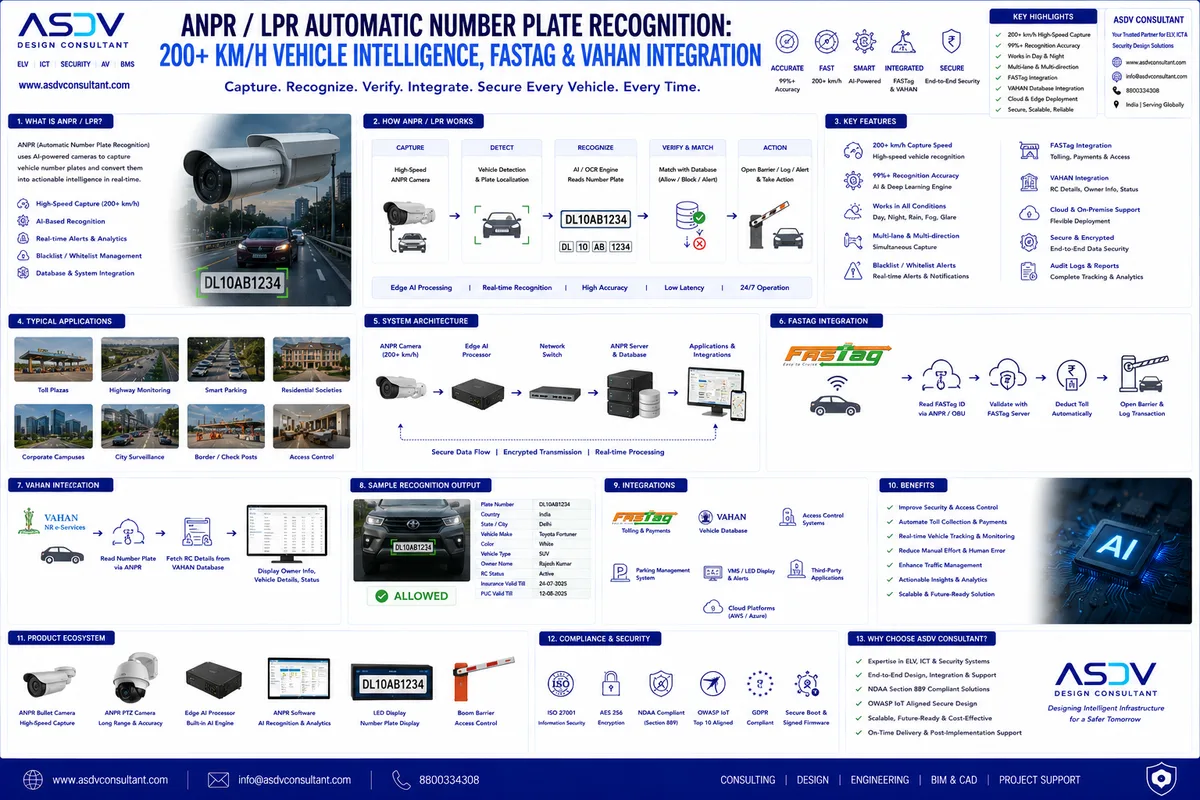
Modern ANPR/LPR systems read licence plates at 200+ km/h with 99.9% accuracy and match against watch-lists in under 100ms.

OS2 single-mode fiber to individual workstations delivers unlimited bandwidth headroom and complete EMI immunity for trading floors.
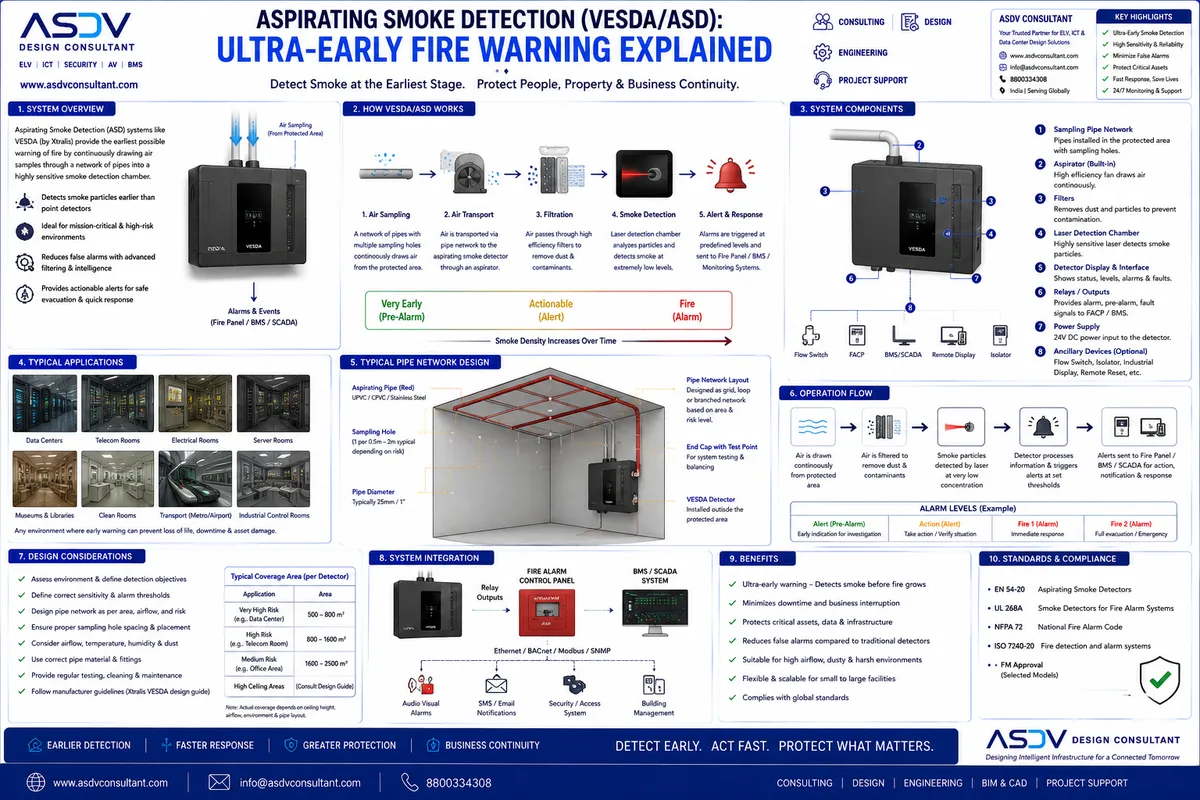
VESDA-E systems sample air continuously, detecting combustion byproducts 100× below conventional detector thresholds — the gold standard for data centres.
Fire alarm system design is the foundation of life safety in any modern building. As an experienced fire alarm design consultant, ASDV Consultant designs intelligent addressable fire detection and alarm systems compliant with NFPA 72, BS 5839, EN 54, IS 2189 and NBC 2016 for high-rises, hospitals, hotels, malls, factories and data centers across India and GCC.
Today's most intelligent buildings don't merely detect fire — they predict it, simulate it through digital twins, and guide every occupant to safety autonomously. These technologies are elevating fire protection from passive compliance into active, AI-driven life safety.
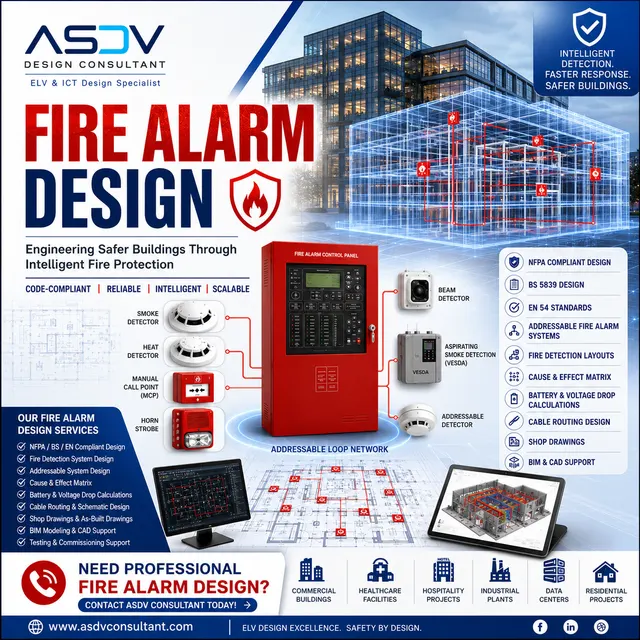
Every detector reports its unique ID, sensitivity drift, contamination level, and predicted end-of-life — enabling proactive replacement before failure rather than reactive emergency response.
Read Article
Camera-based AI detects smoke plumes and open flames within seconds across vast open spaces — warehouses, atriums, and aviation hangars where conventional point detectors are physically impractical.
Read Article
VESDA-E systems sample air continuously, detecting combustion byproducts at concentrations 100× below conventional detector thresholds — the gold standard for data centers, museums, and pharmaceutical clean rooms.
Read Article
Battery-powered wireless detectors and call points enable fire alarm upgrades in heritage buildings and leased spaces where cabling is prohibited or cost-prohibitive — without touching a single structural element.
Read Article
Cloud dashboards give facilities teams a live portfolio view of every building's fire system health — fault alerts, device battery levels, and compliance status — all from a single unified screen.
Read Article
Honeywell, Notifier, and Bosch now stream fire panel health data to service teams continuously — transforming reactive fault response into proactive system wellness management across entire portfolios.
Read Article
Physics-based digital twins simulate fire spread, smoke stratification, and occupant evacuation flow across dozens of scenario combinations — validating detector placement and evacuation strategy with mathematical certainty before construction is complete.
Read Article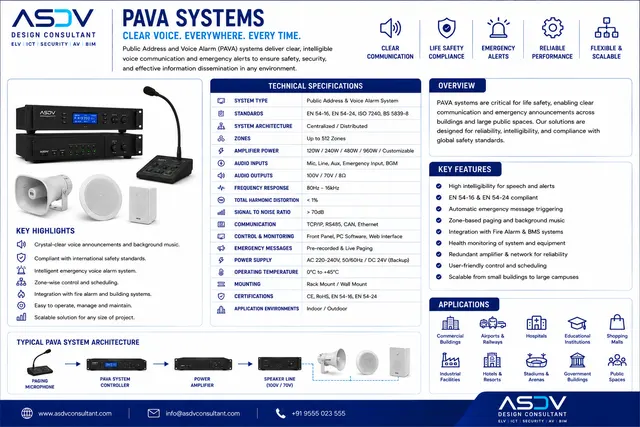
Intelligent fire panels trigger EN 54-certified PAVA systems with pre-recorded multilingual evacuation instructions — delivering the right message to the right zone within 3 seconds of alarm confirmation.
Read Article
Apollo, Hochiki, and Edwards detectors with built-in self-diagnostic capability report contamination levels and predicted end-of-life dates — enabling condition-based maintenance that eliminates unnecessary service visits.
Read ArticleML models trained on millions of alarm records will reduce false alarms by 95% — ending the costly building evacuations that cost UK businesses alone £1 billion annually and erode occupant trust in life-safety systems.
Building fire systems will communicate directly with city emergency platforms — pre-routing fire crews, pre-clearing traffic signals, and alerting neighbouring buildings automatically before the first engine moves.
BLE beacon networks and indoor positioning will guide each occupant via their smartphone through the safest real-time route — accounting for fire location, mobility needs, and evolving incident conditions simultaneously.
AI platforms will continuously score fire risk based on occupancy patterns, maintenance history, weather, and system health — flagging elevated-risk periods before incidents occur and triggering pre-emptive inspections automatically.
As a leading CCTV design consultant, ASDV Consultant delivers IP-based video surveillance designs for commercial, hospitality, healthcare, data center and industrial projects — fully compliant with BS EN 62676, IEC 62676, SIRA (UAE), HCIS (KSA) and global cybersecurity standards.
Modern surveillance has evolved far beyond passive recording. Today's intelligent ecosystem proactively identifies threats, autonomously dispatches response, and generates forensic intelligence — often before a human operator has reviewed a single frame of footage.
Face recognition, intrusion detection, loitering alerts, crowd density analysis, and PPE compliance monitoring all run simultaneously on a single camera — without requiring a dedicated analytics server anywhere in the network.
Read Article
Axis ACAP, Hikvision DeepinView, and Dahua WizMind cameras embed neural processing chips that perform complex analytics locally — reducing bandwidth consumption by 70% compared to cloud-based processing architectures.
Read Article
32-megapixel wide-area cameras replace four standard cameras — delivering identification-quality resolution across entire lobbies and concourses while cutting infrastructure costs and reducing the number of network connections required.
Read Article
FLIR-based thermal cameras detect human presence through complete darkness, smoke, and dense vegetation — the definitive technology for critical infrastructure perimeters, airport boundaries, and high-security compound walls.
Read Article
Large-aperture sensors with supplemental white-light illumination capture full-color forensic-quality footage in near-zero lux — eliminating the grainy monochrome recordings that frustrate investigations and fail in court.
Read Article
Eagle Eye Networks and Verkada eliminate on-site recording hardware entirely — storing encrypted footage in the cloud with zero-trust access from any device, anywhere in the world, with no hardware refresh cycles.
Read Article
OWASP-aligned VMS hardening, certificate-based camera authentication, VLAN segregation, and encrypted video transport prevent surveillance systems from becoming the attackers' entry point into enterprise networks.
Read Article
Autonomous drone fleets patrol large perimeters and respond to sensor alerts — covering terrain in minutes that would take a security team hours, streaming live HD video directly to the command center.
Read Article
Next-generation ANPR reads plates at 200+ km/h in any weather or lighting condition, cross-referencing against watch lists in under 100 milliseconds — securing vehicle access points with frictionless, unhackable precision.
Read Article
AI learns each site's unique behavioral baseline and flags meaningful deviations — an unusual gathering in a restricted stairwell, a vehicle parked against its normal pattern — before they ever escalate into incidents.
Read ArticleInvestigators will query footage in natural language — "find every person in a red jacket near the north entrance between Tuesday and Thursday" — and receive precise results from terabytes of archived video in under 30 seconds.
AI surveillance will dispatch security robots autonomously — the camera detects an anomaly, the robot investigates and documents, and the control room receives a complete situation report within 90 seconds, without human initiation.
AI trained on pre-incident behavioral signatures will detect elevated threat indicators before an individual acts — shifting security from reactive to genuinely preventive for the first time in the industry's history.
Privacy-preserving federated AI will link surveillance across hundreds of independent building systems — enabling cross-city intelligence without any single operator gaining access to another building's raw footage.
Structured cabling is the digital backbone of every modern building. As a structured cabling consultant, ASDV Consultant designs ANSI/TIA-568 and ISO/IEC 11801 compliant copper and fiber networks for offices, data centers, hospitals, hotels and smart buildings — including Cat6, Cat6A, Cat8 and OS2/OM4 fiber backbones.
The physical cabling infrastructure installed today determines a building's digital ceiling for the next 25 years. Tomorrow's AI systems, holographic collaboration platforms, and high-bandwidth applications demand cabling designed with generous headroom for capabilities that are still being invented.
Cat6A (10 Gbps to 100m) is the commercial standard today; Cat8 (40 Gbps to 30m) serves data center top-of-rack switching. Specifying Cat6A as the minimum future-proofs any building for Wi-Fi 7 and the decade beyond.
Read Article
Deploying OS2 single-mode fiber to individual workstations delivers unlimited bandwidth headroom and complete electromagnetic immunity — the preferred architecture for trading floors, broadcast studios, and precision research environments.
Read Article
Pre-terminated MPO/MTP assemblies enable 96-fiber connections in the footprint previously occupied by 12 — making 400G and 800G spine-leaf data center architectures physically achievable within existing cable pathways.
Read Article
IEEE 802.3bt delivers 90W per port — sufficient to power PTZ cameras, LED luminaires, wireless APs, digital signage, and thin-client workstations over a single Cat6A cable, eliminating dedicated electrical circuits for every device.
Read Article
Smart patch panels with LED port guidance and real-time connectivity tracking eliminate manual documentation errors — giving data center and facilities teams a live, accurate map of every physical connection in the building.
Read Article
TIA-568-C.2-1-approved MPTL configurations eliminate patch panels in high-density deployments — connecting field-terminated cables directly to devices and reducing installation labour time by 30–40% on large projects.
Read Article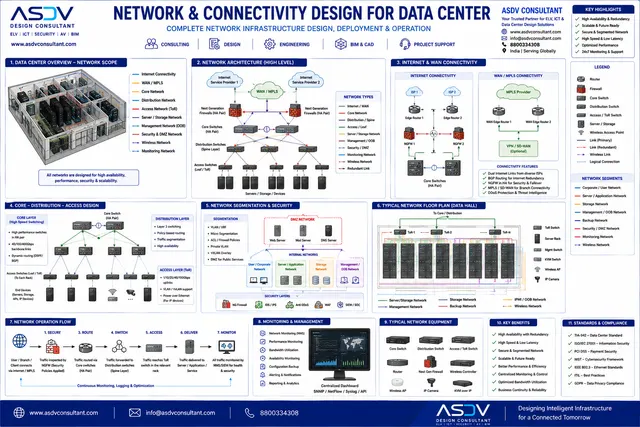
Modern hyperscale spine-leaf topologies using OM5 wideband multimode fiber support 10×100G wavelengths over a single fiber pair — enabling the massive east-west traffic capacity that AI and cloud workloads demand.
Read Article
IEEE 802.3cg SPE delivers Ethernet and PoE power over a single pair of wires to 1,000m — purpose-built for the billions of building IoT sensors, actuators, and field devices arriving in smart buildings over the next decade.
Read Article
Panduit and CommScope intelligent patch panels track port utilization, identify unused connections, and generate automated audit reports — transforming infrastructure management from manual guesswork into data-driven precision.
Read ArticleNext-generation hollow-core photonic bandgap fiber will carry terabit-per-second bandwidth at 99.7% the speed of light — making today's fastest 800G backbone appear as quaint as the dial-up modems of 1995.
Digital twin cabling platforms will predict capacity bottlenecks months in advance, automatically recommend remediation, and guide technicians through reconfiguration procedures using real-time AR overlay guidance.
Embedded optical time-domain reflectometry (OTDR) in fiber assemblies will continuously monitor cable health — detecting bends, breaks, and connector degradation before any performance impact is experienced by end users.
ASDV Consultant is a recognized access control system consultant designing biometric, card, mobile and multi-factor access control systems for commercial, hospitality, healthcare, data center and government projects across India, UAE, KSA and GCC — compliant with ONVIF Profile A/C, EN 60839, UL 294, SIRA and HCIS.
The identity perimeter has moved from the lobby to the cloud. Modern access control is no longer about who carries a card — it's about continuous, contextual verification of identity, intent, and behavioural consistency across every entry point, at every moment of the working day.
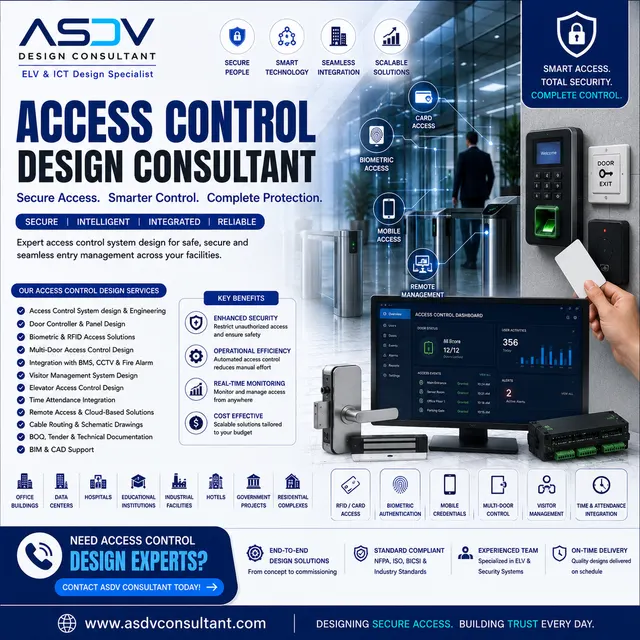
HID Mobile Access, ASSA ABLOY Seos, and Allegion Engage deliver smartphone-based credentials that cannot be lost, copied, or shared — enabling hands-free Twist and Go BLE access without touching a reader.
Read Article
Frictionless face recognition at throughputs exceeding 60 people per minute replaces badge presentations at high-traffic corporate lobbies, stadium concourses, and transit hubs — with zero contact and zero queue.
Read Article
Near-infrared palm vein scanning offers the highest biometric accuracy available — FAR below 0.0001% — while remaining hygienic and usable with gloves, making it ideal for healthcare, pharma, and secure research.
Read Article
Long-range iris recognition from up to 60 cm enables completely hands-free, non-contact identity verification — the technology securing international border controls, Tier IV data centers, and nuclear facilities globally.
Read Article
Genetec Synergis, Brivo, and Openpath deliver enterprise access control entirely from the cloud — eliminating on-premise servers while enabling real-time credential management across unlimited sites from a single dashboard.
Read Article
Wave-to-open door operators, foot-operated handles, and proximity activation eliminate 97% of surface contact points at entry systems — a capability that moved from desirable to non-negotiable in healthcare and food production environments.
Read Article
Envoy and Proxyclick pre-register guests, issue QR-coded time-limited credentials, and notify hosts automatically — replacing paper logbooks with a fully auditable digital trail that satisfies ISO 27001 and data protection requirements.
Read Article
Computer vision at controlled entry points detects multiple individuals passing on a single credential event in real time — eliminating the most common physical security bypass without requiring any additional hardware at the door.
Read Article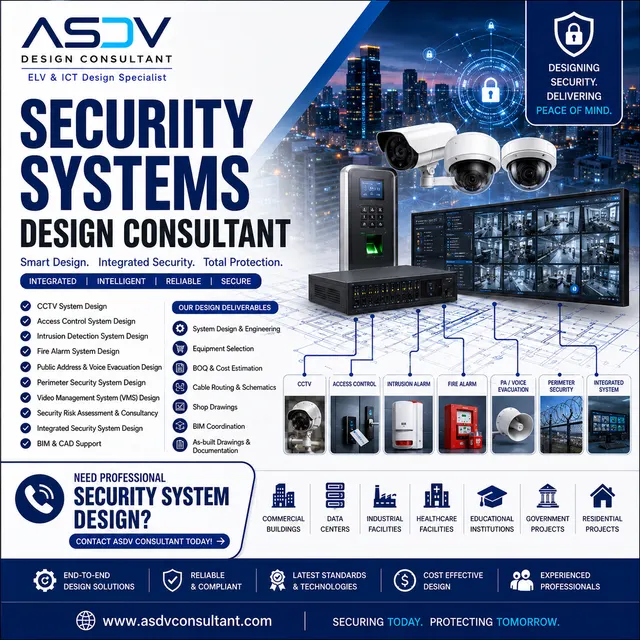
Applying zero-trust principles to physical access — continuous authentication, least-privilege zone access, and microsegmentation of physical areas — mirrors the cybersecurity architecture protecting the most secure enterprise networks.
Read ArticleASDV Consultant is a leading BMS consultant in India and the GCC, designing integrated building management systems for office towers, hospitals, hotels, data centers and smart buildings. Our BMS designs cover BACnet, Modbus, LonWorks, KNX and modern IoT/MQTT integrations, aligned with ASHRAE 135, ISO 16484 and LEED/IGBC.
The building management system is no longer simply an HVAC controller — it has become the cognitive core of intelligent buildings, orchestrating energy, comfort, sustainability, and operational efficiency through AI, real-time analytics, and digital twin intelligence that makes traditional rule-based automation look primitive.
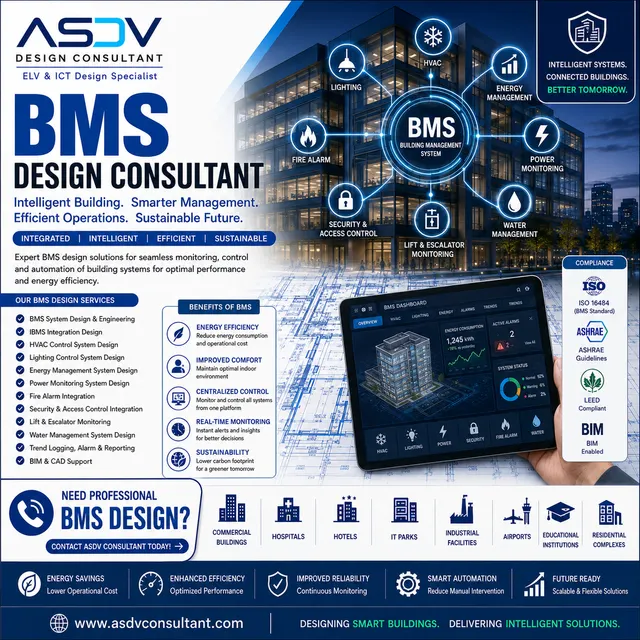
Modern BMS platforms ingest data from thousands of IoT sensors — occupancy, air quality, energy, temperature, vibration — creating a real-time operational awareness that rule-based systems with fixed schedules cannot begin to approach.
Read Article
AI engines like Google DeepMind's cooling optimizer deliver 30–40% energy savings by continuously adjusting HVAC setpoints, chiller sequencing, and airflow — learning building-specific patterns that no human engineer could replicate.
Read Article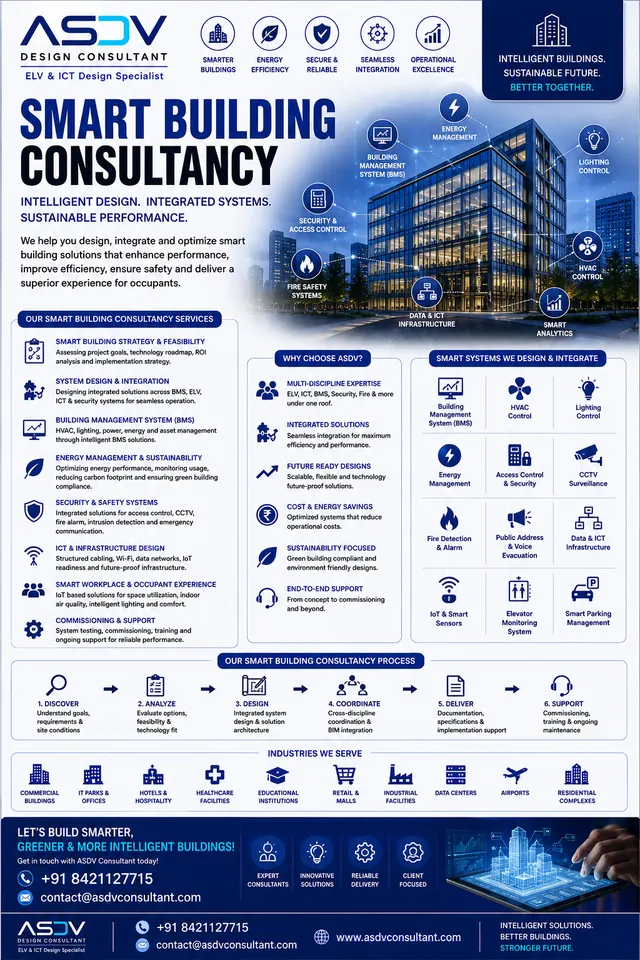
BMS data feeds a live digital twin that simulates how the building responds to weather forecasts, occupancy changes, and equipment failures — enabling pre-emptive action rather than reactive correction after problems manifest.
Read Article
Honeywell Forge, Siemens Building X, and JLL Hank deliver BMS analytics entirely from the cloud — enabling portfolio-wide benchmarking, remote AI optimization, and sustainability insights without any on-site software infrastructure.
Read Article
BACnet/IP, KNX, Modbus TCP, MQTT, and LonWorks create vendor-neutral BMS architectures that integrate every building system on a single data fabric — without locking clients into any single manufacturer's ecosystem.
Read Article
ASHRAE Guideline 36-compliant AI sequences identify simultaneous heating and cooling, stuck dampers, and degraded coils — recovering the 8–15% of energy waste that conventional BMS programming consistently misses.
Read Article
Computer vision occupancy detection adjusts HVAC, lighting, and access zone states in real time to match actual building use — not scheduled assumptions — delivering precision comfort while eliminating energy waste in empty zones.
Read Article
BMS trend data feeds ML models that predict chiller bearing failure, AHU belt wear, and cooling tower biofouling weeks before they manifest — transforming reactive maintenance into precision-scheduled, cost-optimal intervention.
Read Article
Real-time Scope 1, 2, and 3 emissions dashboards integrated with BMS generate automated ESG reporting aligned with GHG Protocol, SEBI BRSR, TCFD, and EU CSRD — turning operational data into investor-grade sustainability intelligence.
Read Article
BMS platforms participate in utility demand response programs automatically — reducing consumption during grid stress events and earning financial incentives while maintaining occupant comfort within pre-approved operational parameters.
Read ArticleASDV Consultant is a trusted AV design consultant for corporate offices, auditoriums, training rooms, hotels, hospitals and command centers. Our AVIXA-aligned designs cover displays, audio DSP, video conferencing, AV-over-IP, control systems (Crestron, Q-SYS, AMX, Extron) and unified communication platforms.
The era of the meeting room as a place to sit and look at a projected slide is ending. The next generation of collaboration spaces are immersive, AI-augmented environments that make every participant — whether present in person or joining from the other side of the world — feel as if they genuinely share the same room.
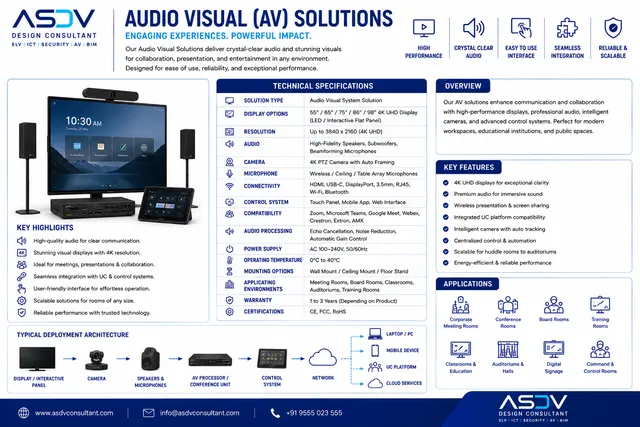
SDVoE, Dante AV, Q-SYS, and NDI protocols deliver uncompressed 4K AV over standard 1/10GbE networks — replacing fixed matrix switchers with infinitely flexible, software-defined signal routing across an entire campus.
Read Article
8K displays and LED video walls in executive boardrooms deliver resolution so sharp that remote participants appear physically present — fundamentally transforming the quality of distributed executive decision-making.
Read Article
Barco ClickShare, Mersive Solstice, and Crestron AirMedia enable any device to present wirelessly to any display in under 5 seconds — permanently eliminating the HDMI cable fumble from every meeting in the building.
Read Article
Certified Microsoft Teams Rooms and Zoom Rooms systems deliver one-touch meeting start, automatic participant tracking, and seamless content sharing — creating a consistent, professional meeting experience across every room type in the portfolio.
Read Article
65"–105" multi-touch interactive displays with native UC apps transform meeting rooms into digital collaboration workspaces where teams ideate, annotate, and share content without a single cable, adapter, or room control system.
Read Article
Shure MXA920, Biamp Tesira, and Sennheiser TeamConnect ceiling arrays use adaptive beamforming to capture every voice at perfect intelligibility — regardless of speaker position, background noise, or challenging room acoustics.
Read Article
PTZ cameras with AI speaker tracking automatically follow the active speaker, frame group discussions, and switch between presenter and audience views — delivering broadcast-quality video without requiring a dedicated camera operator.
Read Article
Audience measurement AI measures dwell time, demographic profiles, and engagement metrics for digital signage content — transforming displays from publishing platforms into precisely measurable communication channels with ROI.
Read Article
Equity-of-experience design philosophy ensures remote participants have identical visual and audio presence to those physically in the room — using intelligent camera framing and spatial audio to eliminate the second-class experience of remote attendance.
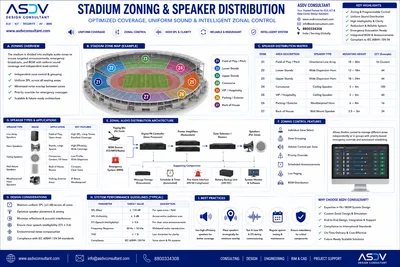
Read ArticleASDV Consultant designs EN 54-16 / EN 54-24 compliant PAVA systems — life-safety voice evacuation networks for malls, airports, metros, hospitals, hotels and high-rise commercial buildings. Our PAVA designs include acoustic modeling (STI ≥ 0.5), zoning, redundancy and full fire alarm integration.
Voice alarm has evolved from a fixed message broadcast to an entire building into a precision life-safety communication system — one that delivers exactly the right instruction, in the right language, to exactly the right zone, adapting in real time as an emergency unfolds and conditions change.
Bosch Praesensa, TOA VX-3000, and Honeywell Variodyn now operate entirely over standard IP networks — enabling enterprise-grade scalability, remote system management, and deep integration with BMS and IT infrastructure.
Read Article
EN 54-16 / EN 54-24 certification guarantees every component — from amplifier to loudspeaker to cable — meets stringent life-safety standards for reliability, intelligibility (STI ≥ 0.5), and fire resistance in real emergency conditions.
Read Article
Distributed networked amplifiers with N+1 redundancy eliminate single points of failure — ensuring the system continues broadcasting clear evacuation instructions even if an amplifier fails during an active emergency event.
Read Article
PAVA integration with firefighter phone systems, emergency call stations, and video intercom networks creates a unified emergency communication platform manageable from a single fire command center interface.
Read Article
Granular zoning aligned with fire alarm sectors enables phased evacuation — alerting only immediately affected zones rather than triggering mass panic across an entire complex simultaneously, protecting both lives and property.
Read Article
Next-generation PAVA systems measure ambient noise levels continuously and automatically adjust loudspeaker output to maintain speech intelligibility — ensuring announcements are heard whether a concourse is empty or packed at capacity.
Read Article
Remote cloud monitoring provides 24/7 visibility into system health, loudspeaker line continuity, amplifier status, and compliance documentation — across an entire building portfolio from a single facilities management dashboard.
Read Article
Pre-recorded messages in up to 20 languages, automatically selected based on building zone and time of day, ensure every occupant — worker, visitor, or patient — receives life-critical instructions in a language they understand.
Read Article
Enterprise platforms like Everbridge and OnSolve coordinate building audio announcements with simultaneous SMS, app push, email, and digital signage alerts — ensuring no occupant misses a critical message regardless of their location.
Read ArticleASDV Consultant is a leading wireless network consultant designing high-density Wi-Fi 6, 6E and Wi-Fi 7 networks for offices, hospitals, hotels, warehouses, schools and stadiums. Predictive surveys (Ekahau / iBwave), AP placement, RF planning, security and post-install validation — delivered end-to-end.
The wireless network has graduated from a convenience layer to mission-critical infrastructure. As buildings become sensor-dense, AI-managed ecosystems, the wireless fabric connecting thousands of devices must be as reliable, intelligent, and secure as the most hardened wired network in the building.
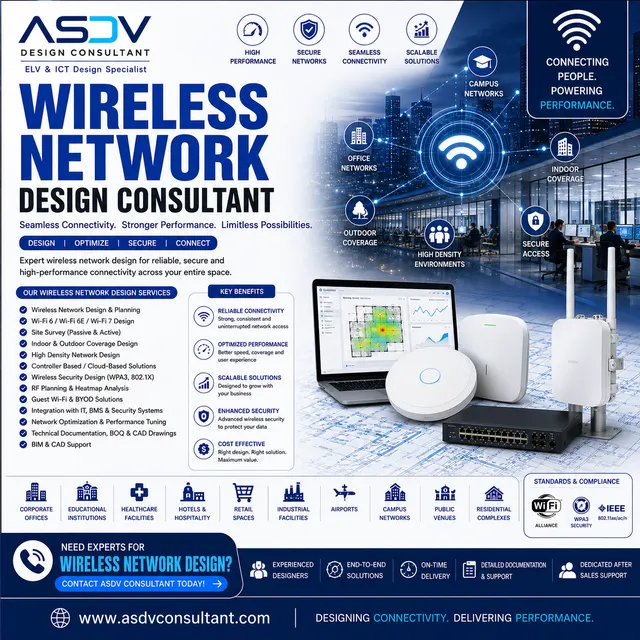
Wi-Fi 7's 46 Gbps peak throughput, multi-link operation, and 320 MHz channels in the 6 GHz band enable low-latency 8K streaming, holographic collaboration, and high-density IoT deployments without spectrum congestion.
Read Article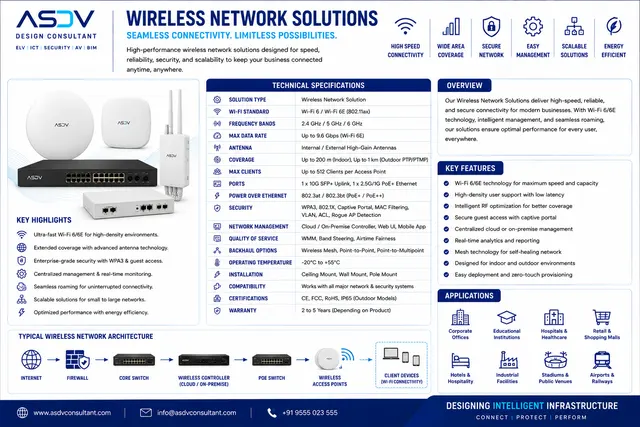
Campus-wide private 5G delivers sub-millisecond latency, guaranteed QoS, and SIM-based security to industrial robots, autonomous vehicles, and mission-critical IoT — without competing with public cellular infrastructure.
Read Article
Software-defined WAN intelligently routes traffic across multiple connections — MPLS, broadband, and 5G — based on application priority, choosing the optimal path for every packet, every millisecond, automatically.
Read Article
Juniper Mist AI, Cisco DNA, and HPE Aruba AIOps analyse millions of wireless events per second to autonomously optimize channel allocation, transmit power, and client steering — without any manual intervention from IT teams.
Read Article
Meraki, Aruba Central, and Juniper Mist deliver full network management, firmware updates, and AI analytics from the cloud — enabling zero-touch provisioning of hundreds of access points from a single global dashboard.
Read Article
ZTNA replaces implicit trust with continuous identity verification — every device, every user, every session must prove legitimacy before accessing any network resource, regardless of their physical location in the building.
Read Article
Self-organizing mesh networks eliminate wired backhaul requirements in retrofit buildings — APs communicate wirelessly to maintain seamless coverage even as individual nodes are added, moved, or removed during fit-out changes.
Read Article
5G and Wi-Fi 7 network slicing creates dedicated virtual segments for different device classes — guaranteeing that a burst of IoT sensor traffic never competes with a latency-sensitive video conference call for shared bandwidth.
Read Article
Juniper Mist Location and Cisco Spaces use Wi-Fi signals to track anonymous occupancy patterns and movement flows — providing facilities managers with behavioral intelligence that transforms space planning and utilisation decisions.
Read ArticleASDV Consultant designs smart parking management systems for malls, hospitals, airports, offices and mixed-use developments — covering ANPR cameras, boom barriers, ticketing kiosks, parking guidance (PGS), payment integration and central management software.
The parking experience is being reinvented from the ground up. What was once the most friction-filled moment of a visitor's day — circling endlessly for spaces, fumbling for tickets, queuing at barriers — is becoming a seamless, invisible background process managed entirely by AI and IoT intelligence.
Camera-based ANPR recognizes vehicles at entry and exit without tickets, barriers, or payment kiosks — charging registered accounts automatically and letting pre-authorized season passes flow through at full speed without stopping.
Read Article
Ultrasonic bay sensors and overhead LED indicators guide drivers to the nearest available space — reducing circulating traffic by 30%, cutting emissions, and recovering 15+ minutes from each visitor's parking experience.
Read Article
Ultrasonic, magnetic, and camera-based bay sensors provide individual space occupancy data to the central platform in real time — with detection accuracy exceeding 99.5% across all lighting conditions and vehicle types.
Read Article
Parking management systems now coordinate EV charging bay allocation, load-balance across multiple chargers, process charging payments, and display real-time charger availability — creating seamless EV experiences while protecting building electrical infrastructure.
Read Article
Drivers pre-book guaranteed spaces via app before leaving their home or office, receive turn-by-turn navigation to their reserved bay, and pay frictionlessly on exit — eliminating uncertainty from the entire parking journey.
Read Article
Multi-modal payment — contactless card, QR code, app, RFID, and ANPR-linked account — processes payments in under 3 seconds, eliminating exit queue times and removing cash-handling costs from parking operations.
Read Article
Predictive AI analyses historical occupancy patterns, event calendars, and weather data to forecast parking demand — enabling dynamic pricing, pre-emptive management interventions, and optimised staffing schedules.
Read Article
Building parking systems share real-time availability with city traffic platforms — enabling GPS navigation to route drivers to available parking before they enter congested areas, reducing city-wide traffic by 8–12% in pilot deployments.
Read Article
Digital valet platforms digitize key handover, vehicle location tracking, and retrieval requests via guest smartphone apps — eliminating paper tickets and reducing retrieval times to under 5 minutes in even the largest hospitality facilities.
Read ArticleBy 2030, AV-compatible facilities will allow self-driving vehicles to drop occupants at the entrance and self-park autonomously — enabling 30% higher bay density through precision robotic parking and eliminating all walking distance.
Automated robotic car parks — already operational in Germany, Japan, and UAE — stack vehicles at 3× the density of conventional parking, require no driving lanes, and retrieve any car in under 120 seconds on demand.
Real-time supply and demand pricing — already deployed at 40+ global airports — will become standard for commercial parking, optimising operator revenue while distributing demand more evenly across available facilities throughout the day.
Vehicle-to-everything communication will enable connected vehicles to query parking availability, reserve bays, and initiate payment entirely autonomously — with zero app interaction required from the driver at any point in the journey.
ASDV Consultant is a specialist data center consultant and ICT design consultant, delivering Tier I–IV / Rated 1–4 designs per TIA-942, Uptime Institute, ANSI/BICSI 002 and EN 50600. Our portfolio includes enterprise data centers, colocation halls, hospital server rooms and bank DR sites across India and GCC.
The data center of the next decade will not resemble today's facility in the same way today's data hall bears no resemblance to the computer rooms of 1990. AI workloads, quantum computing, liquid cooling at 100 kW/rack, and software-defined everything are collectively rewriting every design assumption in the established data center playbook.
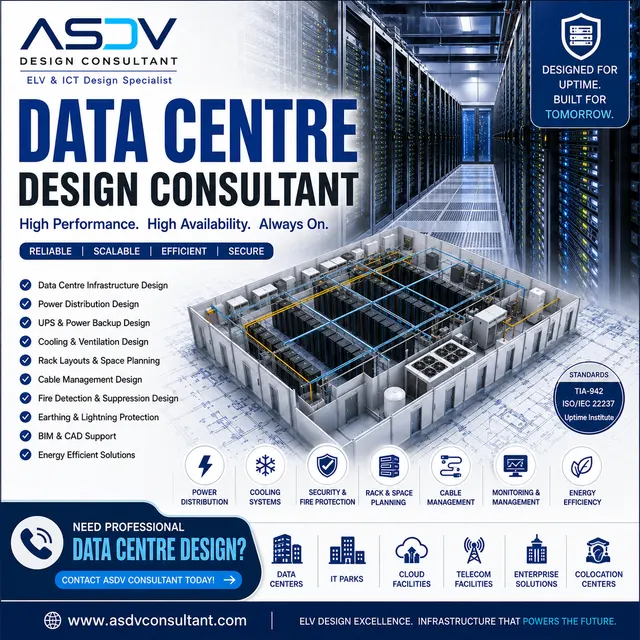
Facilities exceeding 100 MW — operated by AWS, Google, Microsoft, and Meta — define the frontier of data center engineering: custom silicon, direct liquid cooling at unprecedented scale, and proprietary power distribution architectures.
Read Article
Micro data centers deployed within 10ms of end users — at 5G base stations, factory floors, and hospital imaging departments — process latency-sensitive workloads locally without the round-trip delay to central cloud infrastructure.
Read Article
NVIDIA H100/H200 and AMD MI300X GPU clusters generating 700W+ per accelerator demand complete rethinking of power density, structural floor loading, and cooling strategy — creating an entirely new specialist discipline in data center design.
Read Article
Direct liquid cooling, rear-door heat exchangers, and single/two-phase immersion cooling achieve PUE below 1.1 — the only physically viable approach for next-generation AI compute densities that air cooling cannot begin to manage.
Read Article
Virtualizing compute, storage, networking, and security into software layers on commodity hardware enables data centers to be provisioned in hours, scaled in minutes, and migrated without touching a single physical infrastructure component.
Read Article
Nutanix, VMware vSAN, and Microsoft Azure Stack HCI converge compute, storage, and networking into software-defined nodes — reducing data center footprint by 60% while delivering cloud-like scalability and simplicity on-premise.
Read Article
Nlyte, Sunbird, and Vertiv DCIM platforms enhanced with AI detect thermal anomalies, predict power capacity shortfalls, and optimize asset utilization — providing intelligence that static spreadsheet-based capacity planning can never deliver.
Read Article
Microsegmentation, identity-based access for every workload, encrypted east-west traffic, and continuous behavioral monitoring treat every internal request as untrusted — making lateral movement after a breach computationally impossible.
Read Article
100% renewable energy PPAs, waste heat recovery for district heating, and circular hardware lifecycle programs are transforming data centers from environmental liabilities into carbon-neutral — and ultimately carbon-negative — community assets.
Read Article
Schneider Electric EcoStruxure and Rittal modular systems ship as pre-integrated, factory-tested units deployable in weeks — compressing time-to-capacity from 18 months to 12 weeks for organisations that simply cannot wait for traditional build programmes.
Read Article
400G and emerging 800G optical transceivers on spine-leaf architectures handle the massive east-west traffic flows generated by AI training clusters and hyperconverged workloads — delivering bandwidth that 40G infrastructure simply cannot approach.
Read Article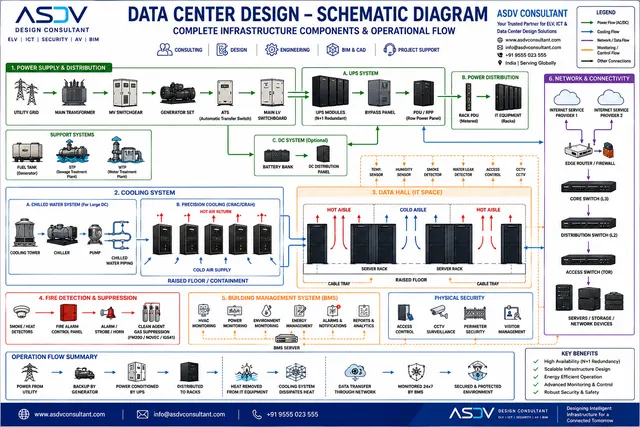
A live digital twin continuously simulates thermal behaviour, power distribution, and capacity utilization — enabling what-if capacity planning, commissioning validation, and emergency scenario modelling entirely in the virtual domain before any physical change.
Read ArticleTell us about your project — building type, size, location and scope. We respond within 24 hours with a tailored proposal.
Or reach us directly: +91-8800334308 · contact@asdvconsultant.com · WhatsApp