
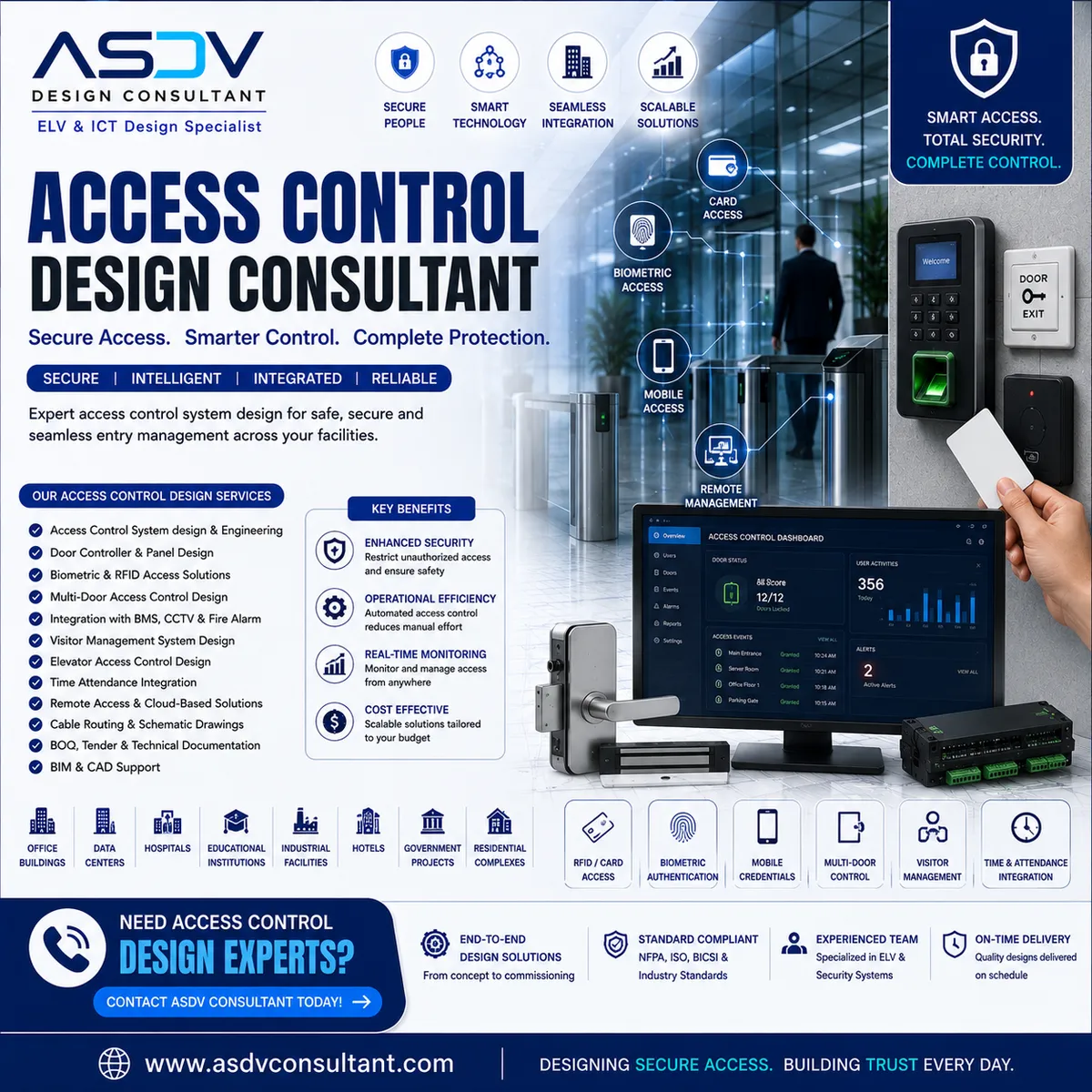
Access Control Design for Qatar Commercial Towers and Mixed-Use Developments | ASDV Consultant
How ASDV designs access control systems for Qatar's commercial towers, balancing MOI security expectations with multi-tenant operational complexity.
Access Control Design for Saudi Giga-Projects (NEOM, Red Sea, Qiddiya) | ASDV Consultant
Practical access control design considerations for Saudi Arabia's giga-projects, where scale and biometric ambition set requirements well beyond conventional buildings.
Access Control Design for Bahrain Financial Sector Buildings | ASDV Consultant
Access control design considerations for Bahrain's banking and financial sector, covering Central Bank of Bahrain expectations.
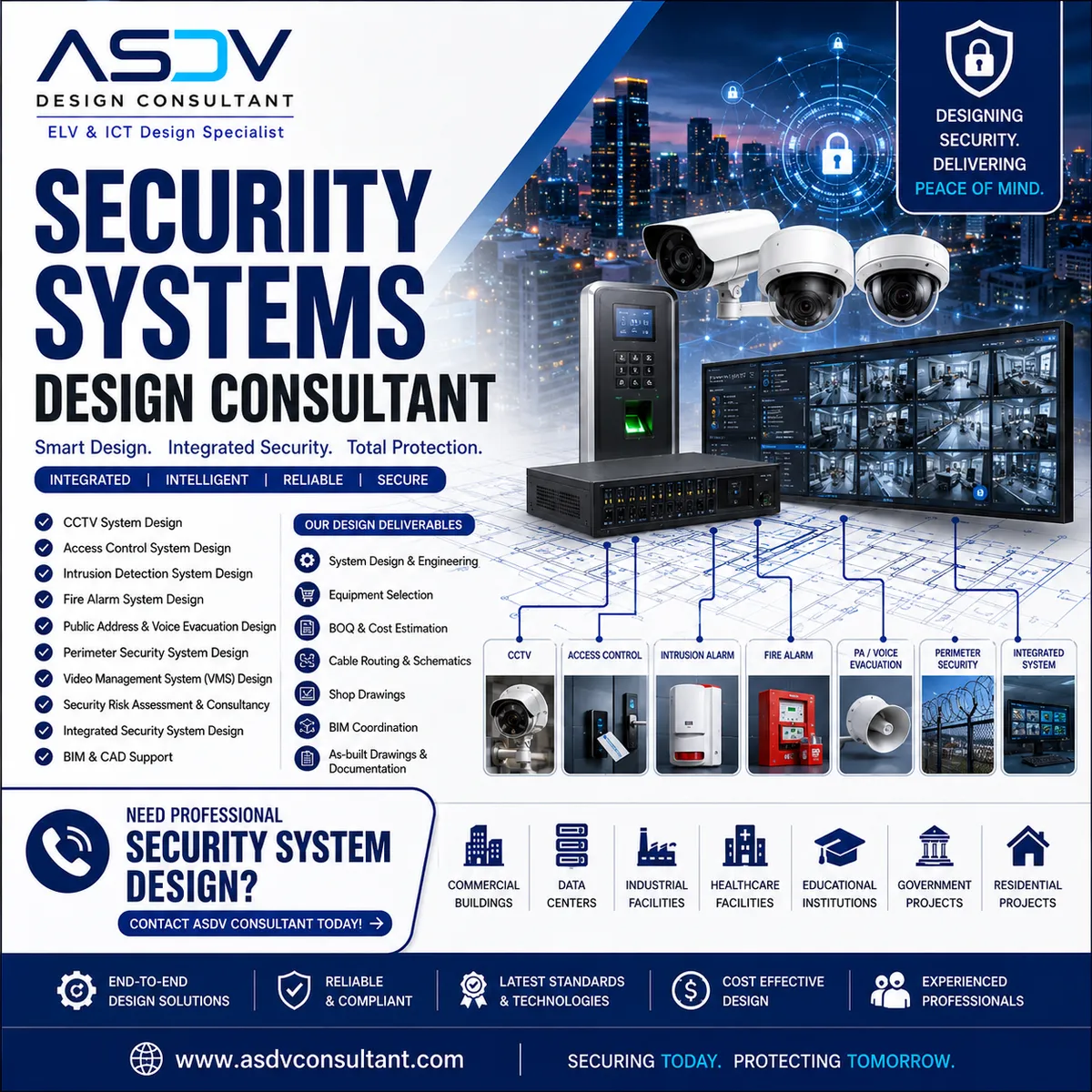
Security System Design for Bahrain Banking and Financial Institutions | ASDV Consultant
An integrated view of security system design for Bahrain's banking sector, bringing together CCTV, access control, and fire-linked alarm systems.
Access Control Design for Canadian Buildings: CSA Standards and ULC-Listed Hardware | ASDV Consultant
Access control design in Canada blends CSA electrical and life safety standards with ULC-listed hardware and provincial fire code integration requirements.
Access Control Design for Oman Government and Commercial Projects | ASDV Consultant
Designing access control systems for Oman's government and commercial sectors, covering data protection obligations and fire/life-safety integration.
Parking Management System Design for Qatar Commercial Malls and Mixed-Use Developments | ASDV Consultant
Designing parking guidance and management systems for Qatar's large-format malls and mixed-use developments, where scale and visitor experience push design beyond a basic barrier system.
ADA Compliance in Access Control Design for US Buildings | ASDV Consultant
Access control hardware in the US must satisfy the ADA's operable-force, reach-range, and clearance rules alongside security requirements.
Access Control and Security Design for US Critical Infrastructure (CISA guidelines) | ASDV Consultant
Critical infrastructure security design in the US increasingly involves CISA guidance and federal supply-chain rules like NDAA Section 889.
AI-Based Parking Occupancy Analytics Design
Predictive AI analyses historical occupancy patterns, event calendars, and weather data to forecast parking demand, enabling dynamic pricing, pre-emptive management, and optimised staffing.
ANPR-Based Ticketless Parking System Design
Camera-based ANPR recognizes vehicles at entry and exit without tickets, barriers, or payment kiosks — charging registered accounts automatically and letting season passes flow through at full speed.
Automated Parking Payment Gateway Design
Multi-modal payment — contactless card, QR code, app, RFID, and ANPR-linked account — processes payments in under 3 seconds, eliminating exit queue times and cash-handling costs.
Autonomous Vehicle Parking: Future Outlook 2028-2037
By 2030, AV-compatible facilities will allow self-driving vehicles to drop occupants at the entrance and self-park autonomously, enabling 30% higher bay density and eliminating walking distance.
Dynamic AI-Based Parking Pricing: Future Outlook 2028-2037
Real-time supply and demand pricing, already deployed at 40+ global airports, will become standard for commercial parking, optimising operator revenue while distributing demand more evenly.
EV Charging Integration in Parking Management Design
Parking management systems now coordinate EV charging bay allocation, load-balance across multiple chargers, process charging payments, and display real-time charger availability.
Integrated Smart City Parking System Design
Building parking systems share real-time availability with city traffic platforms, enabling GPS navigation to route drivers to available parking before congestion, reducing city-wide traffic 8-12%.
IoT Parking Sensors: Ultrasonic, Magnetic, Camera Design
Ultrasonic, magnetic, and camera-based bay sensors provide individual space occupancy data to the central platform in real time, with detection accuracy exceeding 99.5% across all conditions.
Mobile App Parking Reservation System Design
Drivers pre-book guaranteed spaces via app before leaving, receive turn-by-turn navigation to their reserved bay, and pay frictionlessly on exit — eliminating uncertainty from the parking journey.
Robot Parking Systems: Future Outlook 2028-2037
Automated robotic car parks — already operational in Germany, Japan, and UAE — stack vehicles at 3x the density of conventional parking, require no driving lanes, and retrieve any car in under 120 seconds.
Smart Parking Guidance System Design: LED & Sensor
Ultrasonic bay sensors and overhead LED indicators guide drivers to the nearest available space — reducing circulating traffic by 30%, cutting emissions, and recovering 15+ minutes per visit.
V2X-Connected Smart Parking: Future Outlook 2028-2037
Vehicle-to-everything communication will enable connected vehicles to query parking availability, reserve bays, and initiate payment entirely autonomously — with zero app interaction from the driver.
Valet Automation System Design for Hospitality
Digital valet platforms digitize key handover, vehicle location tracking, and retrieval requests via guest smartphone apps, reducing retrieval times to under 5 minutes even in the largest facilities.
AI Tailgating Detection: Computer Vision Controlled Entry, Real-Time Anti-Tailgate & Physical Security
Computer vision AI detects multiple individuals passing on a single credential event at controlled entry points in real time — reducing unauthorised entry by 94% versus anti-passback alone, with instant barrier lock and Genetec/Lenel REST API integration and sub-500ms detection latency.
Blockchain Identity Access Control: Self-Sovereign Identity, Verifiable Credentials & Decentralised PACS
Self-sovereign identity on distributed ledgers lets individuals control verifiable credentials — presenting them to any access system worldwide without a central identity provider, eliminating the single point of failure that makes traditional PACS databases breach targets.
Cloud-Based Access Control: Genetec Synergis, Brivo, Openpath Multi-Site Enterprise Management
Genetec Synergis, Brivo, and Openpath deliver enterprise access control entirely from the cloud — eliminating on-premise servers, enabling real-time credential management across unlimited sites from a single dashboard with 99.9% SLA and 43% lower 5-year TCO.
Continuous Biometric Authentication: Gait Recognition, Ambient AI & Beyond Badge Access | ASDV Future Outlook
AI will continuously verify identity through gait recognition at 97.8% accuracy and ambient biometrics throughout a building stay — revoking access automatically the moment anomalies appear, making the single-event door swipe obsolete by 2030.
Face Recognition Access Control: Frictionless 60 People/Min, Corporate Lobby & DPDP Compliance
Frictionless face recognition access control at 60+ people per minute eliminates badge queues at corporate lobbies, stadiums, and transit hubs — with ISO 19794-5 liveness detection preventing spoofing and DPDP Act 2023 compliant biometric data architecture.
Iris Scanning Access Control: Long-Range 60cm Recognition, Tier IV Data Centres & Border Security
Long-range iris recognition from up to 60cm enables completely hands-free non-contact identity verification at sub-500ms — securing international border controls, Tier IV data centres, and nuclear facilities with FAR below 0.00001% and STQC-certified Aadhaar API integration.
Mobile Credentials NFC & Bluetooth BLE: HID Mobile Access, ASSA ABLOY Seos & Hands-Free Access
HID Mobile Access, ASSA ABLOY Seos, and Allegion Engage deliver smartphone NFC and BLE credentials that eliminate lost cards and cloning — with Twist and Go hands-free access at 99.9% read reliability and instant cloud revocation.
Palm Vein Biometrics Access Control: FAR 0.0001%, Healthcare, Pharma & Hygienic Secure Entry
Near-infrared palm vein scanning delivers FAR below 0.0001% — the highest biometric accuracy available — with hygienic non-contact operation and glove compatibility, making it the premier technology for healthcare, pharma, and secure research access control in India.
Touchless Access Systems: Wave-to-Open Door Operators, Foot Controls & Proximity Activation
Wave-to-open door operators, foot-operated handles, and proximity activation eliminate 97% of surface contact points at entry systems — standard in NABH-accredited hospitals, pharma clean rooms, and food production facilities requiring hygiene-first access design across India.
Visitor Management & QR Digital Passes: Envoy, Proxyclick, ISO 27001 & DPDP Act Compliance
Envoy and Proxyclick pre-register guests, issue QR-coded time-limited credentials, and notify hosts automatically — replacing paper logbooks with a fully auditable digital trail that satisfies ISO 27001 Annex A.11, DPDP Act 2023, and Aadhaar-based visitor verification for Indian enterprises.