
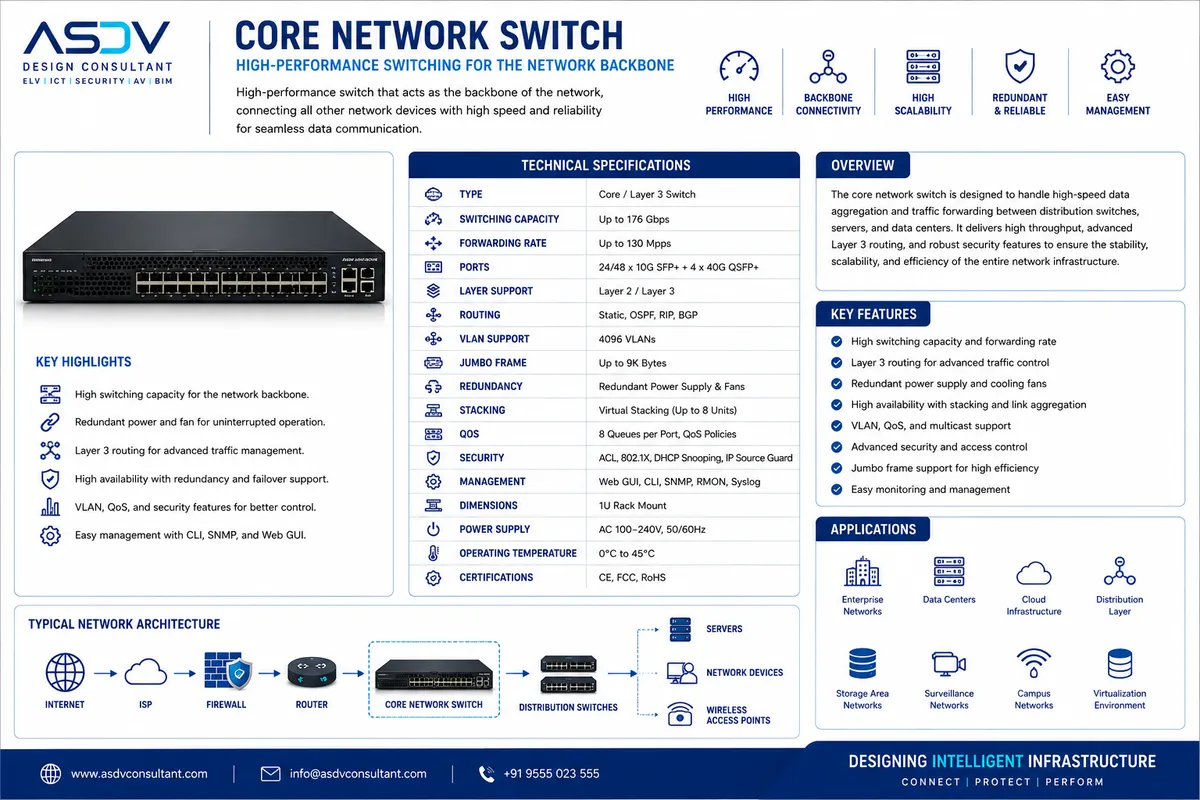
Structured Cabling Design for Bahrain Commercial Towers | ASDV Consultant
Structured cabling design guidance for Bahrain's commercial office towers, covering riser strategy and EWA coordination.
Structured Cabling Design for Canada: CSA T527 and Extreme Cold Climate Considerations | ASDV Consultant
Structured cabling in Canada follows CSA T527/T528/T529 standards and must account for extreme cold climate installation and outdoor pathway conditions.
Structured Cabling Design for Oman: Climate and Infrastructure Considerations | ASDV Consultant
How ASDV designs structured cabling for Oman's buildings, aligned with TRA's internal wiring guidance and adapted for extreme heat and humidity.

Structured Cabling Design for Qatar: Ashghal and Kahramaa Infrastructure Requirements | ASDV Consultant
How structured cabling and telecoms infrastructure design in Qatar must align with Ashghal road/utility corridor rules and Kahramaa electrical requirements.
Structured Cabling Design for Saudi Commercial Towers and Mixed-Use Developments | ASDV Consultant
Structured cabling design guidance for Saudi commercial and mixed-use towers, covering extreme heat, riser strategy, and multi-tenant coordination.
NEC (National Electrical Code) Coordination for ELV System Design in the US | ASDV Consultant
ELV cabling in the US must satisfy NEC Article 725, 760, and 770 circuit classifications — requirements with no direct international equivalent.

AI-Driven Wireless Optimization: Mist AI, Cisco DNA, Aruba
Juniper Mist AI, Cisco DNA, and HPE Aruba AIOps analyse millions of wireless events per second to autonomously optimize channel allocation, transmit power, and client steering without manual IT intervention.
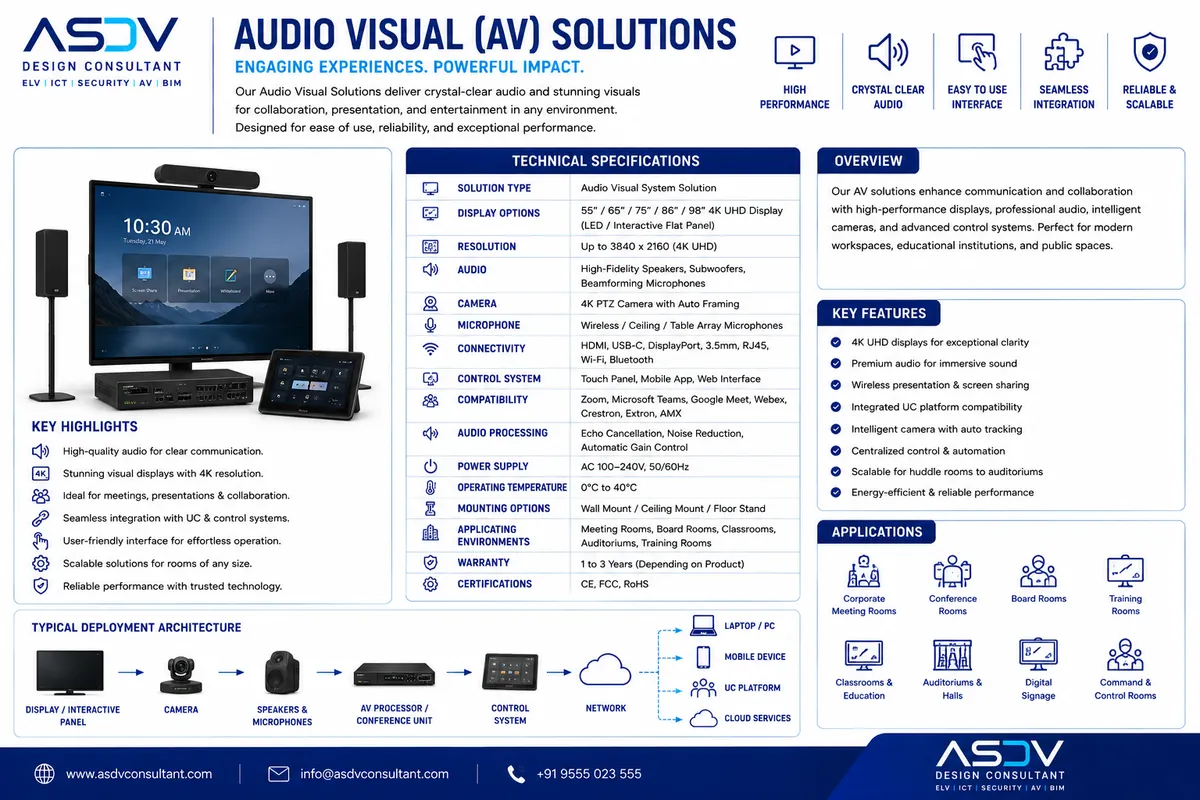
Interactive Smart Displays: 65"-105" Multi-Touch Panels
65 to 105-inch multi-touch interactive displays with native UC apps transform meeting rooms into digital collaboration workspaces where teams ideate, annotate, and share content without a single cable.
Mesh Wi-Fi Systems: Retrofit Network Design
Self-organizing mesh networks eliminate wired backhaul requirements in retrofit buildings — APs communicate wirelessly to maintain seamless coverage even as nodes are added, moved, or removed.
Network Slicing for IoT: 5G & Wi-Fi 7 Design
5G and Wi-Fi 7 network slicing creates dedicated virtual segments for different device classes — guaranteeing IoT sensor traffic never competes with a latency-sensitive video call for bandwidth.
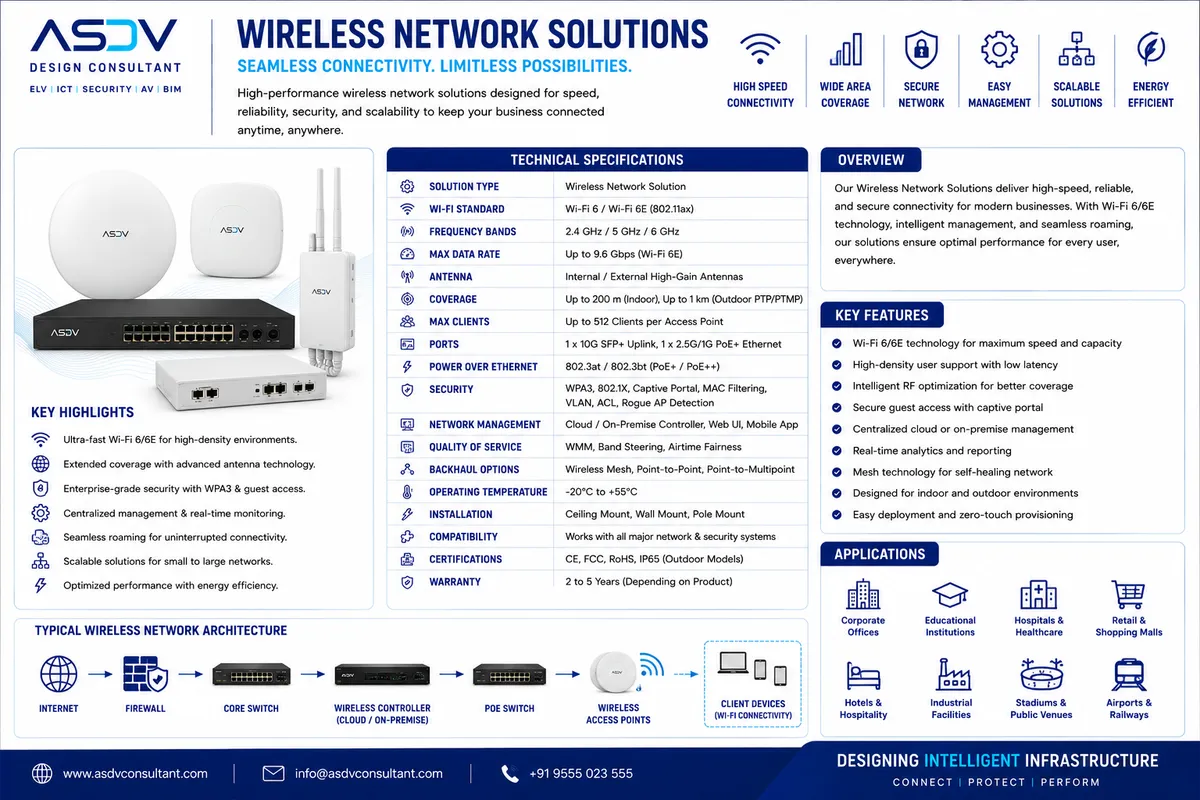
Software-Defined Wireless Campuses: Future Outlook 2029-2038
Every aspect of wireless infrastructure — spectrum allocation, QoS policies, security rules, and physical topology — will be defined entirely in software and deployable in minutes.
Wi-Fi Location Analytics: Mist Location, Cisco Spaces
Juniper Mist Location and Cisco Spaces use Wi-Fi signals to track anonymous occupancy patterns and movement flows — providing facilities managers with behavioral intelligence for space planning.
Wi-Fi 6, Wi-Fi 6E & Wi-Fi 7 Network Design
Wi-Fi 7's 46 Gbps peak throughput, multi-link operation, and 320 MHz channels in the 6 GHz band enable low-latency 8K streaming, holographic collaboration, and high-density IoT deployments.
Wireless Presentation Systems: ClickShare, Solstice, AirMedia
Barco ClickShare, Mersive Solstice, and Crestron AirMedia enable any device to present wirelessly to any display in under 5 seconds — eliminating the HDMI cable fumble from every meeting room.
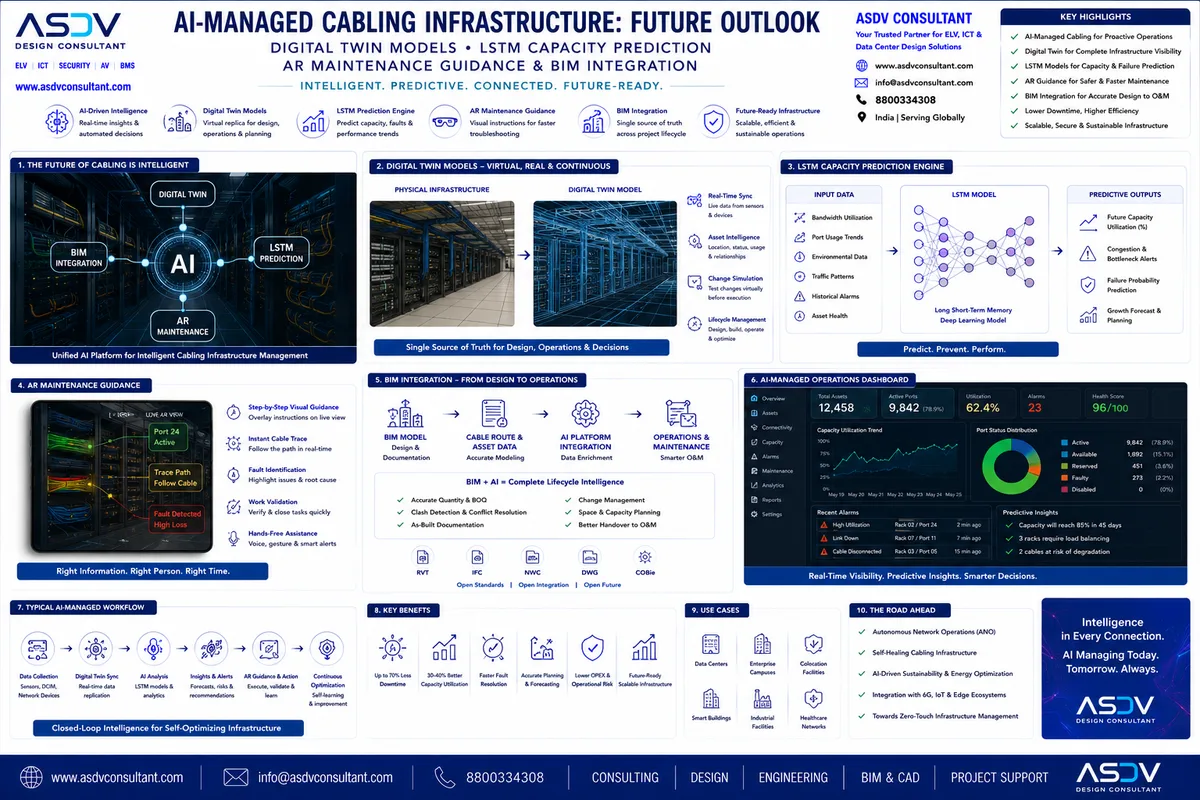
AI-Managed Cabling Infrastructure: Digital Twin, LSTM Capacity Prediction, AR Guidance & BIM | ASDV Future Outlook
AI-managed cabling infrastructure uses digital twin models, LSTM neural network capacity prediction, AR maintenance guidance (Scope AR, PTC Vuforia), and BIM integration to reduce network outages by 87% and eliminate manual physical layer management — the future of intelligent structured cabling.
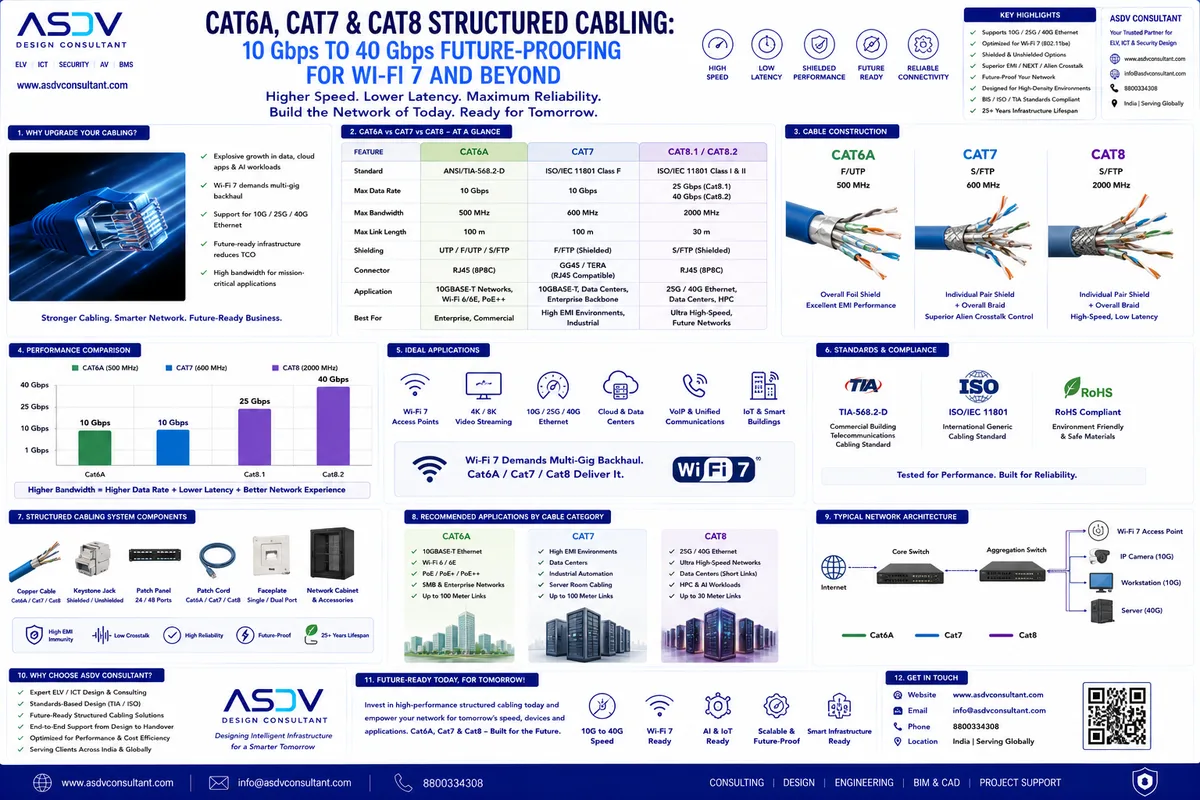
Cat6A / Cat7 / Cat8 Structured Cabling: 10G–40G Future-Proofing Guide
Cat6A (10 Gbps to 100m) is today's commercial standard; Cat8 (40 Gbps to 30m) serves data centre top-of-rack switching. Specifying Cat6A as the minimum future-proofs any building for Wi-Fi 7 and the bandwidth decade beyond.
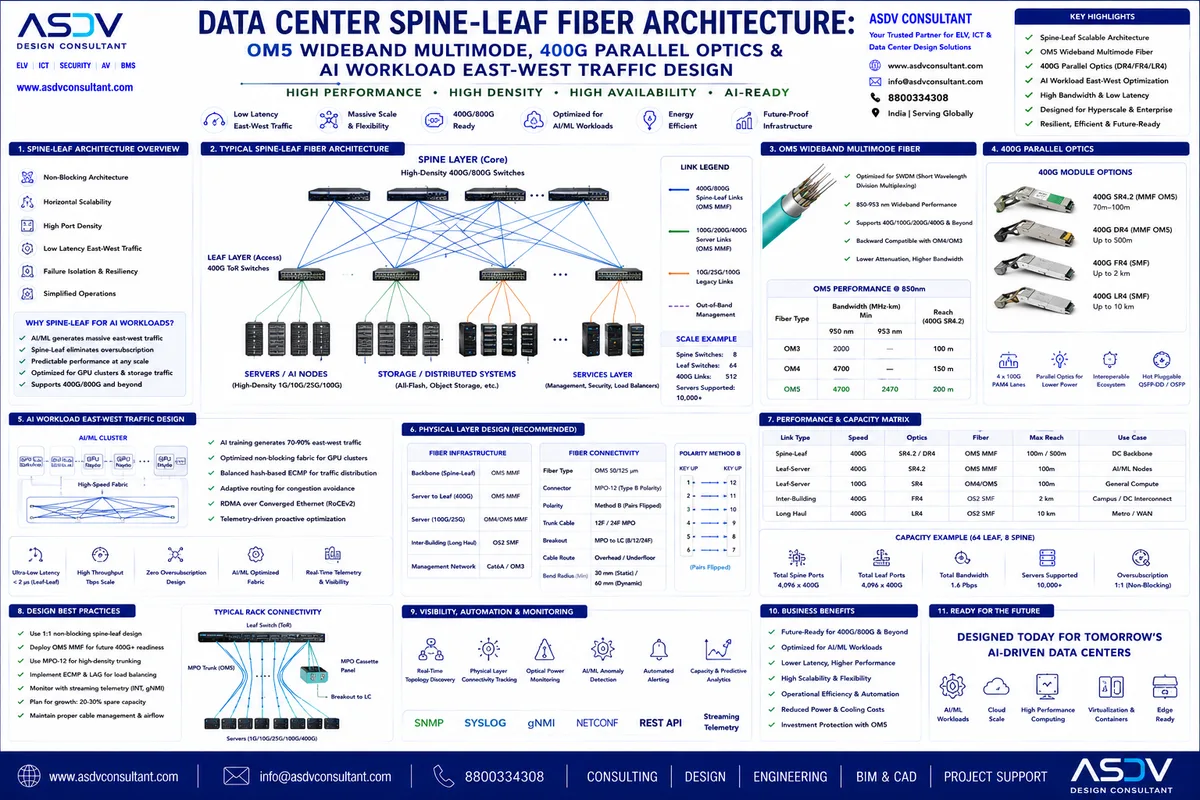
Data Center Spine-Leaf Fiber Architecture: OM5 Wideband, 400G & AI Workload East-West Traffic
OM5 wideband multimode fiber supports 10×100G wavelengths per fiber pair via SWDM4 — enabling the massive east-west GPU-to-GPU bandwidth that AI training workloads demand across thousands of interconnected compute nodes in spine-leaf data center architectures.
Fiber to the Desk (FTTD): OS2 Single-Mode, Trading Floors & EMI-Immune Workstations
OS2 single-mode fiber to individual workstations delivers unlimited bandwidth headroom, complete EMI immunity, and zero ground loop risk — the preferred architecture for trading floors, broadcast studios, and precision research environments.
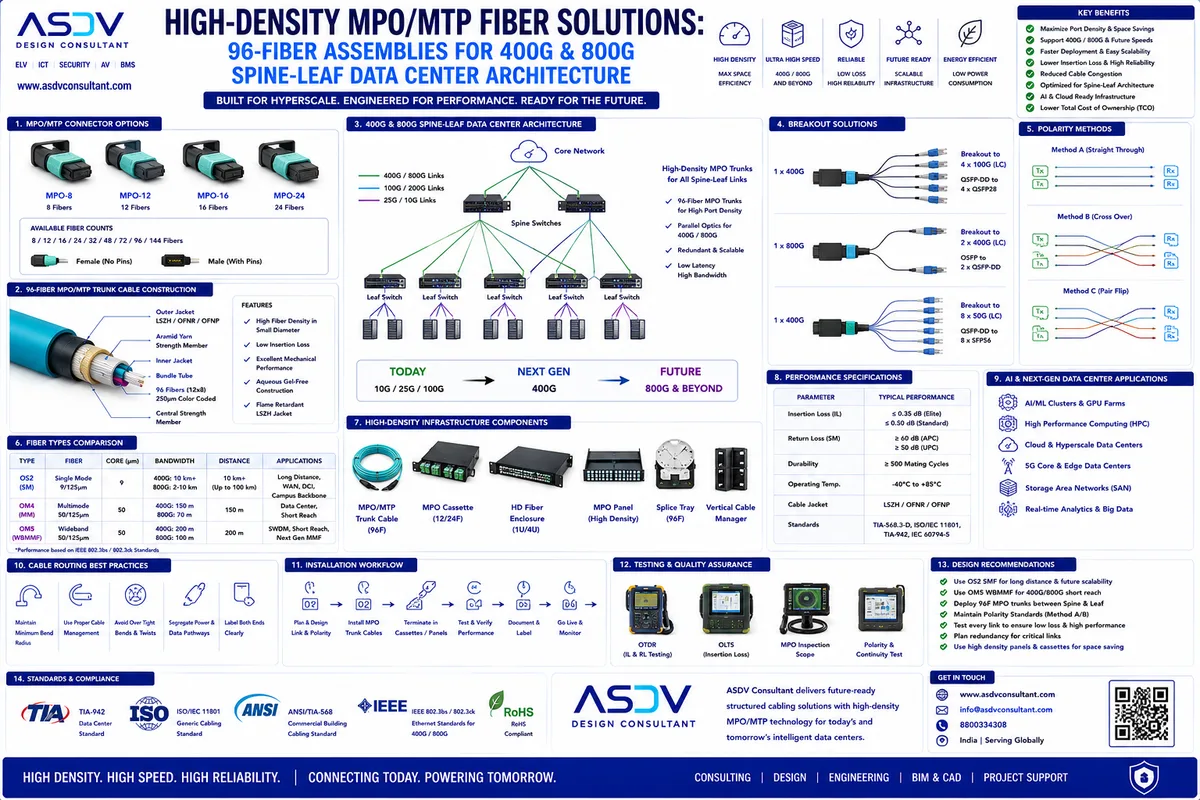
High-Density MPO/MTP Fiber: 96-Fiber 400G & 800G Data Center Cabling Solutions
Pre-terminated MPO/MTP assemblies connect 96 fibers in the footprint of 12 LC connectors — enabling 400G and 800G spine-leaf data center architectures within existing cable pathways. MTP Elite connectors deliver under 0.2dB insertion loss for 800G-ZR coherent wavelengths.
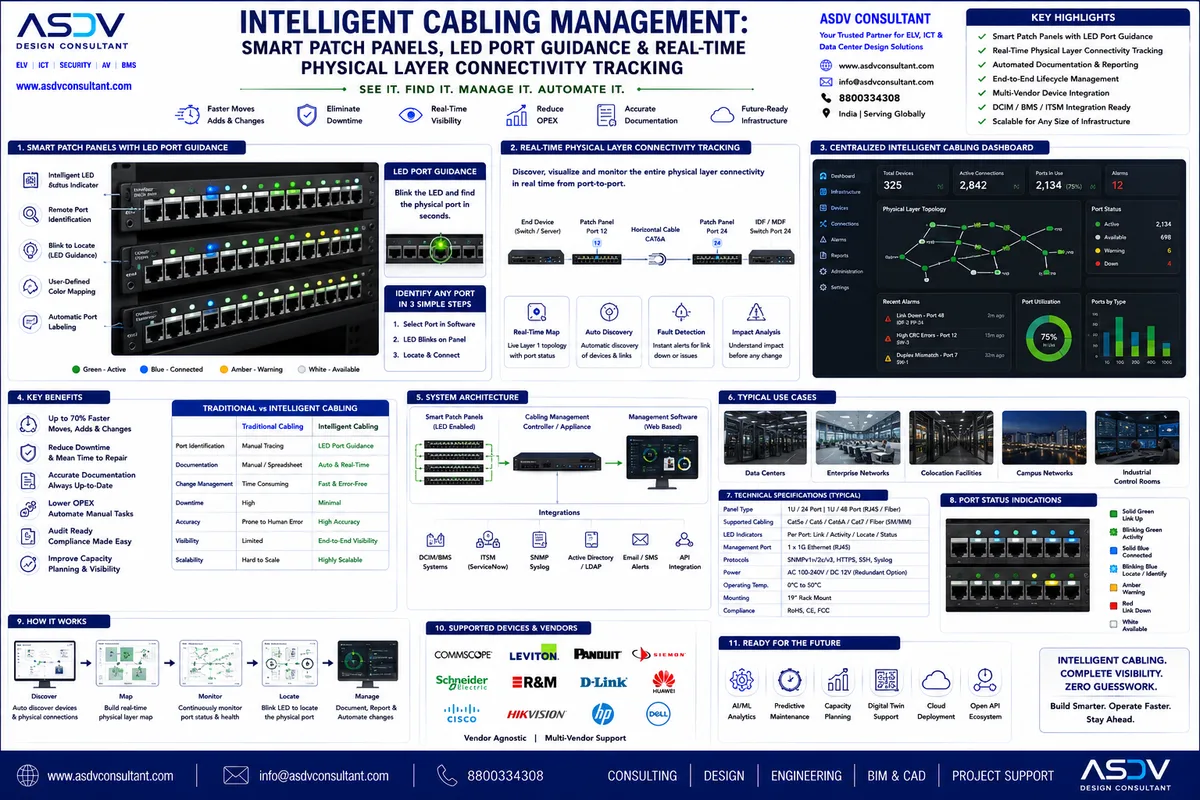
Intelligent Cabling Management: Smart Patch Panels, LED Port Guidance & Real-Time Connectivity
Intelligent cabling management platforms with real-time connectivity tracking and LED port guidance eliminate the 20–35% documentation error rate of manual patch panel management — giving operations teams a live, accurate map of every physical connection across the building.
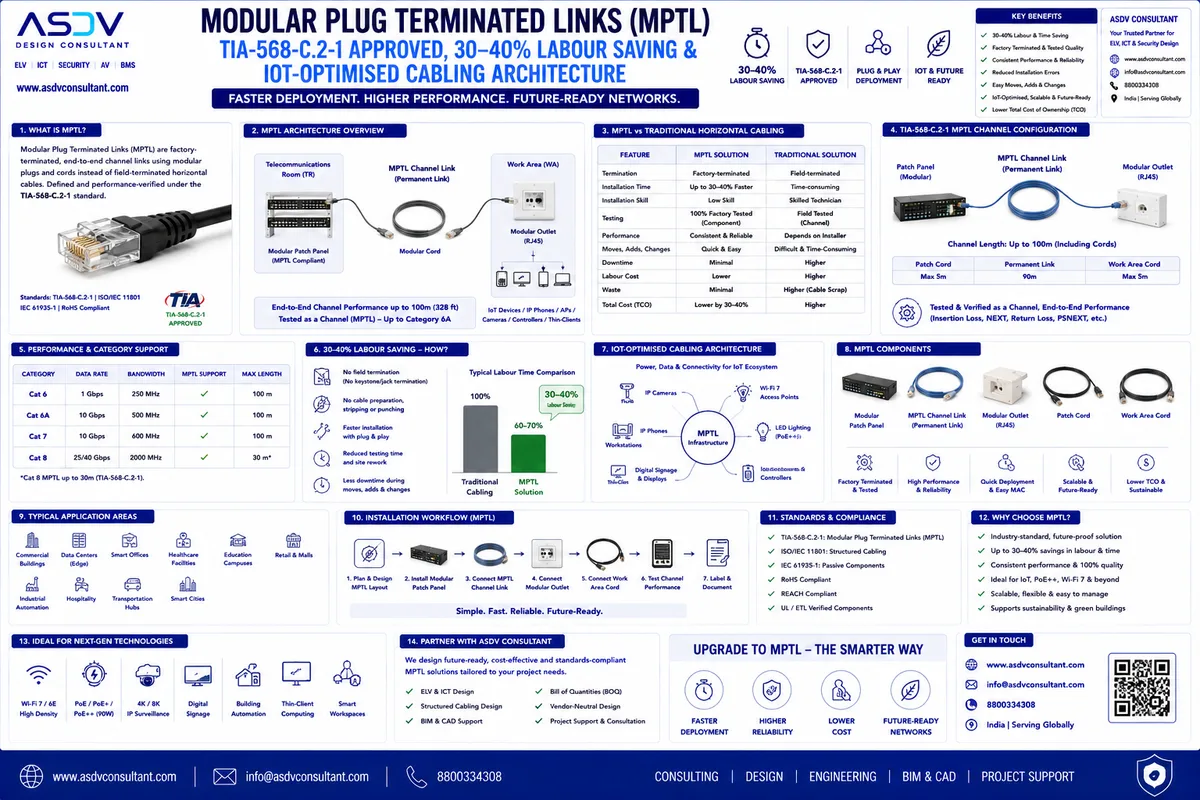
MPTL Modular Plug Terminated Links: TIA-568 Approval, 30–40% Labour Saving & IoT Design
TIA-568-C.2-1 approved MPTL configurations eliminate patch panels at the device end — connecting field-terminated cables directly to IP cameras, access readers, and IoT sensors, reducing installation labour by 30–40% and removing the most common physical layer failure point.
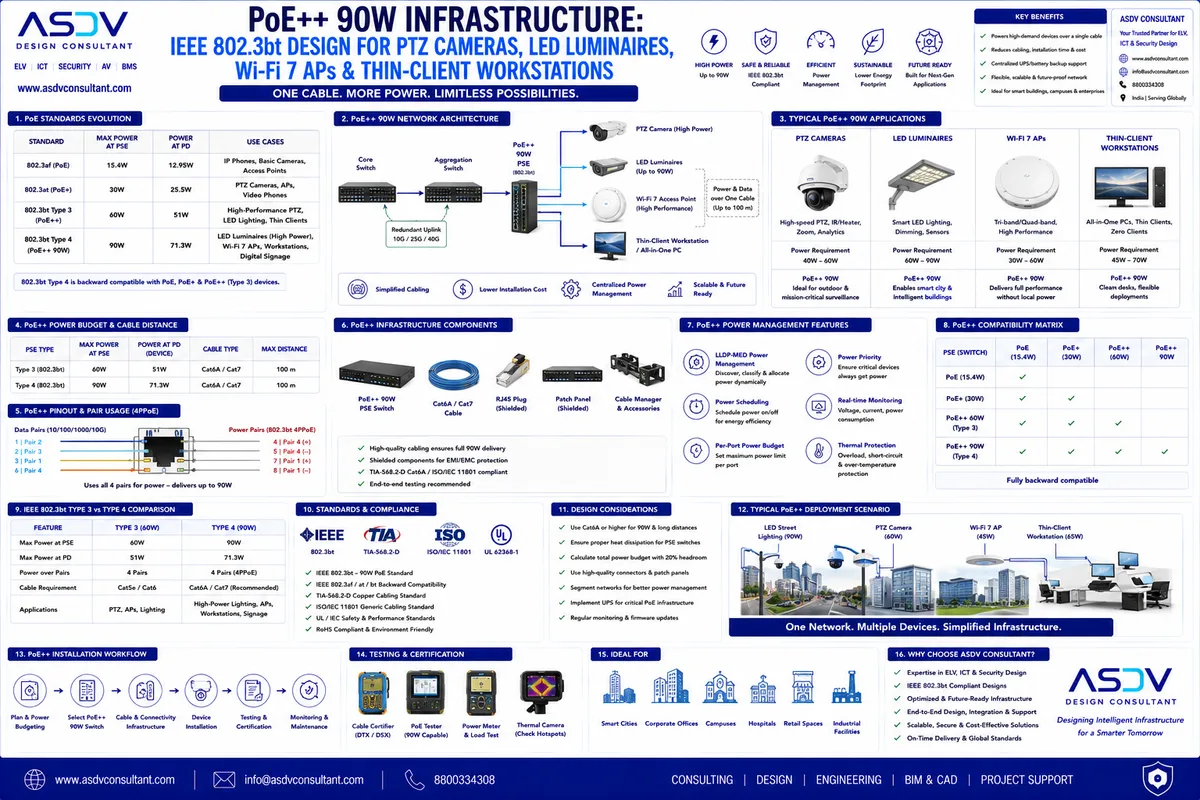
PoE++ 90W Infrastructure: IEEE 802.3bt Design for PTZ Cameras, LED & Wireless APs
IEEE 802.3bt Type 4 delivers 90W per port over Cat6A — powering PTZ cameras, LED luminaires, Wi-Fi 7 APs, digital signage and thin-client workstations over a single cable, reducing electrical installation cost by 35–45% on large commercial deployments.
Self-Monitoring Smart Cables: Embedded micro-OTDR, Connector End-Face Monitoring & Predictive Cabling Maintenance
Self-monitoring smart cables with embedded micro-OTDR (Exfo, VIAVI, AFL), IEC 61300-3-35 end-face contamination detection, and connector resistance trend monitoring identify 73% of cabling faults before service impact — the predictive physical layer of the 2030 enterprise network.
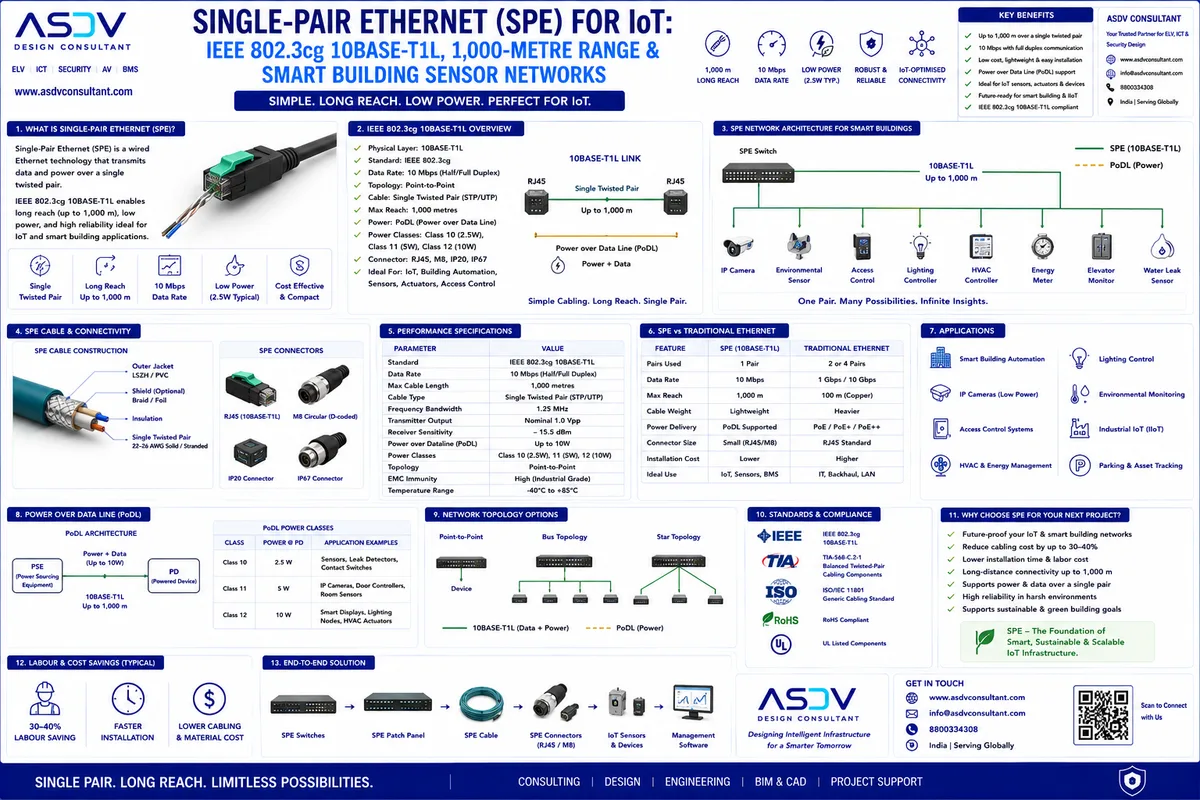
Single-Pair Ethernet (SPE) for IoT: IEEE 802.3cg 10BASE-T1L, 1000m Range & Smart Building
IEEE 802.3cg Single-Pair Ethernet delivers Ethernet and PoE power over a single wire pair to 1,000m — purpose-built for billions of smart building IoT sensors, replacing BACnet MS/TP and Modbus fieldbus with direct IP connectivity at 55–70% lower wiring cost than Cat6A.
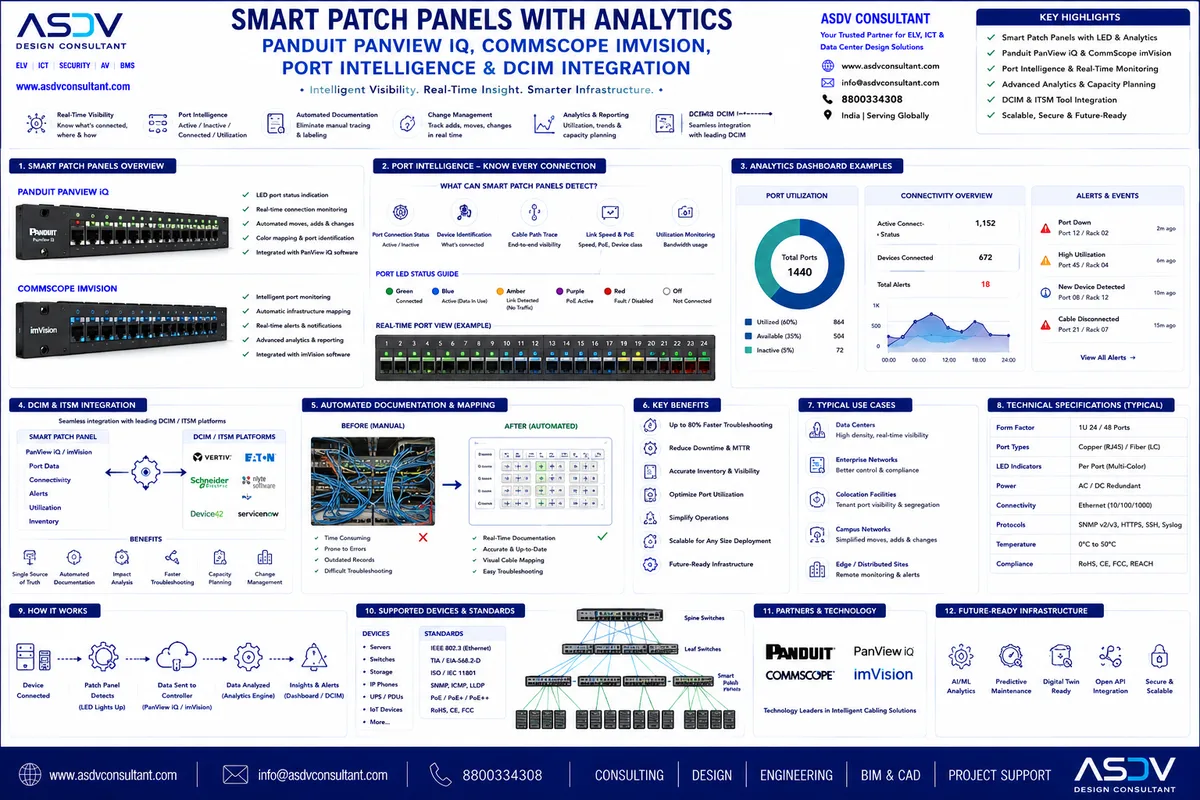
Smart Patch Panels with Analytics: Panduit PanView, CommScope imVision, RFID & Port Intelligence
Smart patch panels with embedded intelligence (Panduit PanView iQ, CommScope imVision, Molex iLink, Belden REVConnect iQ) provide real-time port-level analytics, DCIM integration, and auto-discovery — eliminating manual audits and cutting troubleshooting time by 73% in enterprise structured cabling deployments.
Terabit Optical Cabling: Hollow-Core Fibre, 99.7% Speed of Light & Beyond 400G | ASDV Future Outlook
Hollow-core photonic bandgap fibre achieves 99.7% speed of light propagation at 0.174 dB/km attenuation — 47% lower latency than conventional SMF-28. Explore the terabit optical cabling technologies reshaping hyperscale data centres and long-haul transmission infrastructure by 2030.