
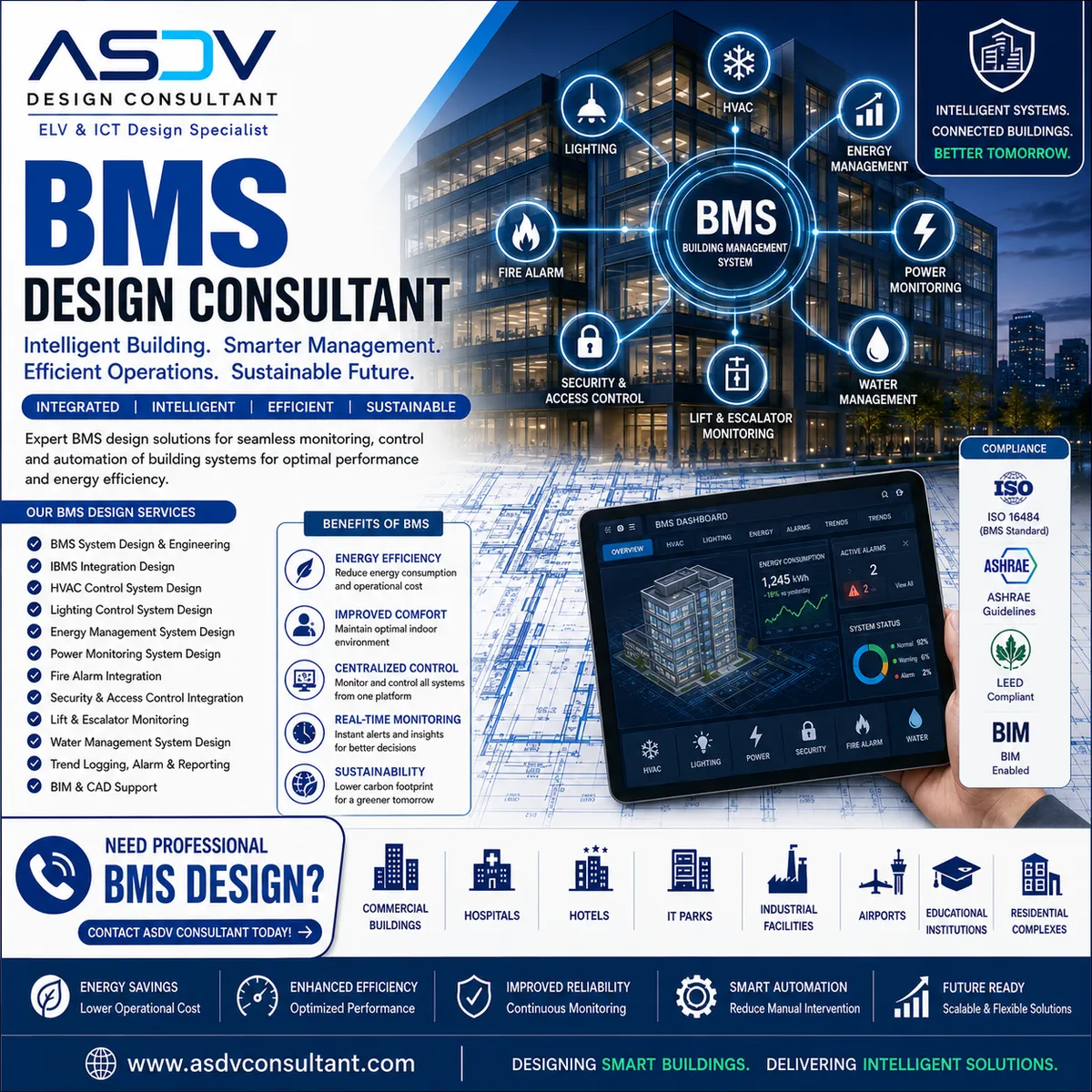
BMS Design for Bahrain Buildings: Climate and Energy Efficiency | ASDV Consultant
Building management system design guidance for Bahrain's climate, covering EWA coordination and practical BMS strategy.
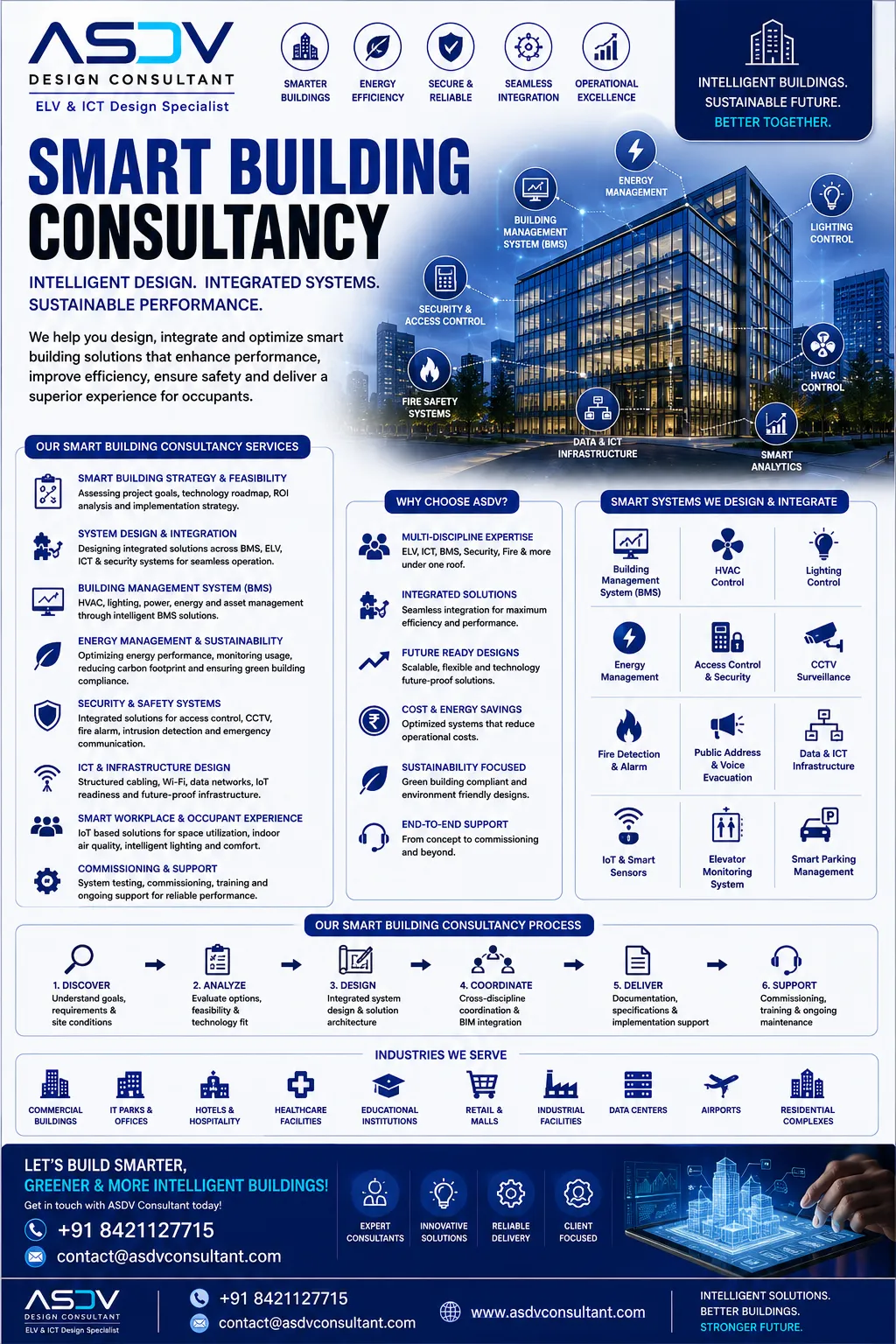
Smart Building and Infrastructure Design for Bahrain Bay and Diyar Al Muharraq Developments | ASDV Consultant
Smart building and infrastructure design considerations for Bahrain's flagship waterfront and reclaimed-land developments.
BMS Design for Qatar Buildings: District Cooling Integration and Energy Efficiency | ASDV Consultant
Building management system design in Qatar has to be engineered around district cooling interfaces, not conventional chiller plants.
BMS Design for Saudi Buildings: Extreme Heat Climate Considerations and Energy Efficiency | ASDV Consultant
Building Management System design guidance for the Saudi climate, covering extreme heat load, SEEC requirements, and the energy strategies that matter most.
BMS Design for Canadian Buildings: Extreme Cold Climate and Energy Code (NECB) | ASDV Consultant
Building management system design in Canada must solve for extreme cold operation and compliance with the National Energy Code of Canada for Buildings.
Smart Building Design for Canadian Commercial Real Estate: CaGBC and Zero Carbon Building Standard | ASDV Consultant
Smart building design for Canadian commercial real estate increasingly aligns with CaGBC's Zero Carbon Building Standard and provincial energy codes.
BMS Design for Oman Buildings: Extreme Heat and Energy Efficiency | ASDV Consultant
Building Management System design for Oman's climate, covering APSR's renewable initiatives and extreme heat engineering demands.
Smart Building Design for Qatar: Lusail City and Msheireb Downtown Doha Standards | ASDV Consultant
What Lusail City and Msheireb Downtown Doha reveal about the smart building design standard Qatar now expects, and how to design toward it.
Smart Building Design for US Commercial Real Estate: WELL and LEED Integration | ASDV Consultant
LEED v5 and the WELL Building Standard now expect real-time BMS and sensor data, not just design-stage modeling.
Next-Generation BMS: Technology Innovation Spotlight | AI, IoT & Digital Twin Building Management
How AI-driven energy optimization, IoT sensor fusion, digital twins, and cloud-native platforms are transforming Building Management Systems — 30-40% energy savings, predictive maintenance, and the roadmap to fully autonomous buildings by 2032.
AI-Driven Energy Optimization BMS: 30-40% Savings, Chiller Sequencing & DeepMind-Style AI
AI engines modeled on Google DeepMind's cooling optimizer deliver 30-40% energy savings by continuously adjusting HVAC setpoints, chiller sequencing, and airflow — learning building-specific patterns no human engineer could replicate, validated across Indian commercial building deployments.
Cloud-Native BMS Platforms: Honeywell Forge, Siemens Building X & Portfolio-Wide Analytics
Honeywell Forge, Siemens Building X, and JLL Hank deliver BMS analytics entirely from the cloud — enabling portfolio-wide benchmarking, remote AI optimization, and sustainability insights without on-site software infrastructure, at 38% lower 5-year TCO for multi-site Indian portfolios.
Demand Response Integration BMS: Grid Stress Automation, Utility Incentives & Load Shedding
BMS platforms participate in utility demand response programs automatically — reducing consumption during grid stress events and earning financial incentives while maintaining occupant comfort within pre-approved operational parameters, delivering 12-18% peak demand reduction for Indian commercial buildings.
Digital Twin Buildings: Live BMS Simulation, Weather Prediction & Pre-Emptive Operations
BMS data feeds a live digital twin that simulates how a building responds to weather forecasts, occupancy changes, and equipment failures — enabling pre-emptive action rather than reactive correction, cutting unplanned downtime by 35% in Indian commercial building deployments.
Net-Zero Monitoring & ESG Reporting: Scope 1-3 Emissions Dashboards, SEBI BRSR & GHG Protocol
Real-time Scope 1, 2, and 3 emissions dashboards integrated with BMS generate automated ESG reporting aligned with GHG Protocol, SEBI BRSR, TCFD, and EU CSRD — turning operational building data into investor-grade sustainability intelligence for Indian listed companies and REITs.
Occupancy-Based Automation: Computer Vision HVAC & Lighting Control for Real-Time Building Use
Computer vision occupancy detection adjusts HVAC, lighting, and access zone states in real time to match actual building use — not scheduled assumptions — delivering precision comfort while eliminating energy waste in empty zones, cutting HVAC energy 18-25% in variable-occupancy Indian offices.
Open Protocol BMS Integration: BACnet/IP, KNX, Modbus TCP & MQTT Vendor-Neutral Architecture
BACnet/IP, KNX, Modbus TCP, MQTT, and LonWorks create vendor-neutral BMS architectures that integrate every building system on a single data fabric — without vendor lock-in, reducing multi-vendor integration costs by 42% versus proprietary closed-protocol BMS deployments.
Predictive Maintenance via BMS: ML Chiller Failure Prediction, AHU Wear & Cooling Tower Analytics
BMS trend data feeds ML models that predict chiller bearing failure, AHU belt wear, and cooling tower biofouling weeks before they manifest — transforming reactive maintenance into precision-scheduled intervention, cutting unplanned HVAC downtime by 45% in Indian commercial buildings.
Smart HVAC Analytics: ASHRAE Guideline 36 AI Sequences, Fault Detection & 8-15% Energy Recovery
ASHRAE Guideline 36-compliant AI sequences identify simultaneous heating and cooling, stuck dampers, and degraded coils — recovering the 8-15% of energy waste that conventional BMS programming consistently misses, with automated fault detection and diagnostics (FDD) for Indian HVAC systems.
Smart IoT-Based BMS: Real-Time Sensor Fusion, Occupancy & Air Quality Monitoring
Modern BMS platforms ingest data from thousands of IoT sensors — occupancy, air quality, energy, temperature, vibration — creating real-time operational awareness that fixed-schedule rule-based systems cannot approach, with 45% faster fault detection in Indian commercial buildings.