
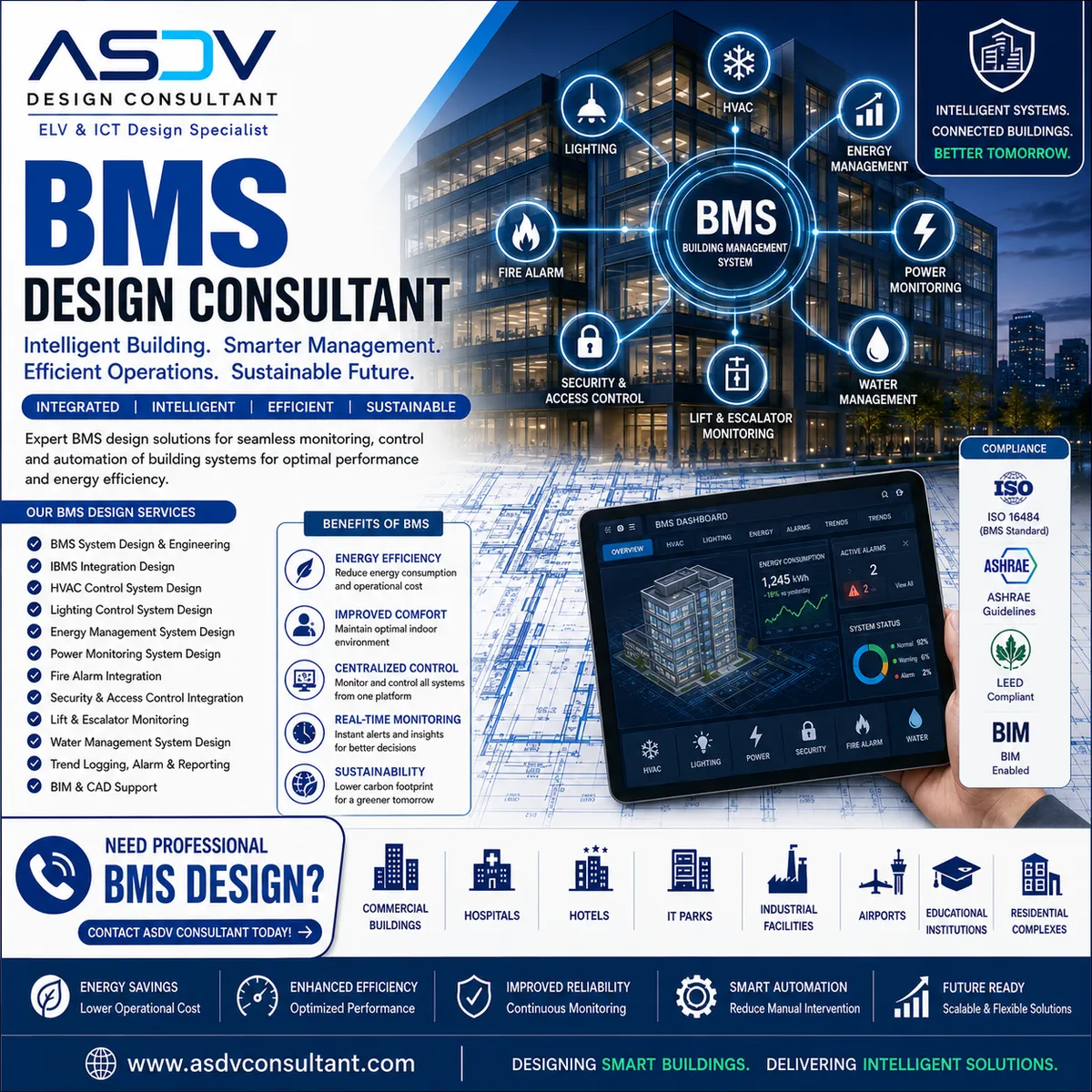
For decades, a Building Management System meant one thing: a central controller executing fixed time-of-day schedules and static setpoints, with a facility engineer manually overriding logic whenever conditions changed. That model is now obsolete. Next-generation BMS platforms ingest live data from thousands of IoT sensors, apply machine learning to continuously optimise energy and comfort, simulate the building's future behaviour through a digital twin, and run entirely from the cloud — enabling a level of operational awareness and precision that rule-based systems with fixed schedules simply cannot approach.
This shift is not incremental. It is a re-architecture of how buildings sense, decide, and act — moving from reactive maintenance and manual tuning toward predictive, self-optimising, and eventually autonomous operation. Below, we break down the ten technologies driving this transformation today, followed by a future outlook for 2028–2037.
Ten Technologies Defining Next-Generation BMS
1. Smart IoT-Based BMS
Modern BMS platforms ingest data from thousands of IoT sensors — occupancy, air quality, energy, temperature, vibration — creating a real-time operational awareness that rule-based systems with fixed schedules cannot begin to approach. Every zone, every air handling unit, and every piece of rotating equipment becomes a continuous data source rather than a periodic inspection point, giving facility teams a live, granular picture of building performance at all times.
2. AI-Driven Energy Optimization
AI engines like Google DeepMind's cooling optimizer deliver 30–40% energy savings by continuously adjusting HVAC setpoints, chiller sequencing, and airflow — learning building-specific patterns that no human engineer could replicate. Unlike static schedules, these models retrain continuously on live operating data, so the optimisation strategy improves as the building ages and usage patterns shift, rather than degrading over time as fixed programming typically does.
3. Digital Twin Buildings
BMS data feeds a live digital twin that simulates how the building responds to weather forecasts, occupancy changes, and equipment failures — enabling pre-emptive action rather than reactive correction after problems manifest. Facility managers can test a control strategy in the digital twin before deploying it in the physical building, eliminating the trial-and-error tuning that has historically characterised BMS commissioning and re-commissioning.
4. Cloud-Native BMS Platforms
Honeywell Forge, Siemens Building X, and JLL Hank deliver BMS analytics entirely from the cloud — enabling portfolio-wide benchmarking, remote AI optimization, and sustainability insights without any on-site software infrastructure. This architecture removes the burden of on-premise server maintenance, patching, and hardware refresh cycles, while giving portfolio owners a single pane of glass across every property regardless of location.
5. Open Protocol Integration (BACnet, KNX, Modbus)
BACnet/IP, KNX, Modbus TCP, MQTT, and LonWorks create vendor-neutral BMS architectures that integrate every building system on a single data fabric — without locking clients into any single manufacturer's ecosystem. This open-protocol philosophy protects long-term investment: building owners can competitively procure HVAC, lighting, and metering hardware from multiple vendors while retaining a unified control and analytics layer.
6. Smart HVAC Analytics
ASHRAE Guideline 36-compliant AI sequences identify simultaneous heating and cooling, stuck dampers, and degraded coils — recovering the 8–15% of energy waste that conventional BMS programming consistently misses. These fault-detection and diagnostics (FDD) routines run continuously in the background, surfacing degraded performance long before it would be caught by a scheduled maintenance inspection.
7. Occupancy-Based Automation
Computer vision occupancy detection adjusts HVAC, lighting, and access zone states in real time to match actual building use — not scheduled assumptions — delivering precision comfort while eliminating energy waste in empty zones. Instead of conditioning an entire floor because "office hours" say it should be occupied, the system responds to the building as it actually is being used, minute by minute.
8. Predictive Maintenance via BMS
BMS trend data feeds ML models that predict chiller bearing failure, AHU belt wear, and cooling tower biofouling weeks before they manifest — transforming reactive maintenance into precision-scheduled, cost-optimal intervention. This shifts maintenance budgets away from expensive emergency call-outs and unplanned downtime toward scheduled interventions timed to actual equipment condition rather than a generic calendar interval.
9. Net-Zero Monitoring & ESG Reporting
Real-time Scope 1, 2, and 3 emissions dashboards integrated with BMS generate automated ESG reporting aligned with GHG Protocol, SEBI BRSR, TCFD, and EU CSRD — turning operational data into investor-grade sustainability intelligence. For India-based portfolios in particular, this automated reporting pathway significantly reduces the manual effort required to meet SEBI's Business Responsibility and Sustainability Reporting (BRSR) obligations.
10. Demand Response Integration
BMS platforms participate in utility demand response programs automatically — reducing consumption during grid stress events and earning financial incentives while maintaining occupant comfort within pre-approved operational parameters. The building becomes an active grid participant rather than a passive consumer, automatically curtailing non-critical loads during peak stress windows and reverting once the event clears.
Legacy BMS vs. Next-Generation BMS
| Capability | Legacy Rule-Based BMS | Next-Generation AI/IoT BMS |
|---|---|---|
| Control logic | Fixed schedules, static setpoints | Continuous AI optimisation, self-learning |
| Data granularity | Periodic trend logs, limited points | Thousands of live IoT sensor streams |
| Fault detection | Manual inspection, reactive | Automated FDD (ASHRAE G36), predictive |
| Infrastructure | On-premise server, single site | Cloud-native, portfolio-wide |
| Vendor architecture | Proprietary, closed ecosystem | Open protocol (BACnet, KNX, Modbus, MQTT) |
| Occupancy response | Scheduled assumptions | Real-time computer vision detection |
| Sustainability reporting | Manual data compilation | Automated ESG / BRSR / CSRD dashboards |
| Grid interaction | None | Automated demand response participation |
Future Outlook: 2028–2037
Fully Autonomous Buildings
By 2032, leading commercial buildings will achieve Level 3 autonomy — AI managing 80% of routine decisions without human oversight, with operators reserved exclusively for edge cases and strategic policy exceptions. Day-to-day setpoint tuning, sequencing, and load balancing will run entirely on AI-driven logic, with facility teams shifting from hands-on operators to policy supervisors who set strategic guardrails rather than issuing daily commands.
Self-Healing Building Systems
When a sensor fails, AI will cross-validate against adjacent sensors, impute missing values, reroute control signals through backup paths, and schedule replacement — without paging a facility manager or creating a logged fault condition. The building's control layer becomes resilient by design: individual sensor or communication failures are absorbed and compensated for automatically, rather than cascading into occupant-visible comfort or safety issues.
Portfolio-Wide AI Sustainability Optimization
AI managing 500 buildings simultaneously will transfer learned efficiency optimizations between properties — a new building inheriting decades of operational intelligence from its portfolio siblings the moment it connects to the shared platform. Commissioning timelines compress dramatically, since a newly connected asset starts from a mature, portfolio-tested optimisation baseline instead of a blank-slate learning period.
Key Takeaways for Building Owners
- IoT sensor density drives AI accuracy: the more granular the occupancy, air quality, energy, and vibration data feeding the platform, the more precise the AI optimisation and fault detection become
- Open protocols protect long-term flexibility: BACnet/IP, KNX, Modbus TCP, MQTT, and LonWorks architectures avoid single-vendor lock-in and enable competitive multi-vendor procurement over the building's lifecycle
- Digital twins de-risk commissioning: simulating control strategies before deployment reduces the trial-and-error tuning period and lowers the risk of occupant comfort complaints during rollout
- Predictive maintenance shifts capex/opex balance: ML-driven failure prediction on chillers, AHUs, and cooling towers converts unplanned emergency repairs into scheduled, cost-optimal interventions
- ESG reporting becomes a BMS byproduct: once energy and emissions data is captured at the BMS layer, GHG Protocol, SEBI BRSR, TCFD, and EU CSRD reporting can be automated rather than manually compiled
- Cloud-native platforms enable portfolio scale: Honeywell Forge, Siemens Building X, and JLL Hank-style architectures allow benchmarking and optimisation across dozens or hundreds of properties from a single platform