
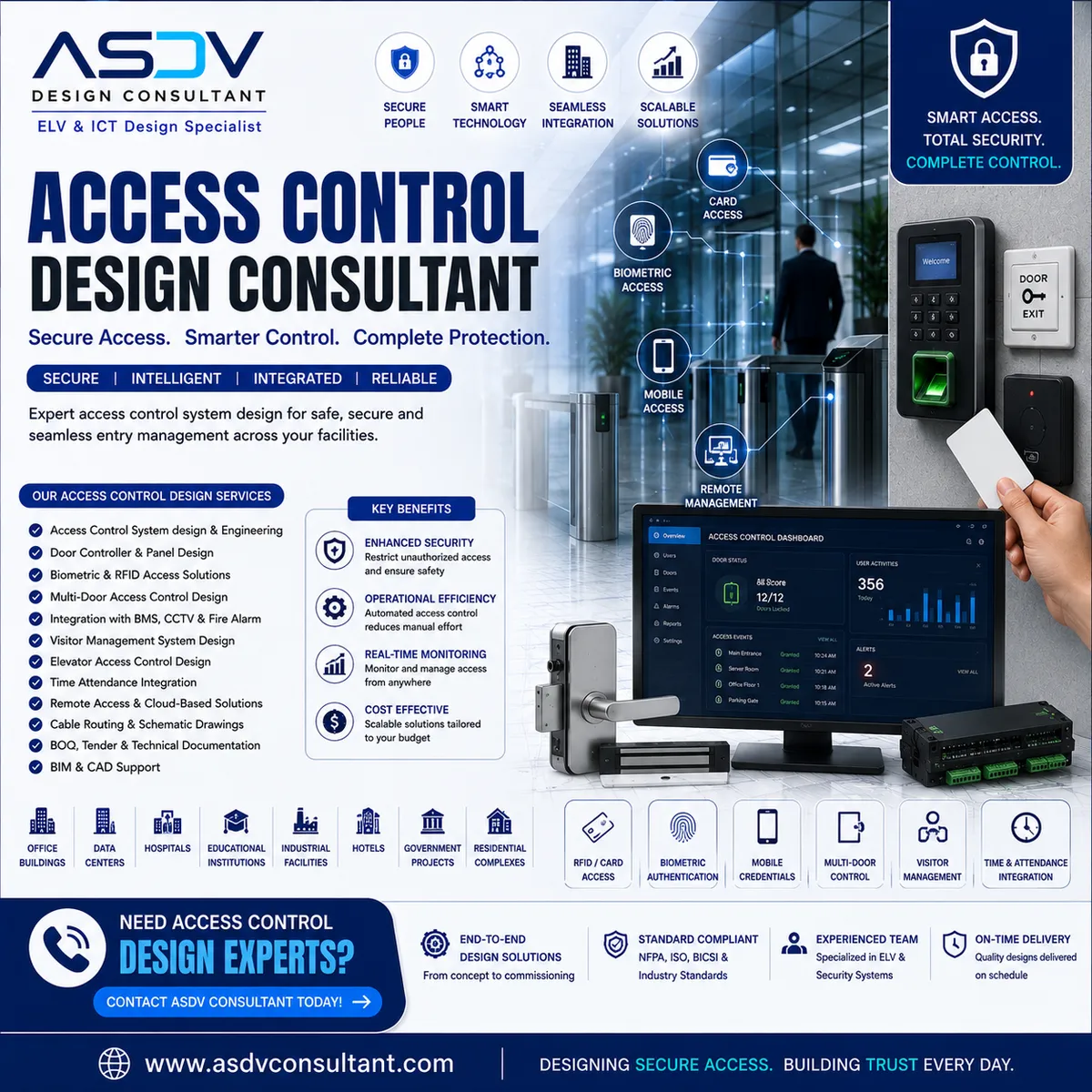
Access control system design in Oman must restrict and audit entry while never conflicting with fire and life safety egress requirements enforced by the Civil Defence and Ambulance Authority under Decision 77/2002 (as amended) and, in Muscat, Local Order 23/92's escape-route provisions.
Government projects typically carry additional layers: procurement through government tendering frameworks, integration with government-wide identity initiatives tied to Vision 2040, and coordination with multiple stakeholders. Commercial projects are more often driven by tenant security requirements and biometric or mobile-credential systems as owners chase smart-building positioning.
The PDPPL (Royal Decree 6/2022) is directly relevant: access control systems using biometric credentials process a category of personal data that typically receives heightened treatment, and ASDV treats any biometric specification in Oman as requiring an explicit compliance review.
| Consideration | Standard Commercial Approach | Oman-Specific Approach |
|---|---|---|
| Egress conflict resolution | Local fire code cross-check | Must satisfy CDAA under Decision 77/2002 and applicable local order |
| Credential type | Card, PIN, biometric | Biometric use triggers PDPPL data-handling considerations |
| Government project stakeholders | Building owner + fire authority | Client ministry/authority + ROP + CDAA |
| Smart building alignment | Optional | Increasingly expected given Vision 2040 digital push |
| Licensing of monitoring/security staff | Varies | Security services generally require Omani licensing |
Design guidance
Always design fail-safe (unlocked on power/fire alarm signal) on doors along egress routes, documented explicitly for CDAA review. For government projects, build in extra time for multi-stakeholder sign-off. For biometric systems, include a data protection impact assessment step in the design programme.
Common mistakes
Specifying fail-secure locking on fire escape doors without an integrated release-on-alarm strategy; assuming a single "government standard" exists across all ministries; under-scoping audit-trail requirements.
Future outlook
As Vision 2040's digital economy programme drives more integrated, credential-based building ecosystems, access control design will likely move toward greater interoperability with national digital identity frameworks.