Data Centre Design in Bahrain: Regional Connectivity and Financial Sector Requirements | ASDV Consultant
Data centre design considerations for Bahrain, covering its role as a regional cloud hub and financial sector resilience requirements.
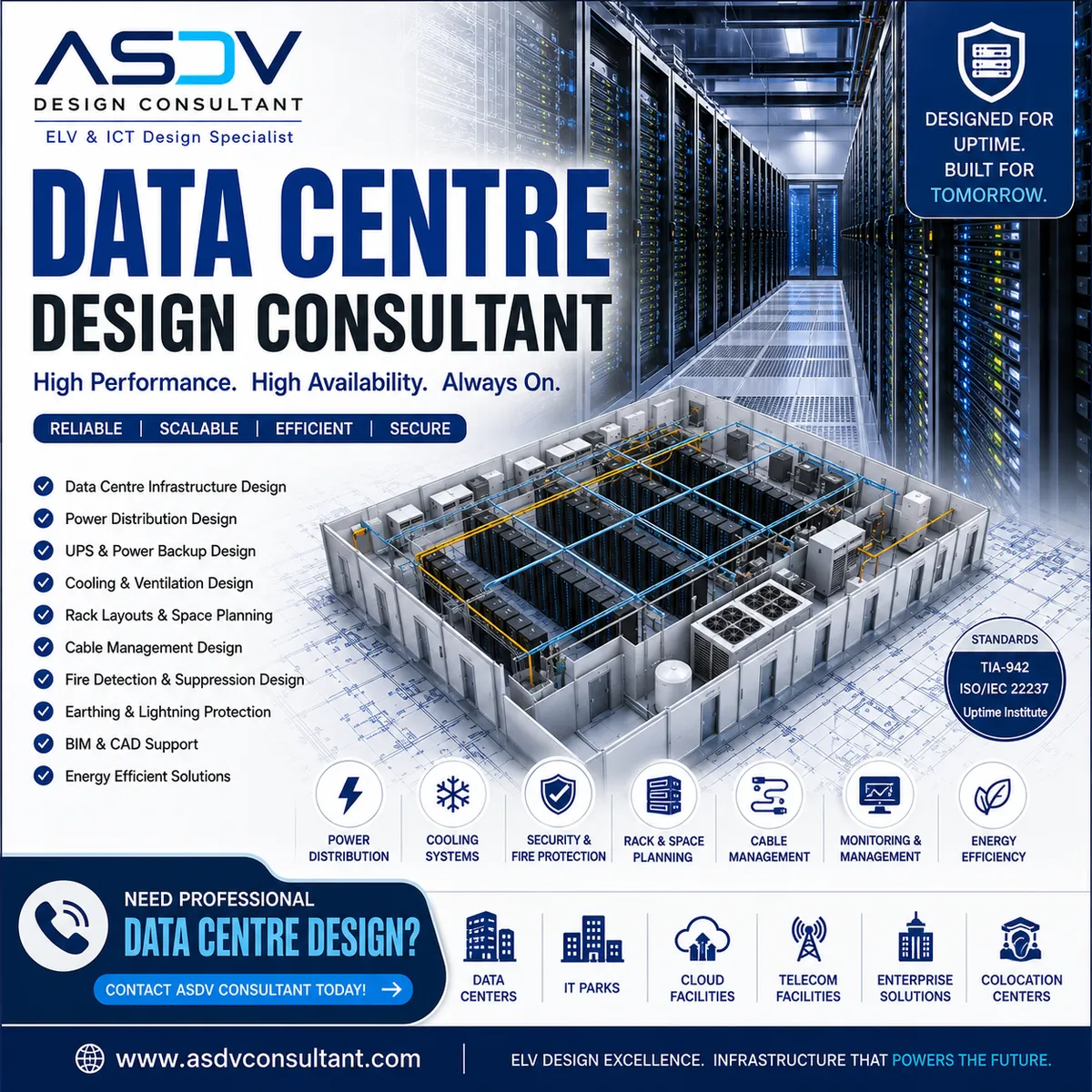
Data centre design spans site selection, Tier I–IV classification, power and cooling architecture, and the structured cabling and networking that ties it together. This tag collects every article touching data centre infrastructure, from hyperscale 100MW+ facilities to the 400G/800G networking and GPU-dense infrastructure that AI training workloads now demand.

Data centre design considerations for Bahrain, covering its role as a regional cloud hub and financial sector resilience requirements.

Canada offers strong free-cooling economics for data centres alongside growing data sovereignty requirements. ASDV explains the design implications.

How Qatar's Digital Agenda 2030 and growing data localization expectations are shaping data centre design decisions for government, enterprise and hyperscale projects.

How Saudi Arabia's CST regulations and data localization rules shape data centre design decisions for government, enterprise, and hyperscale projects.

Data centre design considerations for Oman's growing market, covering Vision 2040's digital economy targets and climate-driven cooling engineering.

US data centers must satisfy ASHRAE 90.1 (adopted into state energy codes) or the dedicated ASHRAE 90.4 data center energy standard.

ANSI/TIA-942-C, updated in 2024, remains the primary US-originated data center infrastructure standard — distinct from the Uptime Institute Tier system.

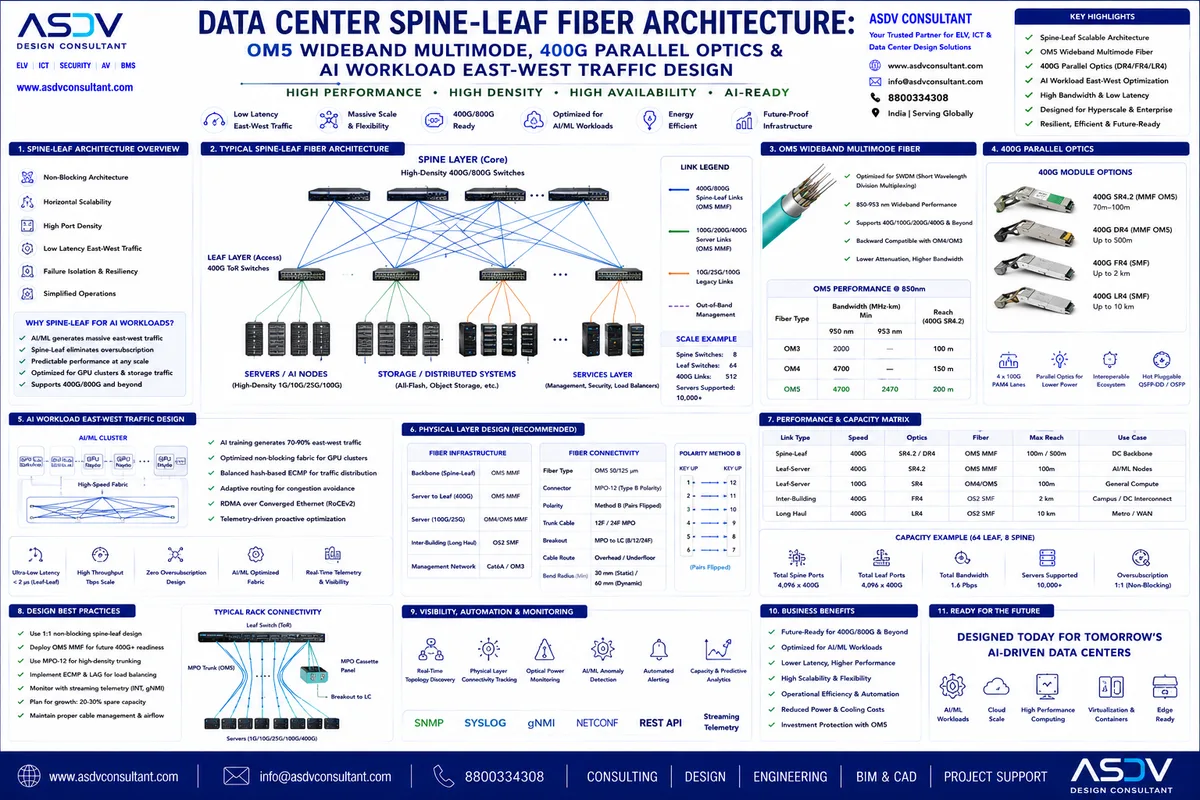
400G and emerging 800G optical transceivers on spine-leaf architectures handle the massive east-west traffic flows generated by AI training clusters and hyperconverged workloads.

NVIDIA H100/H200 and AMD MI300X GPU clusters generating 700W+ per accelerator demand complete rethinking of power density, structural floor loading, and cooling strategy in data center design.

By 2032, leading hyperscalers will operate dark data centers — facilities running without permanent human presence, managed entirely by AI systems that self-configure, self-heal, and self-optimize.

The most ambitious operators will go beyond net-zero, using direct air capture powered by excess renewable energy to actively remove more CO2 from the atmosphere than their operation produces.

A live digital twin continuously simulates thermal behaviour, power distribution, and capacity utilization, enabling what-if capacity planning, commissioning validation, and emergency modelling.

Micro data centers deployed within 10ms of end users — at 5G base stations, factory floors, and hospital imaging departments — process latency-sensitive workloads locally without cloud round-trip delay.

100% renewable energy PPAs, waste heat recovery for district heating, and circular hardware lifecycle programs are transforming data centers into carbon-neutral — and ultimately carbon-negative — assets.

Nutanix, VMware vSAN, and Microsoft Azure Stack HCI converge compute, storage, and networking into software-defined nodes — reducing data center footprint by 60% while delivering cloud-like scalability.

Facilities exceeding 100 MW — operated by AWS, Google, Microsoft, and Meta — define the frontier of data center engineering: custom silicon, direct liquid cooling, and proprietary power distribution.

Direct liquid cooling, rear-door heat exchangers, and single/two-phase immersion cooling achieve PUE below 1.1 — the only physically viable approach for next-generation AI compute densities.

Schneider Electric EcoStruxure and Rittal modular systems ship as pre-integrated, factory-tested units deployable in weeks, compressing time-to-capacity from 18 months to 12 weeks.

Photonic chips eliminate the electronic bottleneck in AI inference; DNA-based storage encodes an exabyte of data in a single gram of synthetic DNA — technologies defining data centers of 2035 and beyond.

Data centers of the late 2020s will house quantum processors requiring dilution refrigerators at 15 millikelvin — a facility design challenge that makes Class A cleanroom construction look straightforward.

Virtualizing compute, storage, networking, and security into software layers on commodity hardware enables data centers to be provisioned in hours, scaled in minutes, and migrated seamlessly.

Microsegmentation, identity-based access for every workload, encrypted east-west traffic, and continuous behavioral monitoring treat every internal request as untrusted, making lateral movement impossible.

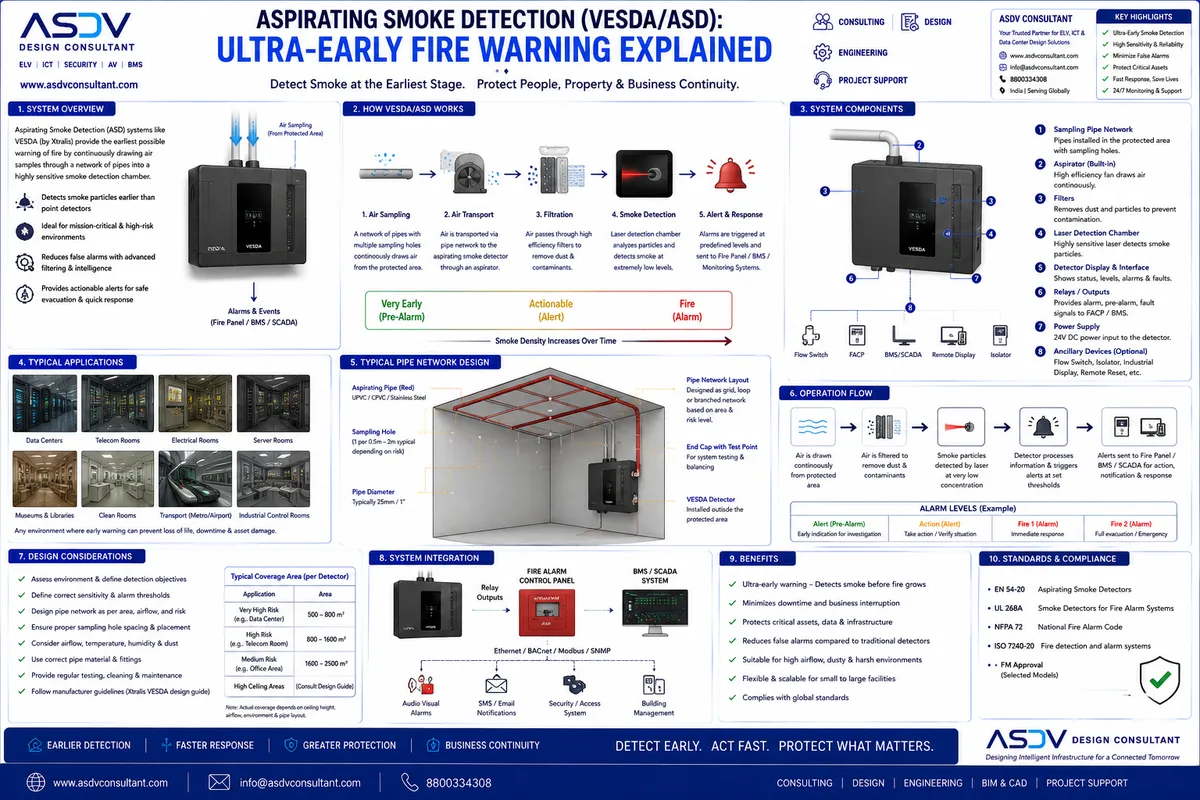
VESDA-E aspirating smoke detection systems sample air continuously, detecting combustion byproducts 100× below conventional detector thresholds — the gold standard for data centres, museums & cleanrooms.

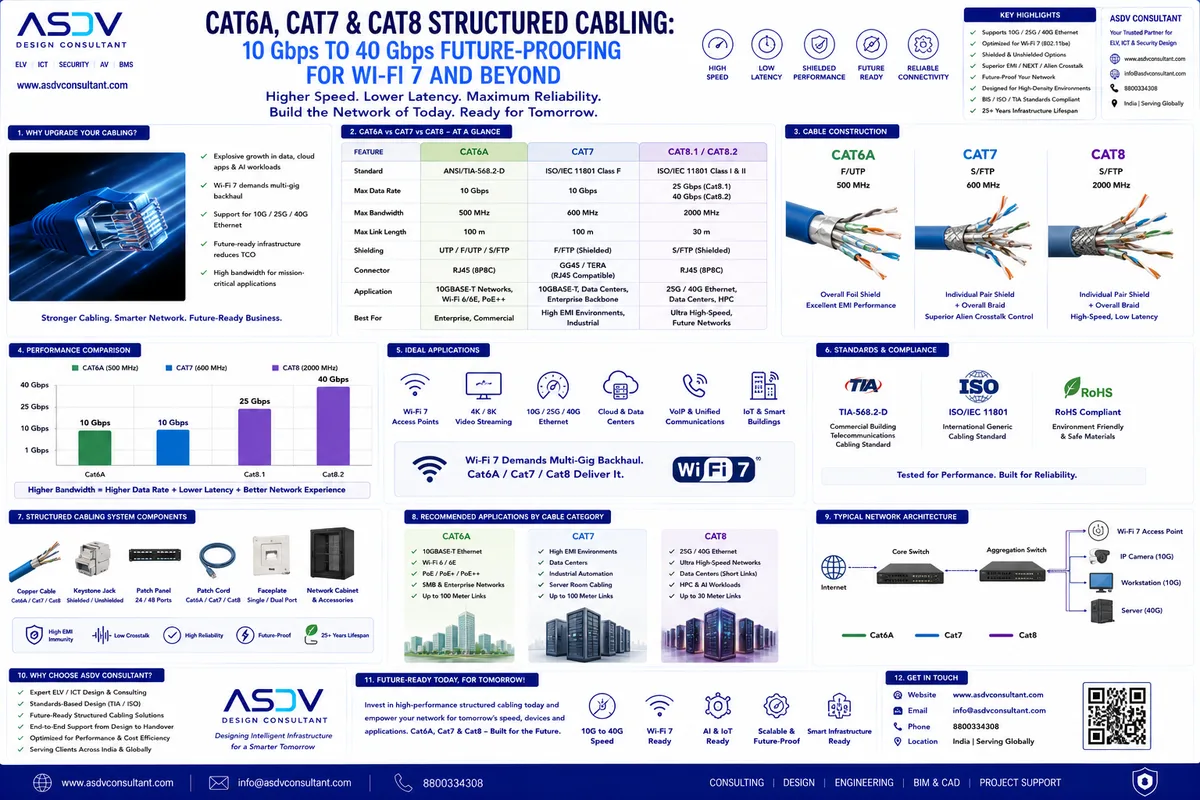
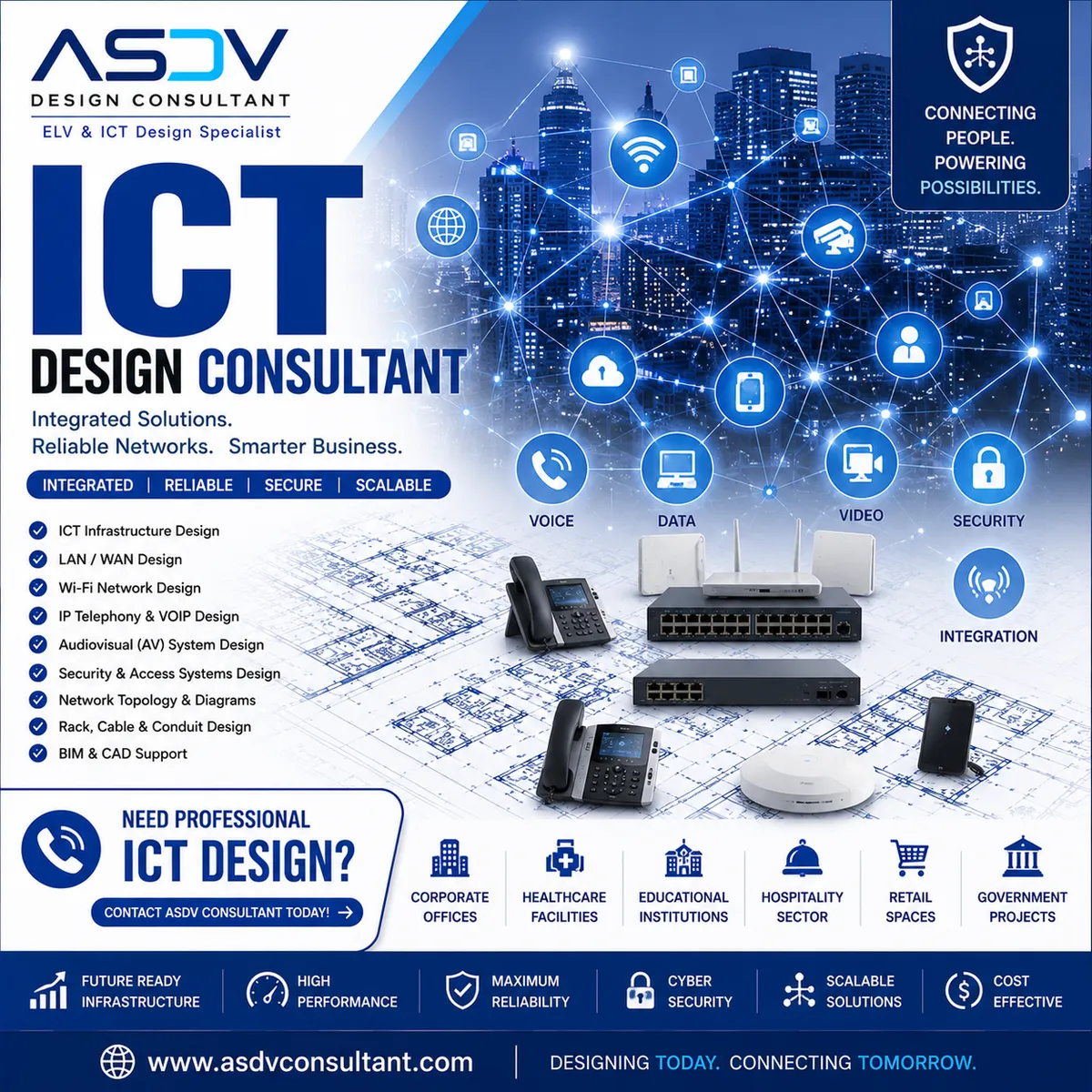
Cat6A (10 Gbps to 100m) is today's commercial standard; Cat8 (40 Gbps to 30m) serves data centre top-of-rack switching. Specifying Cat6A as the minimum future-proofs any building for Wi-Fi 7 and the bandwidth decade beyond.

OM5 wideband multimode fiber supports 10×100G wavelengths per fiber pair via SWDM4 — enabling the massive east-west GPU-to-GPU bandwidth that AI training workloads demand across thousands of interconnected compute nodes in spine-leaf data center architectures.

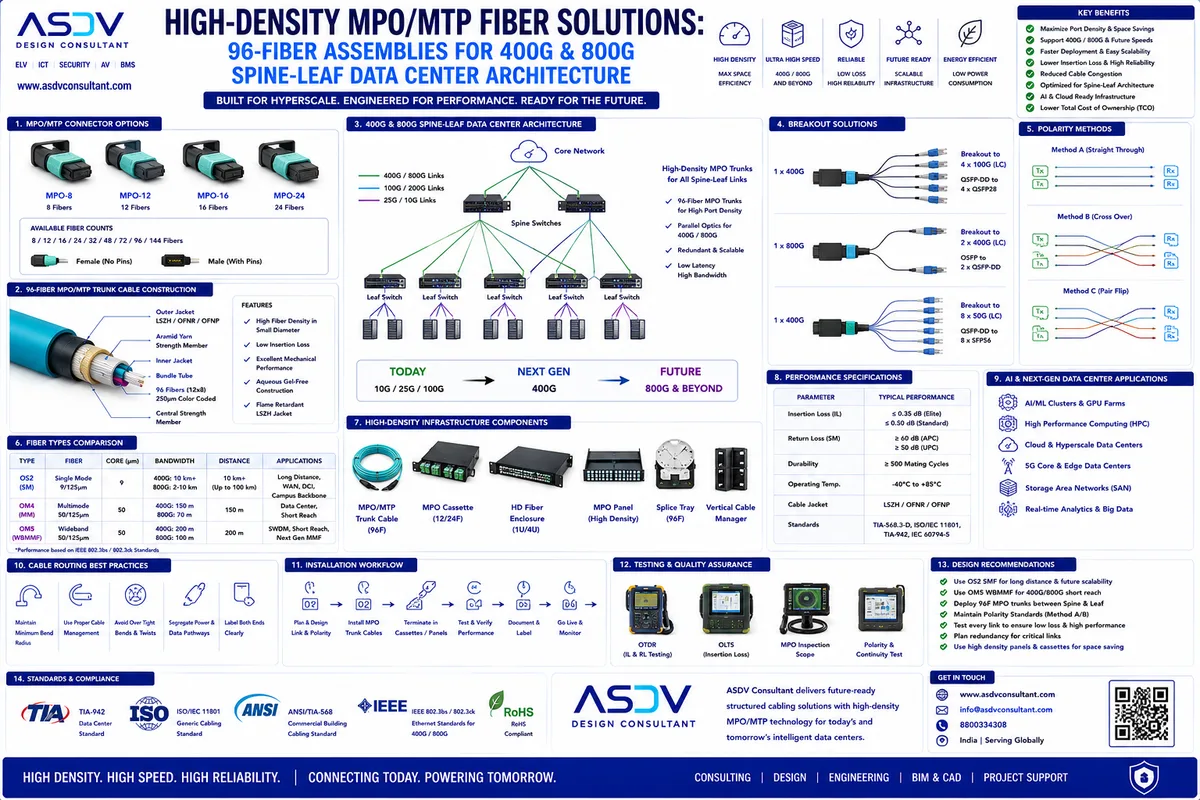
Pre-terminated MPO/MTP assemblies connect 96 fibers in the footprint of 12 LC connectors — enabling 400G and 800G spine-leaf data center architectures within existing cable pathways. MTP Elite connectors deliver under 0.2dB insertion loss for 800G-ZR coherent wavelengths.

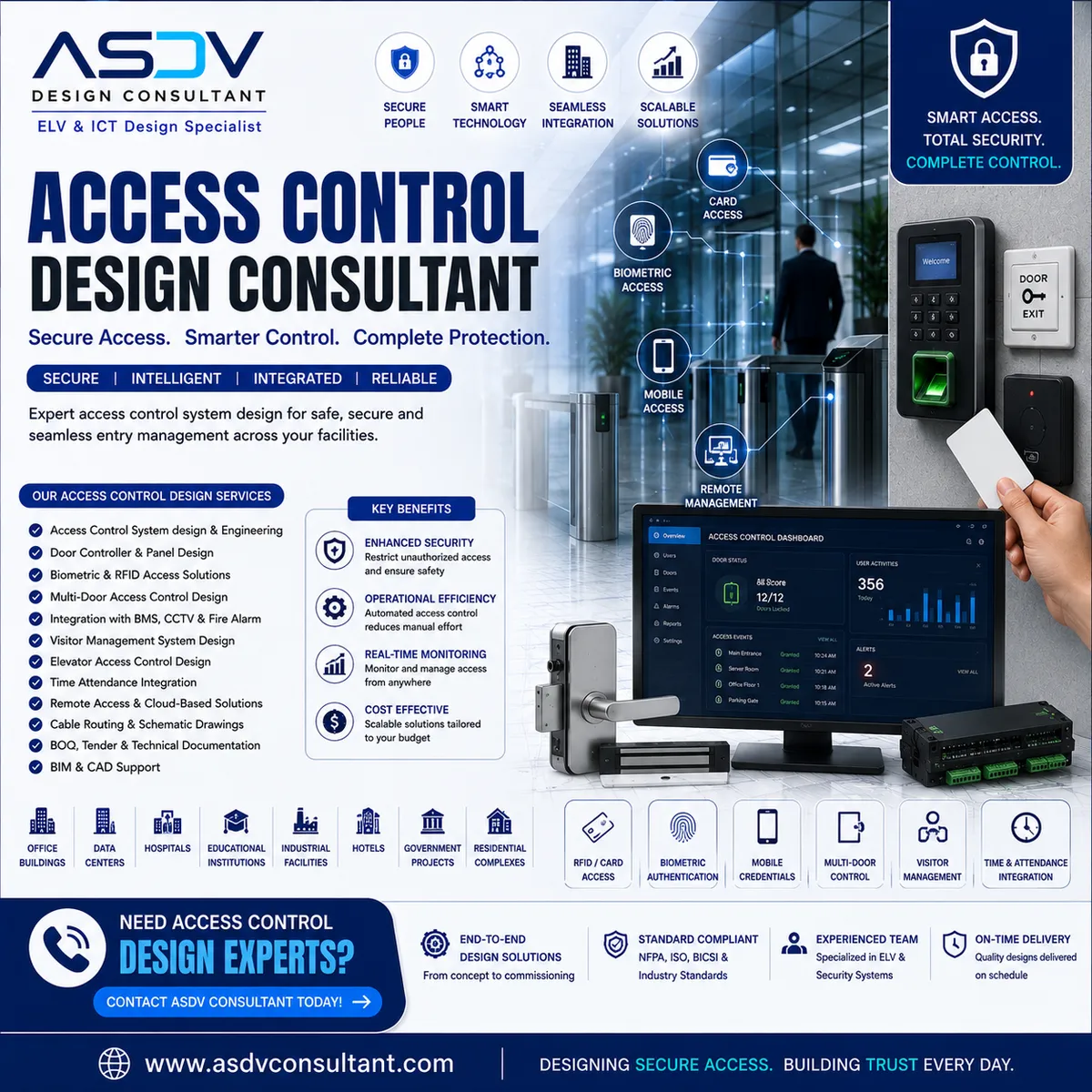
Long-range iris recognition from up to 60cm enables completely hands-free non-contact identity verification at sub-500ms — securing international border controls, Tier IV data centres, and nuclear facilities with FAR below 0.00001% and STQC-certified Aadhaar API integration.

Hollow-core photonic bandgap fibre achieves 99.7% speed of light propagation at 0.174 dB/km attenuation — 47% lower latency than conventional SMF-28. Explore the terabit optical cabling technologies reshaping hyperscale data centres and long-haul transmission infrastructure by 2030.
Talk to ASDV Consultant about your project across India, UAE, KSA, Qatar, UK and USA.
Get a Design