
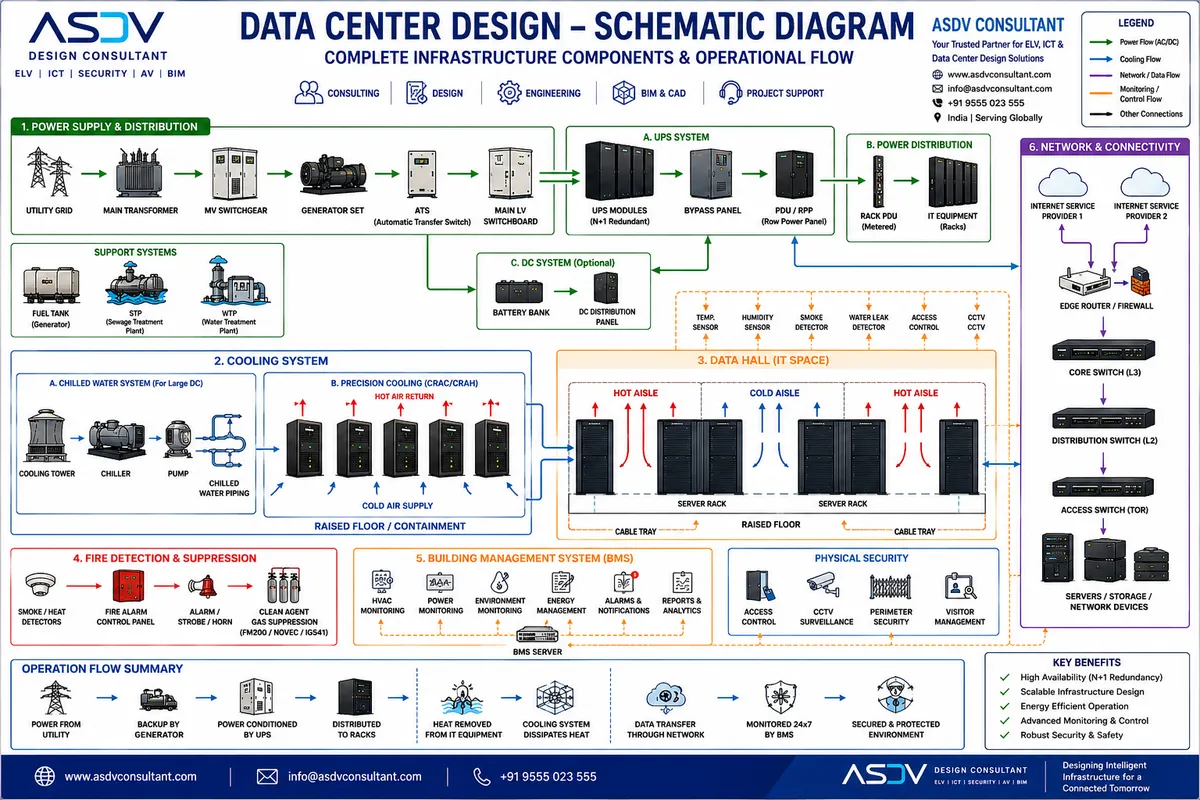
Data center capacity planning and change management have traditionally involved genuine physical risk: adding a new high-density rack, reconfiguring cooling airflow, or testing an emergency failover scenario have historically required either careful manual calculation with inherent uncertainty, or direct testing on live production infrastructure with the operational risk that implies. Both approaches leave meaningful room for costly surprises — a new deployment that creates an unexpected hot spot, or a capacity assumption that proves wrong only after physical installation.
Digital twin technology eliminates much of this uncertainty by creating a continuously updated, physics-accurate virtual model of the facility — synchronized with real-time sensor data from the DCIM platform (covered elsewhere in this spotlight) — allowing facility engineers to simulate the thermal, power, and capacity impact of a proposed change entirely in the virtual domain, validating the outcome before committing to physical implementation, and providing a safe environment to model emergency scenarios that would be far too risky to test on live production infrastructure.
Digital Twin Data Center Application Comparison
| Application | What It Enables | Risk Without Digital Twin |
|---|---|---|
| What-If Capacity Planning | Simulate new deployment impact before installation | Unexpected thermal/power issues post-deployment |
| Commissioning Validation | Verify new facility/expansion design in simulation | Design flaws discovered only during physical commissioning |
| Emergency Scenario Modelling | Test failover/failure scenarios safely in simulation | Untested emergency procedures risk real incident response failure |
| Cooling Optimization | Model airflow and thermal changes virtually | Trial-and-error physical adjustment, wasted energy |
Technical Design: Digital Twin Data Center Architecture
- Physics-based thermal and airflow modelling: Digital twin platforms use computational fluid dynamics (CFD) and thermal modelling to accurately simulate how heat and airflow behave throughout the facility, accounting for actual rack layout, cooling equipment placement, and equipment heat output rather than simplified approximations
- Real-time DCIM data synchronization: The digital twin is continuously synchronized with live sensor data from the facility's DCIM platform, ensuring the virtual model accurately reflects current facility state — actual equipment deployed, actual power draw, actual environmental conditions — rather than becoming a stale, outdated model disconnected from physical reality
- What-if scenario simulation engine: Facility engineers can define proposed changes (adding a new rack of specific power density, relocating equipment, adjusting cooling setpoints) within the digital twin and simulate the resulting thermal and power impact before any physical change is made, identifying potential issues in the safe virtual environment
- Commissioning and design validation: For new facility construction or major expansion projects, digital twin simulation validates the design's thermal and power performance against specifications before physical construction is complete, catching design issues while they remain comparatively inexpensive to correct rather than after physical build-out
- Emergency and failure scenario modelling: Digital twins enable safe simulation of failure scenarios (cooling system failure, power feed loss, equipment overheating) that would be far too risky to deliberately test on live production infrastructure, supporting emergency response procedure development and validation without genuine operational risk
- Integration with capacity planning and DCIM workflow: Digital twin simulation capability is most valuable when tightly integrated into the facility's standard capacity planning and change management workflow, ensuring proposed changes are routinely validated in simulation as a standard practice rather than an occasional specialized exercise
AI-Driven Autonomous Digital Twin Optimization
Digital twin platforms will increasingly incorporate AI-driven autonomous optimization capability — not merely simulating the outcome of a proposed human-defined change, but proactively identifying and recommending optimal facility configuration changes (cooling setpoint adjustments, workload placement optimization) based on continuous analysis of the live-synchronized twin, moving from a validation tool for human-proposed changes toward an active optimization engine that itself proposes improvements, directly connecting to the broader autonomous AI-operated data center future outlook covered in this spotlight.