
For a striking number of data centers — including many otherwise sophisticated facilities — the authoritative record of what equipment exists where, how much power and cooling capacity remains available, and which racks have space for new deployments has historically lived in spreadsheets, manually updated (and frequently out of date) by facilities staff, creating genuine operational risk when capacity planning decisions are made on data that may not reflect current physical reality.
Modern DCIM platforms replace this manual record-keeping with continuous, automated data collection directly from facility power, cooling, and IT equipment sensors, and AI-enhanced platforms go further still — applying machine learning to this continuous data stream to detect subtle thermal anomalies indicating a developing equipment problem before it causes failure, forecast when available power or cooling capacity will be exhausted based on actual growth trends rather than static assumptions, and identify underutilized assets that represent genuine capacity recovery opportunity.
AI-Enhanced DCIM Platform Comparison
| Platform | AI Capability Focus | Core Strength | Integration |
|---|---|---|---|
| Nlyte (Carrier) | Predictive capacity and asset analytics | Comprehensive asset/capacity management | Broad IT/facilities integration |
| Sunbird DCIM | Power/thermal anomaly detection, capacity forecasting | Strong power chain monitoring depth | BMS, ITSM integration |
| Vertiv Environet/Trellis | AI-driven cooling optimization, predictive maintenance | Deep integration with Vertiv power/cooling hardware | Native Vertiv infrastructure integration |
| Spreadsheet-Based Tracking | None — manual, static, reactive | Simplicity for very small deployments only | None, manual data entry only |
Technical Design: AI-Enhanced DCIM Architecture
- Real-time sensor data integration: AI-enhanced DCIM platforms continuously ingest data from power distribution units, environmental sensors, cooling equipment, and IT hardware telemetry, building the real-time, always-current data foundation that manual spreadsheet tracking cannot replicate
- Predictive thermal anomaly detection: Machine learning models trained on normal thermal behavior patterns for specific equipment types and rack configurations automatically flag subtle deviations that indicate developing cooling issues or equipment degradation, often well before the anomaly would trigger a conventional threshold-based alert
- Power capacity forecasting: AI models analyze historical power consumption growth trends, combined with planned deployment pipeline data, to forecast when specific circuits, PDUs, or the overall facility will reach power capacity constraints, enabling proactive capacity planning rather than reactive capacity crisis management
- Asset utilization optimization: AI analytics identify underutilized rack space, stranded power/cooling capacity, and orphaned or forgotten equipment, surfacing genuine capacity recovery opportunities that manual auditing processes frequently miss given the scale and complexity of modern facilities
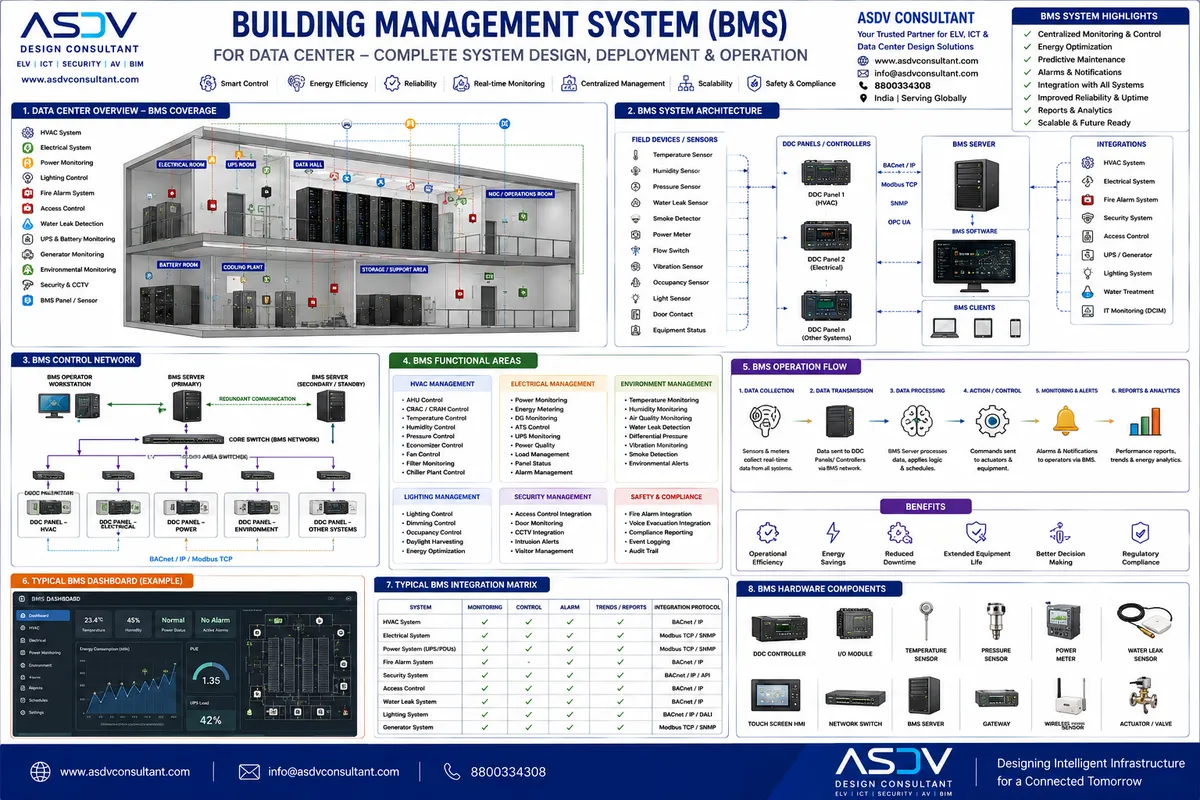
- Integration with BMS and IT service management: Modern DCIM platforms integrate with the building management system (extending environmental and power data beyond the data hall to whole-facility context) and IT service management tools, connecting infrastructure capacity data directly to IT deployment workflow and change management processes
- Digital twin foundation: AI-enhanced DCIM increasingly serves as the real-time data foundation underlying the facility's digital twin capability (covered elsewhere in this spotlight), providing the continuously updated operational data that makes digital twin simulation genuinely representative of current facility state rather than a static model
Autonomous DCIM-Driven Operational Response
AI-enhanced DCIM will progress from predictive detection and human-actioned recommendations toward autonomous operational response — automatically implementing cooling system adjustments, workload migration recommendations, or capacity reallocation in response to detected anomalies or forecasted constraints without requiring manual facilities team intervention for well-understood, bounded response scenarios, directly connecting to the broader autonomous AI-operated data center future outlook covered in this spotlight and representing the specific operational intelligence layer that makes that broader autonomy possible.