
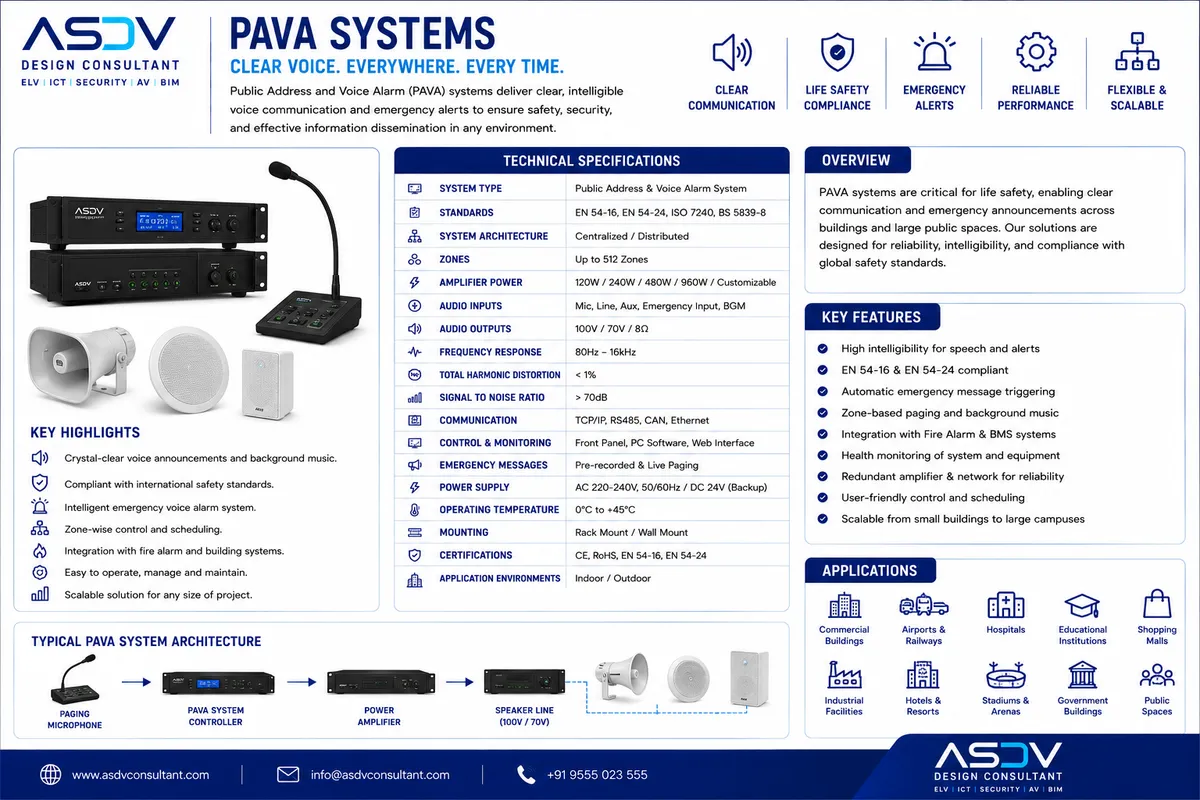
A voice evacuation announcement that cannot be understood is functionally no different from no announcement at all — and in a real fire, with crackling smoke alarms, crowd noise, and occupant panic, the margin for unintelligible audio is zero. EN 54-16 and EN 54-24 exist precisely because voice evacuation is a life-safety system, not a convenience PA system, and every component in the signal chain must be proven to perform under emergency conditions, not merely under laboratory quiet.
EN 54-16 certifies the voice alarm control and indicating equipment — the amplifiers, controllers, and central processing units — for functional reliability, fault monitoring, and correct operation during power loss or component failure scenarios. EN 54-24 certifies loudspeakers specifically for fire resistance, mechanical integrity, and consistent acoustic output even as cabling and mounting are exposed to heat and fire conditions during an actual event.
EN 54-16 vs. EN 54-24 Certification Scope
| Standard | Certifies | Key Requirements | Applies To |
|---|---|---|---|
| EN 54-16 | Voice Alarm Control & Indicating Equipment | Fault monitoring, power supply resilience, message priority handling | Amplifiers, controllers, VACIE panels |
| EN 54-24 | Loudspeakers for Voice Alarm | Fire resistance, mechanical robustness, consistent SPL/frequency response | Ceiling, wall, horn, and cabinet loudspeakers |
| EN 54-4 | Power Supply Equipment | Battery backup, charging monitoring, fault reporting | PAVA/fire alarm power supplies |
| BS 5839-8 | UK Voice Alarm System Design Code | Design, installation, commissioning practice | UK-market voice alarm system design |
Technical Design: EN 54-Compliant System Specification
- Speech Transmission Index (STI) modelling: Acoustic modelling software (EASE, CadnaA, or equivalent) predicts STI across every zone during design, targeting minimum STI ≥ 0.5 ("fair" intelligibility) with ≥ 0.6 preferred for critical zones like stairwells and assembly areas
- Fire-resistant cabling: Loudspeaker circuits use fire-resistant cable (typically rated for 120 minutes or per local code) to maintain circuit integrity long enough for a full building evacuation even as fire progresses through the building
- A/B loop redundancy: EN 54-16 systems typically implement A/B loop wiring redundancy so that a single cable fault does not silence an entire zone — the loudspeaker circuit continues operating on the surviving loop path
- Priority message hierarchy: Certified controllers enforce a strict message priority hierarchy — live microphone override takes precedence over pre-recorded evacuation messages, which take precedence over background music or paging, ensuring critical instructions are never delayed or blocked
- Fault monitoring & self-test: Continuous automated self-test of amplifiers, loudspeaker line continuity, and power supply status is a mandatory EN 54-16 requirement, with fault conditions reported to the fire control panel within specified response times
- Commissioning & STI verification: Post-installation acoustic verification measures actual STI at representative points throughout each zone, confirming the as-built system meets design intelligibility targets before life-safety sign-off
- Local code alignment: ASDV aligns EN 54 certified system designs with local fire code requirements — NFPA 72 ECS provisions in the US, UAE Civil Defence PAVA guidelines, and equivalent Indian fire safety codes — ensuring certification and local compliance are addressed together
AI-Assisted Real-Time Intelligibility Verification
The next generation of EN 54-compliant systems will incorporate AI-driven real-time STI monitoring — continuously measuring actual speech intelligibility at representative points throughout a building during live operation (not just at commissioning), and automatically flagging or compensating for degradation caused by furniture changes, occupancy density, or partial equipment faults. This moves intelligibility assurance from a point-in-time commissioning certificate to a continuously verified, always-current life-safety guarantee.