
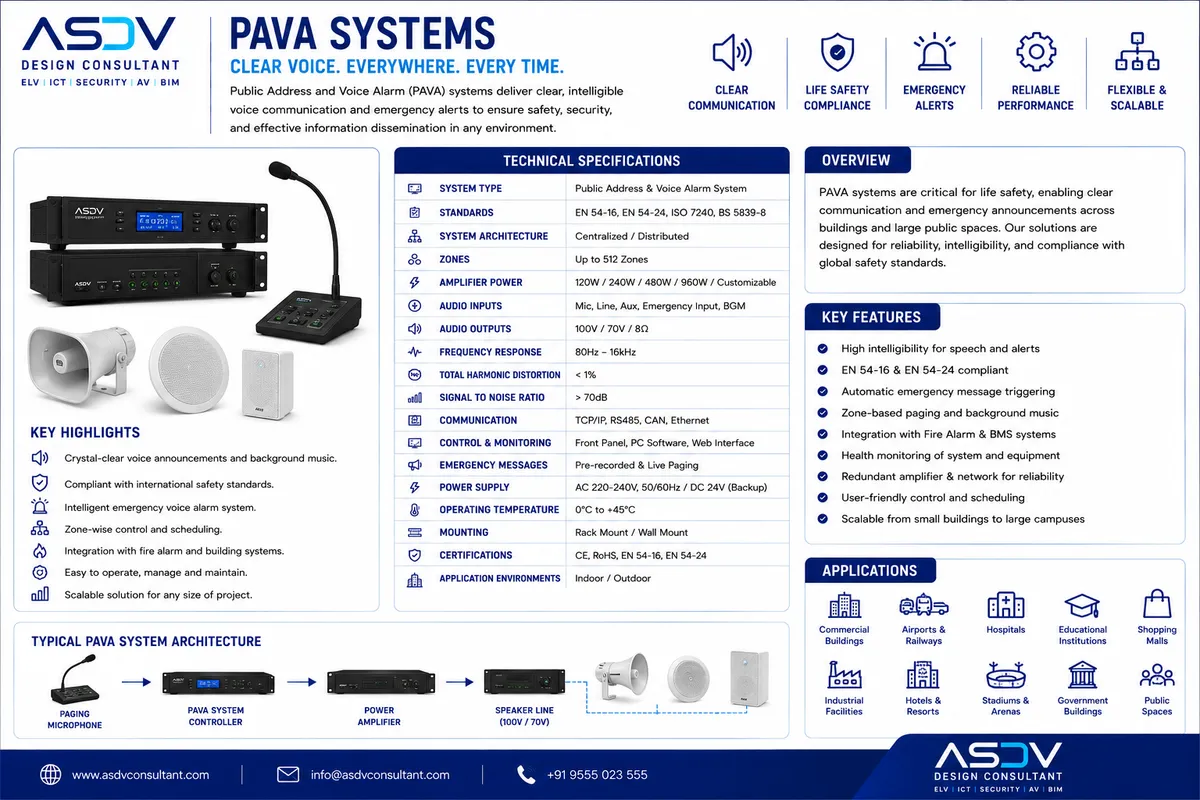
Evacuating an entire 40-story tower simultaneously for a fire confined to a single floor is not merely inefficient — it is actively dangerous, flooding stairwells with far more occupants than they can safely handle, delaying the evacuation of the floors genuinely at risk, and creating exactly the kind of panic-driven crowd crush that phased evacuation protocols are designed to prevent. Zoned intelligent paging makes phased evacuation technically achievable by giving the voice evacuation system granular, fire-alarm-sector-aligned control over exactly which zones receive which instructions, and when.
In a properly zoned system, an alarm on a specific floor triggers immediate evacuation instructions for that floor and the floors immediately above it (most at risk from smoke spread), while other floors receive a hold/standby message and are brought into the evacuation sequence progressively — following established fire engineering phased-evacuation protocols rather than an indiscriminate full-building alarm.
Zoned Paging Evacuation Strategy Comparison
| Strategy | Zones Alerted Initially | Stairwell Load | Best Fit |
|---|---|---|---|
| Simultaneous Full Evacuation | All zones at once | High congestion risk | Small buildings, low occupancy |
| Two-Stage Phased (Fire Floor + Floor Above) | Fire floor and floor immediately above | Moderate, controlled | Mid-rise commercial buildings |
| Sequential Phased (Rolling Evacuation) | Fire floor, then adjacent floors progressively | Low, well-distributed | High-rise towers |
| Defend-in-Place with Selective Zoning | Only directly affected zone/compartment | Minimal | Hospitals, care facilities |
Technical Design: Zoned Intelligent Paging Architecture
- Fire alarm sector mapping: PAVA zone boundaries are designed to precisely mirror fire detection zone boundaries, ensuring the voice evacuation system can respond to a detected alarm with instructions targeted to exactly the affected sector, no broader and no narrower
- Cause-and-effect matrix programming: A detailed cause-and-effect matrix defines, for every possible fire alarm zone activation, exactly which PAVA zones receive evacuation messages, which receive hold/standby messages, and the timing sequence for progressive expansion if the incident escalates
- Message escalation logic: Systems are programmed to automatically escalate from phased to full-building evacuation if the fire alarm system detects spread to additional zones, without requiring manual reconfiguration by the fire command center operator during the live incident
- Stairwell and refuge area zoning: Stairwells and refuge areas are typically treated as distinct PAVA zones from general floor areas, allowing specific instructions (e.g., "proceed calmly," "stairwell congested, use alternate exit") relevant to occupants already in the egress path
- Live override capability: Fire command center operators retain live microphone override capability at any zone or zone group, allowing real-time human judgment to supplement or override the automated phased evacuation sequence as the actual incident develops
- Evacuation modelling validation: Zoning and phasing strategy is validated against fire engineering evacuation modelling (crowd simulation software) during design, confirming the planned zone sequencing achieves target evacuation times without exceeding stairwell capacity thresholds
Real-Time Adaptive Zone Sequencing
Zoned intelligent paging will evolve from pre-programmed cause-and-effect sequencing to real-time adaptive zone control — dynamically adjusting which zones are instructed to evacuate and in what order based on live occupancy sensor data, smoke spread modelling, and stairwell congestion feedback, rather than following a fixed pre-incident sequence regardless of how the actual emergency unfolds. This capability connects directly to the smart crowd-guidance systems covered in ASDV's future outlook on AI-driven evacuation, of which zoned paging is the foundational control layer.