
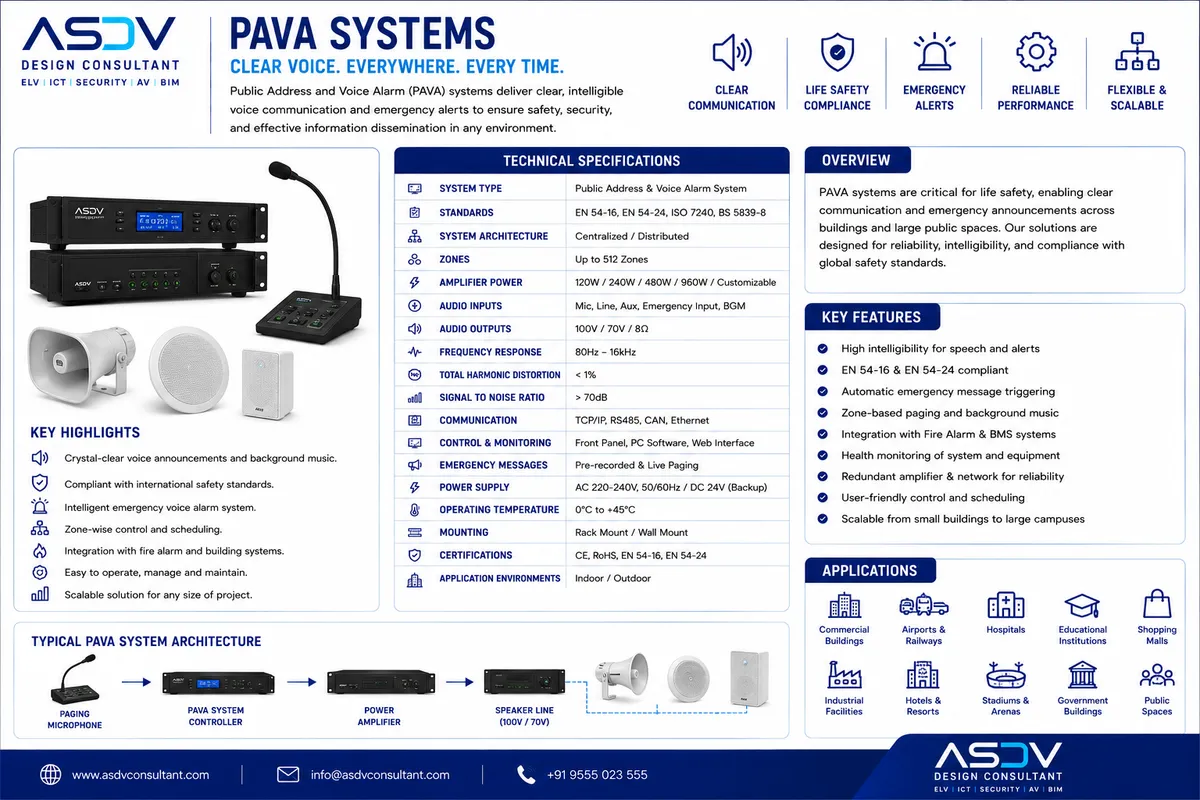
During a real building emergency, several distinct communication systems typically operate in parallel: the voice evacuation system broadcasting instructions to occupants, a firefighter telephone network allowing fire crews to communicate between the fire command center and points throughout the building, emergency call stations letting occupants report incidents or request assistance, and video intercoms verifying identity and situation at specific points. When these systems are separately managed and separately displayed, the fire command center operator's cognitive load during a crisis multiplies.
Integrated emergency communication design converges these previously siloed systems into a single operational interface — so that a fire command center operator managing an active incident sees voice evacuation zone status, firefighter phone call activity, emergency call station alerts, and video intercom feeds together, correlated by location and incident timeline, rather than switching between separate unconnected panels.
Integrated Emergency Communication System Components
| System | Function | Integration Point | Standard/Code Reference |
|---|---|---|---|
| PAVA Voice Evacuation | Zone-based occupant instruction broadcast | Unified fire command interface | EN 54-16 / EN 54-24 |
| Firefighter Telephone | Two-way fire crew communication points | Shared incident timeline/log | BS 5839-9, NFPA 72 |
| Emergency Call/Help Stations | Occupant-initiated assistance requests | Location-tagged alert routing | Local fire code, DDA/accessibility codes |
| Video Intercom | Visual verification at entry/refuge points | Correlated video feed on incident record | IP video standards, ONVIF |
Technical Design: Integrated Emergency Communication Architecture
- Unified fire command center interface: A single software platform aggregates PAVA zone status, firefighter phone call logs, emergency call station alerts, and video intercom feeds into one operator interface, reducing the risk of missed information during high-stress incident response
- Location-correlated incident timeline: Every event across all integrated systems — a zone alarm, a firefighter phone call, an emergency call station activation — is logged against a shared incident timeline and building location model, supporting both real-time response and post-incident review
- Firefighter telephone network design: Dedicated firefighter phone jacks or handsets at required locations (stairwells, refuge areas, plant rooms) per local code (BS 5839-9, NFPA 72 fire department communication requirements) are integrated with the same network backbone as the PAVA system where architecture permits
- Emergency call station routing: Occupant-activated call stations (used for assistance requests, refuge area check-ins, or accessible egress support) are configured to route alerts directly to the fire command center with location identification, supporting coordinated response prioritization
- Video intercom verification: Integration with video intercom at designated refuge areas or entry points allows fire command center operators to visually verify occupant status or environmental conditions before dispatching response resources to a specific location
- Interoperability standards: ASDV specifies open, standards-based integration protocols (BACnet, ONVIF, SIP for voice) wherever possible to avoid vendor lock-in and support future system expansion or component replacement without a full platform re-architecture
AI-Correlated Multi-System Incident Intelligence
Integrated emergency communication platforms will incorporate AI-driven incident intelligence — automatically correlating signals across PAVA, firefighter phone activity, emergency call stations, video intercom, and building sensor data to construct a real-time, continuously updated situational picture for fire command center operators, flagging anomalies (an unusual concentration of emergency calls in one area, a zone with unexpectedly high foot traffic) that a human operator monitoring separate panels might miss during a fast-developing incident.