
A large multi-purpose stadium — combining a football/athletics field, tiered seating, concourses, hospitality suites and back-of-house areas — needs a public address and background music (PA/BGM) system that does three jobs at once: deliver clear match-day announcements and BGM, guarantee EN 54-16/EN 54-24 compliant emergency voice evacuation, and do both uniformly across radically different acoustic environments in the same venue. This case study walks through the zoning strategy, speaker selection and system architecture behind that kind of design.
Zone-by-Zone Design
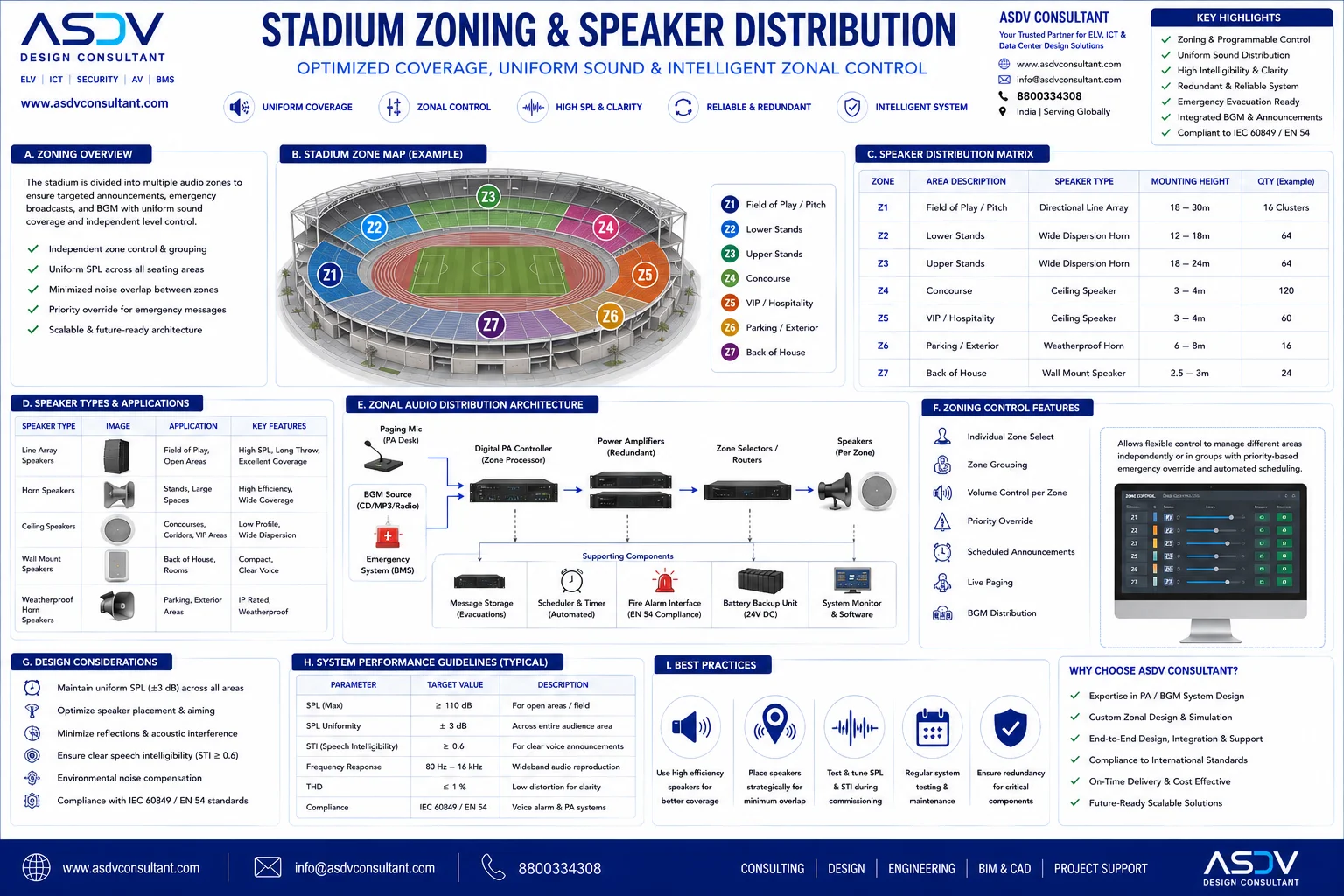
The stadium is divided into seven independently controlled audio zones, each with its own speaker type, mounting height and SPL (sound pressure level) target — because a field-of-play announcement and a concourse BGM feed have completely different coverage and intelligibility requirements.
| Zone | Area | Speaker Type | Mounting Height | Qty (Example) | SPL Target |
|---|---|---|---|---|---|
| Z1 | Field of Play | Line Array | 18–30 m | 16 clusters | 110 dB |
| Z2 | Lower Stands | Wide Dispersion Horn | 12–18 m | 64 | 104 dB |
| Z3 | Upper Stands | Wide Dispersion Horn | 18–24 m | 64 | 102 dB |
| Z4 | Concourse | Ceiling Speaker | 3–4 m | 120 | 95 dB |
| Z5 | VIP / Hospitality | Ceiling Speaker | 3–4 m | 60 | 95 dB |
| Z6 | Parking / Exterior | Weatherproof Horn | 6–8 m | 16 | 105 dB |
| Z7 | Back of House | Wall Mount Speaker | 2.5–3 m | 24 | 95 dB |
System Architecture
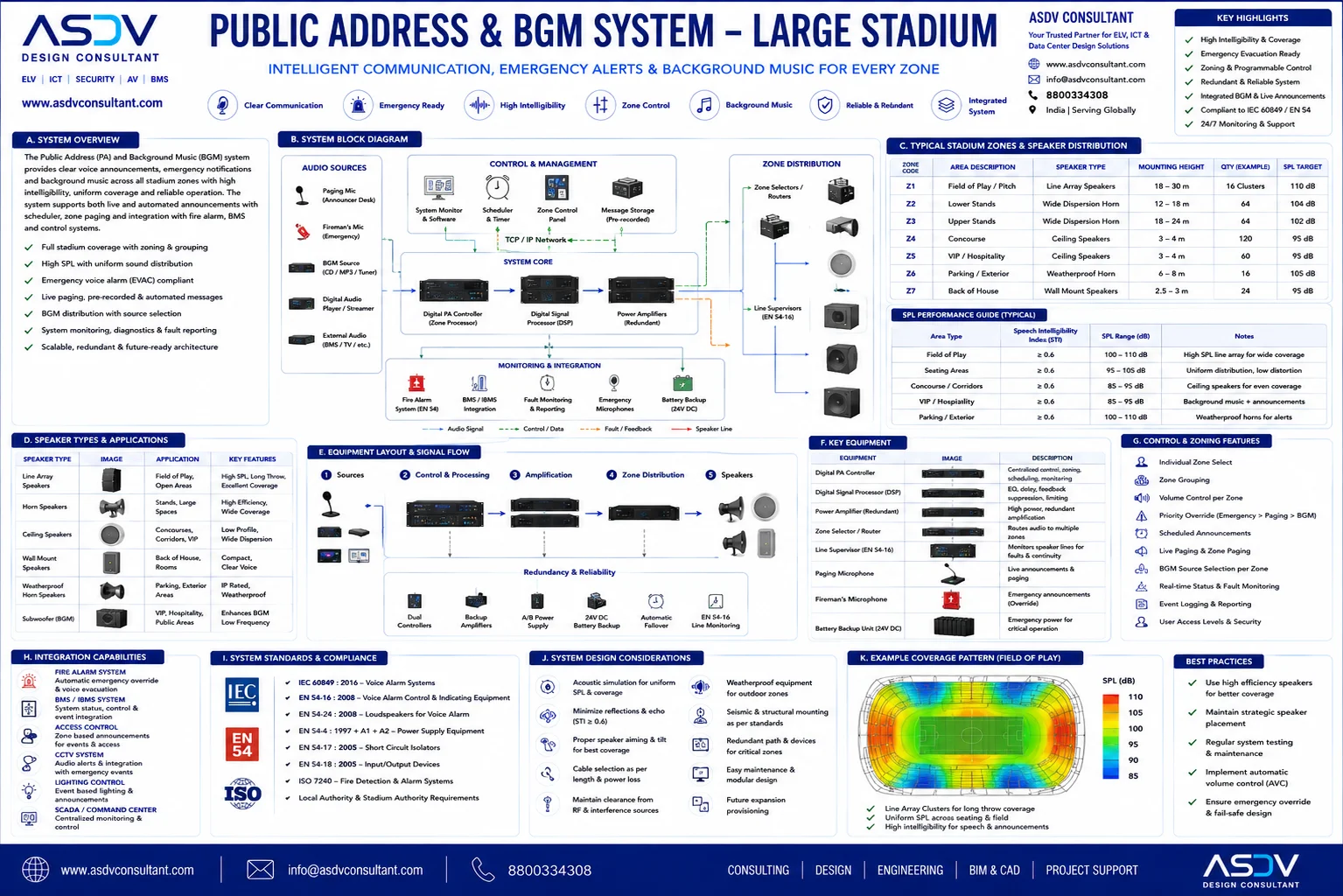
Audio sources (paging microphone, fireman's microphone, BGM source, digital audio player, and external feeds from BMS/TV) feed a Digital PA Controller acting as the zone processor, followed by a Digital Signal Processor (DSP) and redundant power amplifiers. From there, zone selectors/routers distribute audio to each of the seven zones independently, with line supervisors monitoring for faults per EN 54-16.
- Redundancy throughout: dual controllers, backup amplifiers, A/B power supply with automatic failover, and 24V DC battery backup for emergency operation.
- Fire alarm integration: the fire alarm system (EN 54 compliant) can override all zones for emergency voice evacuation, taking priority over paging and BGM.
- BMS/IBMS integration: system status, faults and diagnostics report into the building management system for centralized monitoring.
- Zoning & control: individual zone select, zone grouping, per-zone volume control, priority override (emergency > paging > BGM), and scheduled announcements.
Speaker Selection by Application
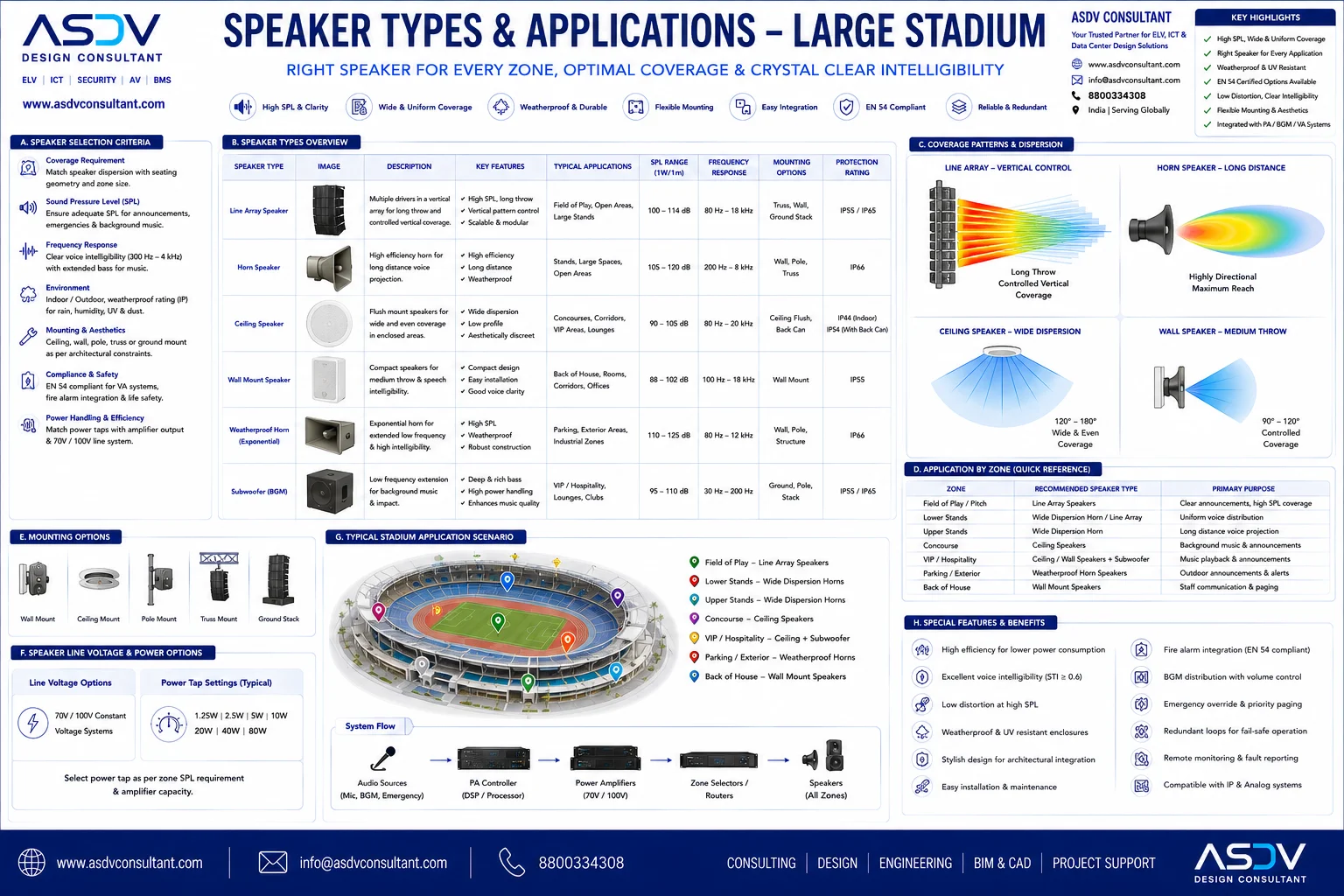
| Speaker Type | Application | Key Features |
|---|---|---|
| Line Array | Field of Play, open areas | High SPL, long throw, excellent coverage |
| Horn | Stands, large spaces | High efficiency, wide coverage |
| Ceiling | Concourses, corridors, VIP areas | Low profile, wide dispersion |
| Wall Mount | Back of house, plant rooms | Compact, clear voice |
| Weatherproof Horn | Parking, exterior areas | IP rated, weatherproof |
Performance Targets & Standards
| Parameter | Target |
|---|---|
| SPL (Max) | ≥ 110 dB (field of play) |
| SPL Uniformity | ± 3 dB across the audience area |
| Speech Intelligibility (STI) | ≥ 0.6, every zone |
| Frequency Response | 80 Hz – 16 kHz |
| THD | ≤ 1% |
| Compliance | IEC 60849 / EN 54-16 & EN 54-24 |
Standards referenced throughout the design: IEC 60849:2016 (sound systems for emergency purposes), EN 54-16 (voice alarm control and indicating equipment), EN 54-24 (loudspeakers for voice alarm systems), EN 54-4 (power supply equipment), EN 54-17 (short-circuit isolators) and EN 54-18 (input/output devices) — alongside ISO 7240 (fire detection and alarm systems) and local authority/stadium-authority requirements.
Installation & Commissioning Flow
Planning & zoning → speaker placement → cable routing & termination → equipment installation → system configuration → testing & commissioning → handover & training. Design considerations at each stage include acoustic simulation for uniform SPL and coverage, minimizing reflections and echo, weatherproofing for outdoor zones, seismic/structural mounting for critical zones, and redundant paths for critical-zone cabling.