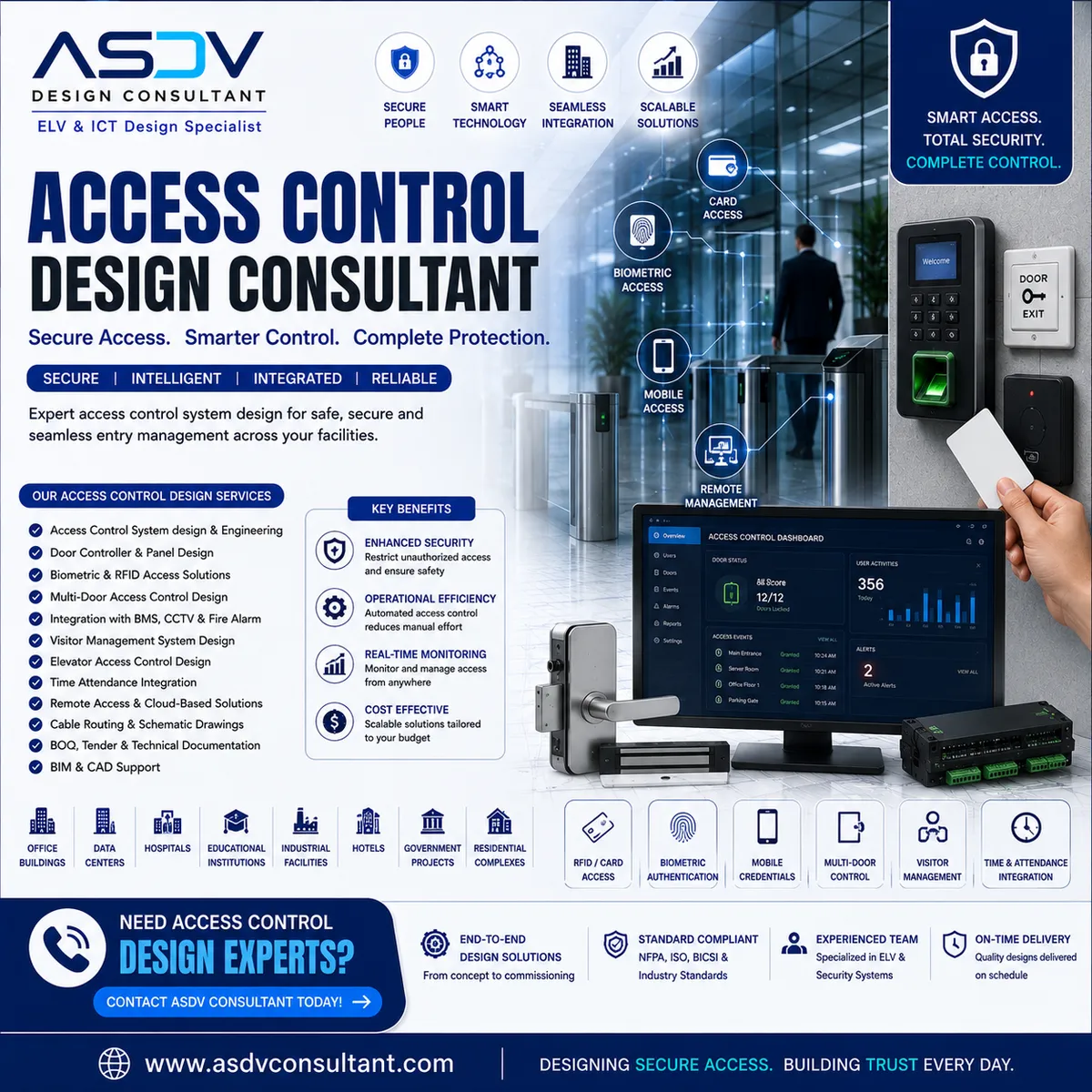
Access Control Design for Qatar Commercial Towers and Mixed-Use Developments | ASDV Consultant
How ASDV designs access control systems for Qatar's commercial towers, balancing MOI security expectations with multi-tenant operational complexity.
Every networked ELV system — CCTV, access control, BMS, data centre infrastructure — is now a cybersecurity surface. This tag collects articles on zero-trust architecture, cybersecure CCTV design (NDAA Section 889, OWASP alignment), and the network-security considerations that belong in every modern system design, not bolted on afterward.

How ASDV designs access control systems for Qatar's commercial towers, balancing MOI security expectations with multi-tenant operational complexity.

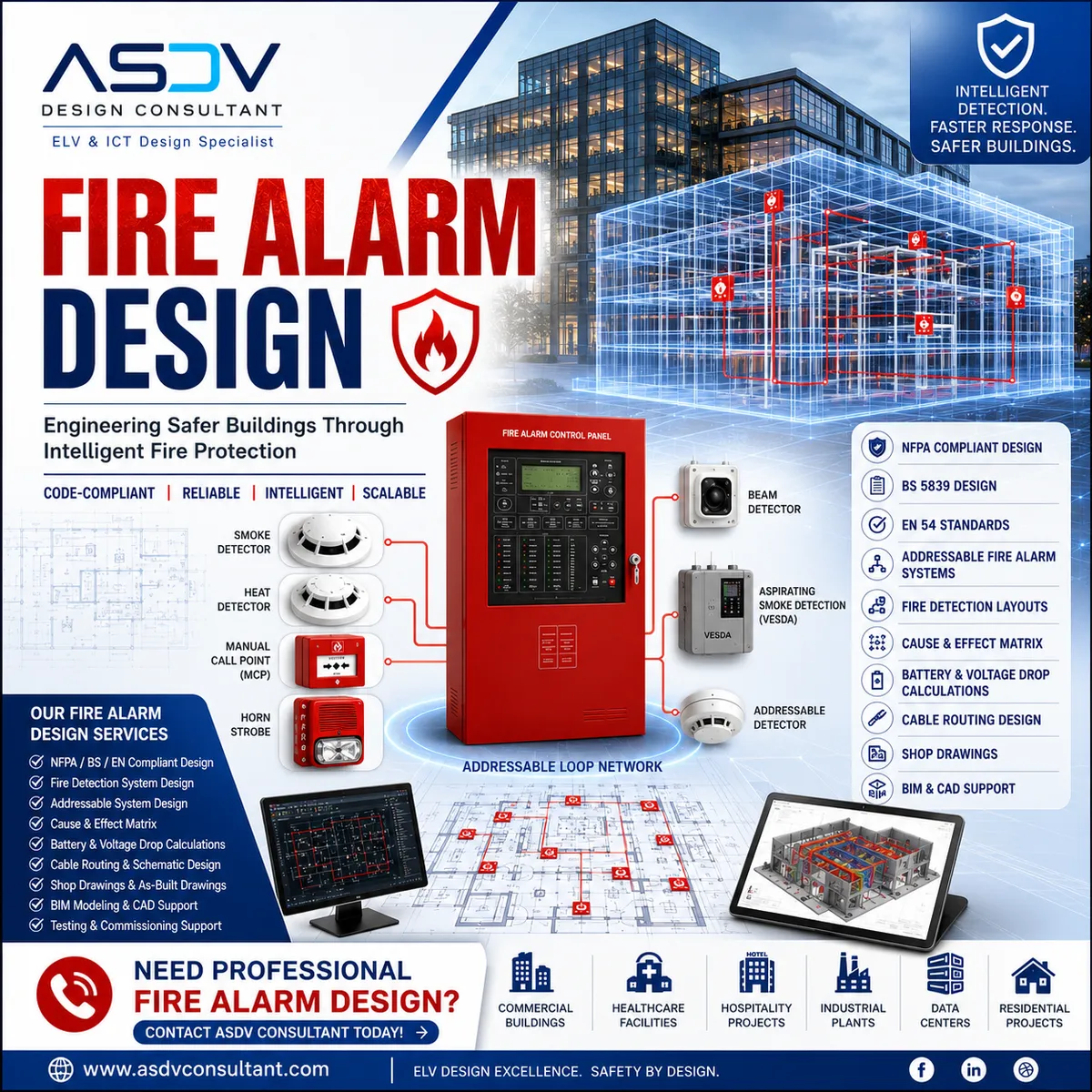
An integrated view of security system design for Bahrain's banking sector, bringing together CCTV, access control, and fire-linked alarm systems.

Designing fire, security, and ELV systems for Quebec requires bilingual documentation discipline and familiarity with the Code de construction du Québec.

A guide to Qatar's Ministry of Interior CCTV approval process, technical specification requirements, and the design decisions that keep a system compliant.

How ASDV designs CCTV and security systems for Oman's commercial sector, covering ROP guidance and Oman's Personal Data Protection Law.

Access control hardware in the US must satisfy the ADA's operable-force, reach-range, and clearance rules alongside security requirements.

Critical infrastructure security design in the US increasingly involves CISA guidance and federal supply-chain rules like NDAA Section 889.

There is no single US license for fire alarm or security system installers — requirements vary by state, and often by county and city.

In the US,

Self-managing networks will configure, optimise, and heal themselves without human intervention — detecting security threats, rerouting around hardware failures, and adapting to new device types.

Campus-wide private 5G delivers sub-millisecond latency, guaranteed QoS, and SIM-based security to industrial robots, autonomous vehicles, and mission-critical IoT without competing with public cellular.

Virtualizing compute, storage, networking, and security into software layers on commodity hardware enables data centers to be provisioned in hours, scaled in minutes, and migrated seamlessly.

Every aspect of wireless infrastructure — spectrum allocation, QoS policies, security rules, and physical topology — will be defined entirely in software and deployable in minutes.

Microsegmentation, identity-based access for every workload, encrypted east-west traffic, and continuous behavioral monitoring treat every internal request as untrusted, making lateral movement impossible.

AI assigns dynamic risk scores to every physical access request — granting conditional access with reduced privileges when behavioural patterns suggest elevated risk, replacing binary allow/deny with intelligent continuous physical security posture management aligned to RBI and SEBI frameworks.

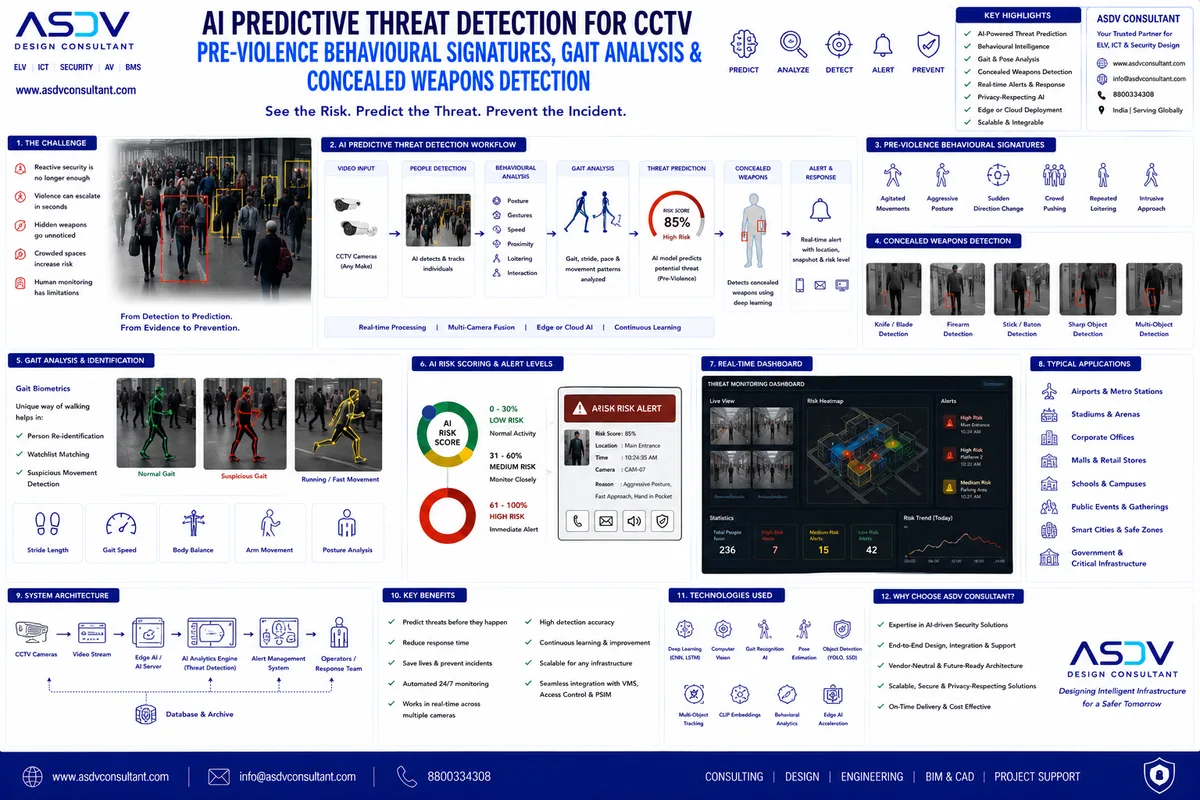
AI predictive threat detection in CCTV identifies pre-violence behavioural signatures, concealed weapons from gait analysis, and aggression precursors from posture and movement — alerting security teams before an incident occurs rather than recording it for post-event review.

Computer vision AI detects multiple individuals passing on a single credential event at controlled entry points in real time — reducing unauthorised entry by 94% versus anti-passback alone, with instant barrier lock and Genetec/Lenel REST API integration and sub-500ms detection latency.

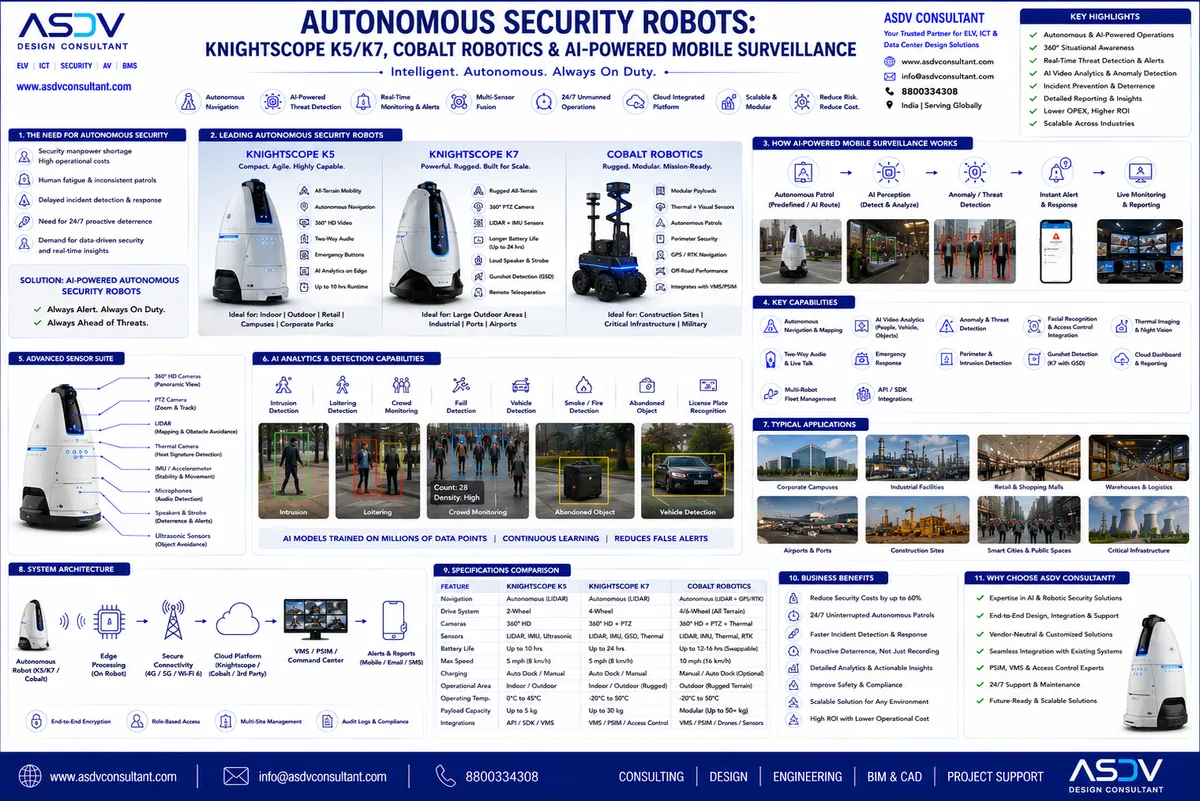
Autonomous security robots like Knightscope K5/K7 and Cobalt Robotics patrol facilities 24/7 on programmed routes — with 360° HD cameras, thermal sensors, ANPR, two-way audio, and AI anomaly detection, generating incident reports in under 90 seconds and integrating with existing VMS platforms.

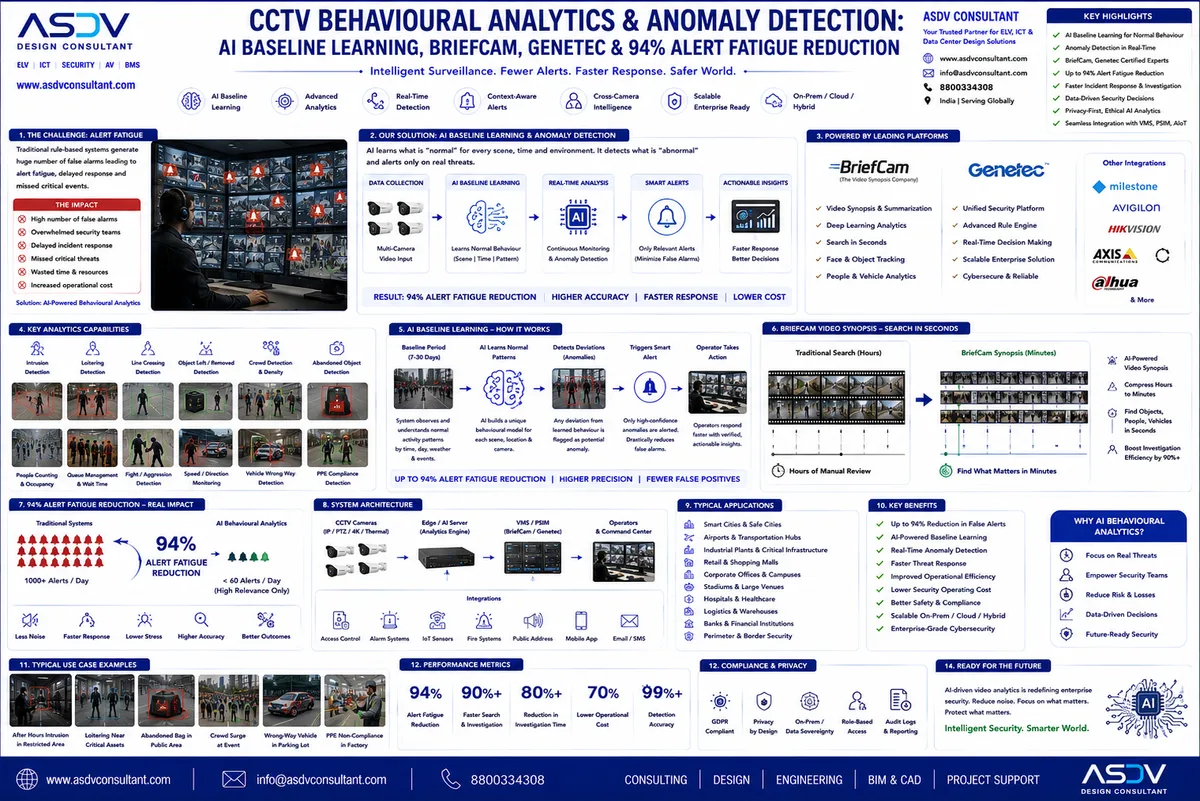
CCTV behavioural analytics platforms like BriefCam and Genetec Security Center learn normal activity patterns over 7–14 days, then detect deviations in real time — reducing security alert fatigue by 94% while detecting genuine threats faster than operator-monitored systems.

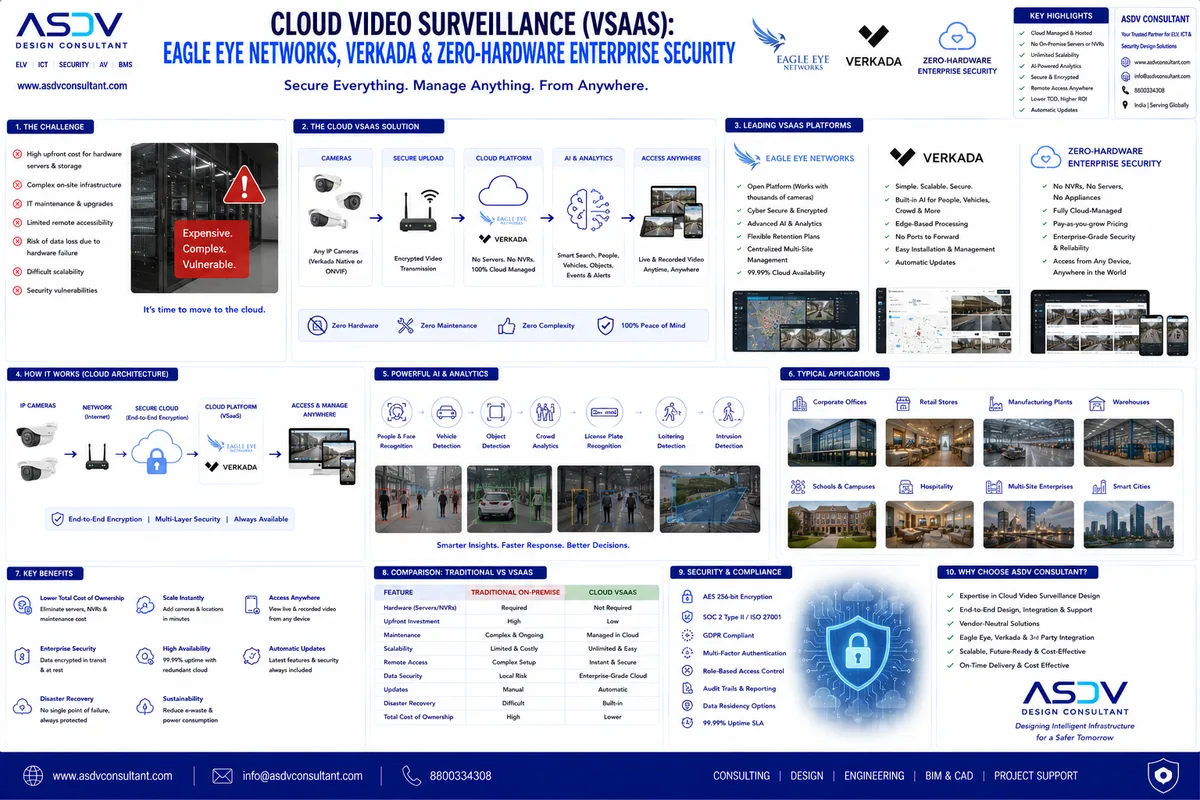
Cloud VSaaS platforms like Eagle Eye Networks and Verkada eliminate on-site NVR hardware entirely — storing encrypted footage in the cloud with zero-trust access from any device, reducing 5-year infrastructure costs by 40-60%.

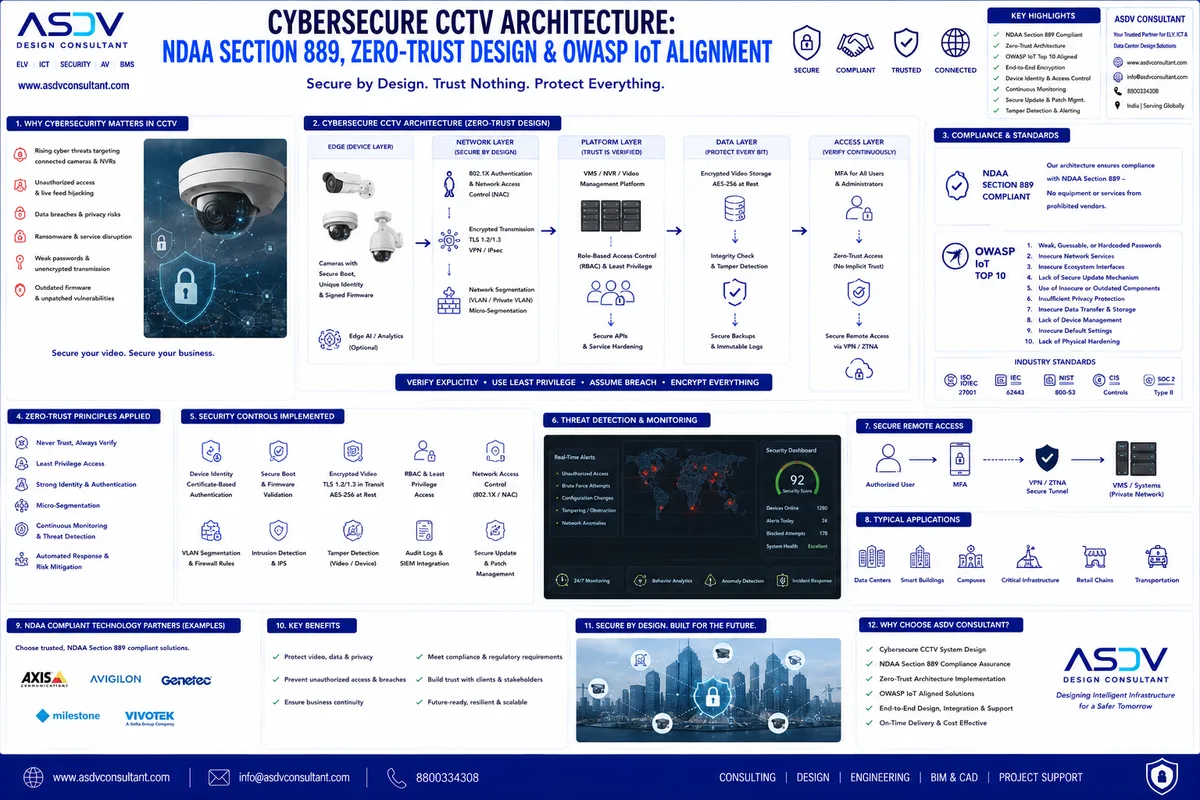
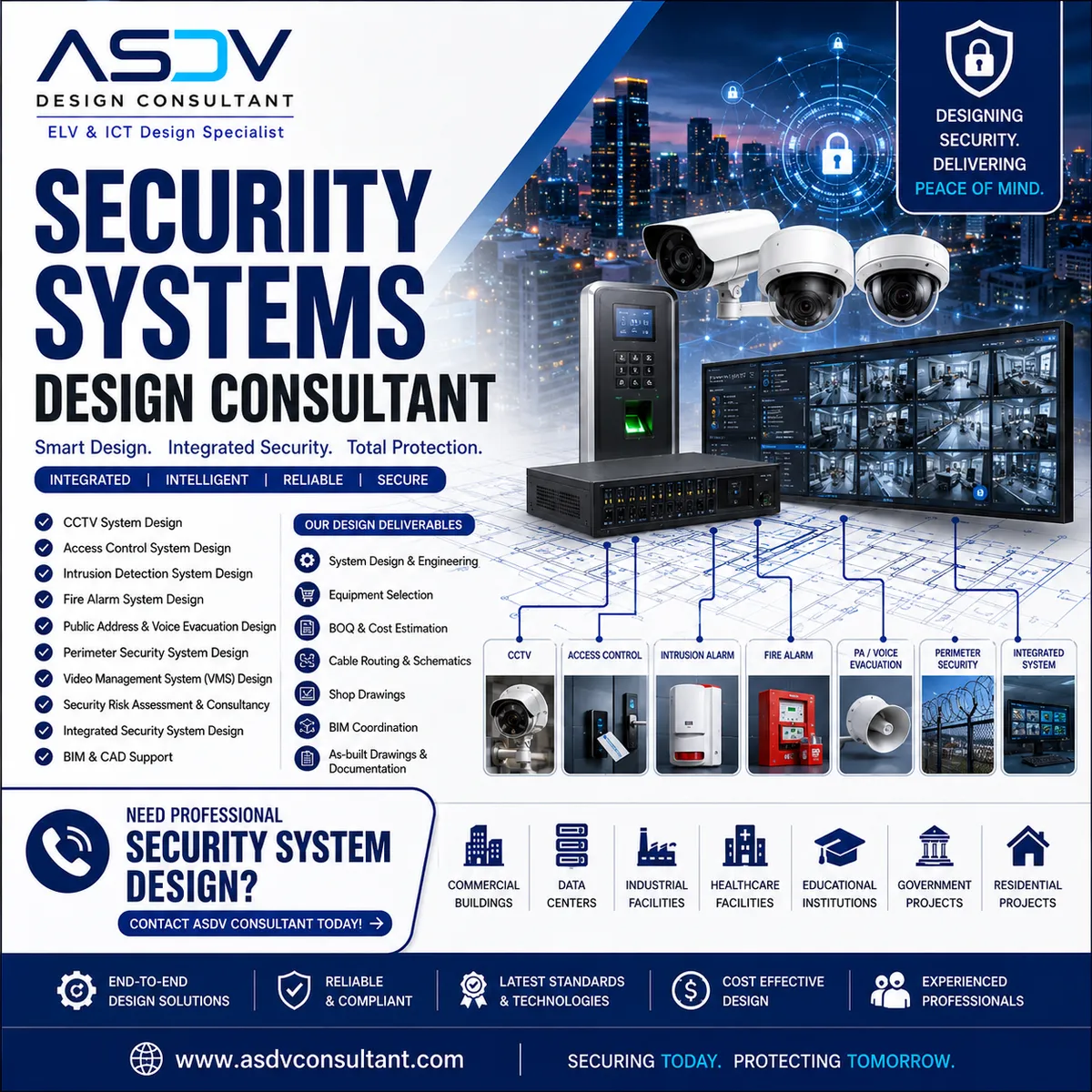
Cybersecure CCTV design requires NDAA Section 889 compliant hardware, VLAN segmentation, TLS 1.3 encrypted streams, role-based VMS access, and OWASP IoT security alignment — protecting surveillance infrastructure from network intrusion and credential attacks.

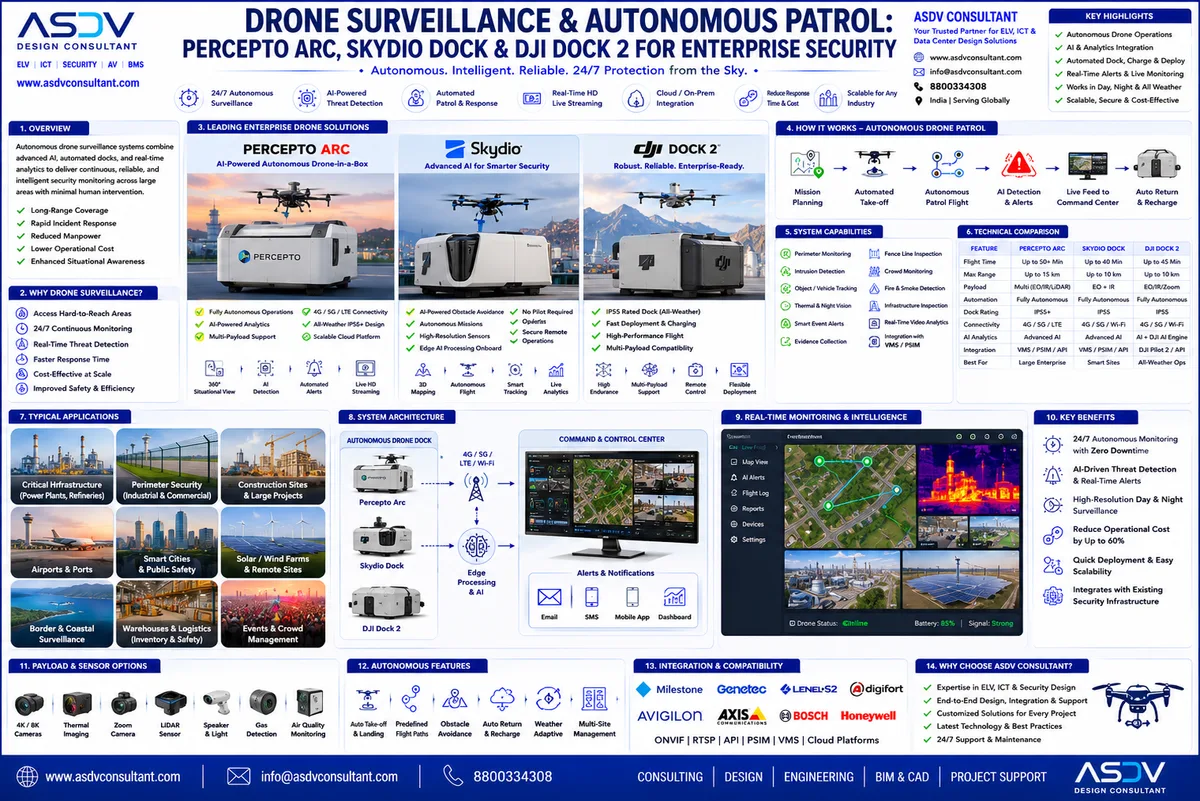
Autonomous drone surveillance systems like Percepto Arc, Skydio Dock, and DJI Dock 2 enable continuous perimeter patrols across 50+ hectares without security personnel — launching on scheduled or event-triggered missions, streaming live 4K video to VMS, and returning to dock to recharge automatically.

Long-range iris recognition from up to 60cm enables completely hands-free non-contact identity verification at sub-500ms — securing international border controls, Tier IV data centres, and nuclear facilities with FAR below 0.00001% and STQC-certified Aadhaar API integration.

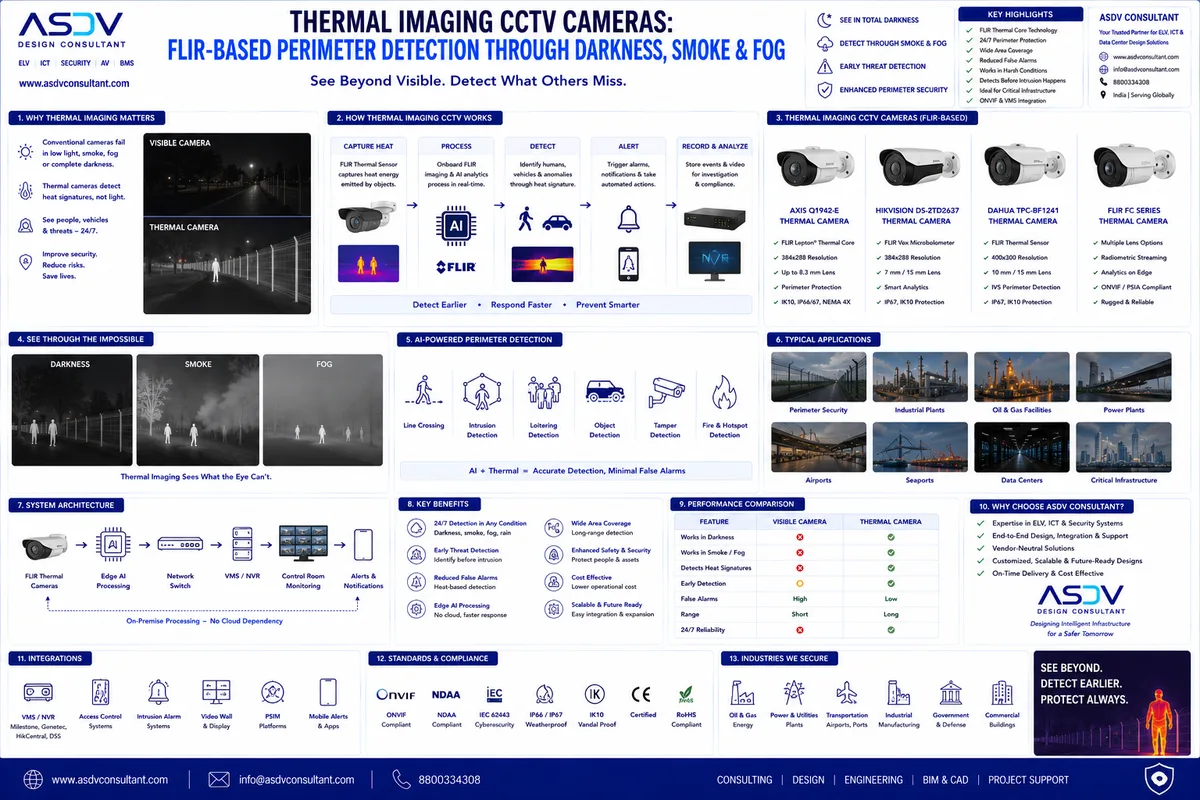
FLIR-based thermal CCTV cameras detect human presence through complete darkness, smoke, and dense vegetation at 400+ metres — the definitive technology for critical infrastructure and high-security perimeters.

Zero-trust applied to physical access — continuous authentication, least-privilege zone access, and microsegmentation of physical areas — reduces insider-threat incidents by 76%, with NIST SP 800-207 alignment and SIEM integration for RBI and SEBI cybersecurity framework compliance.
Talk to ASDV Consultant about your project across India, UAE, KSA, Qatar, UK and USA.
Get a Design