
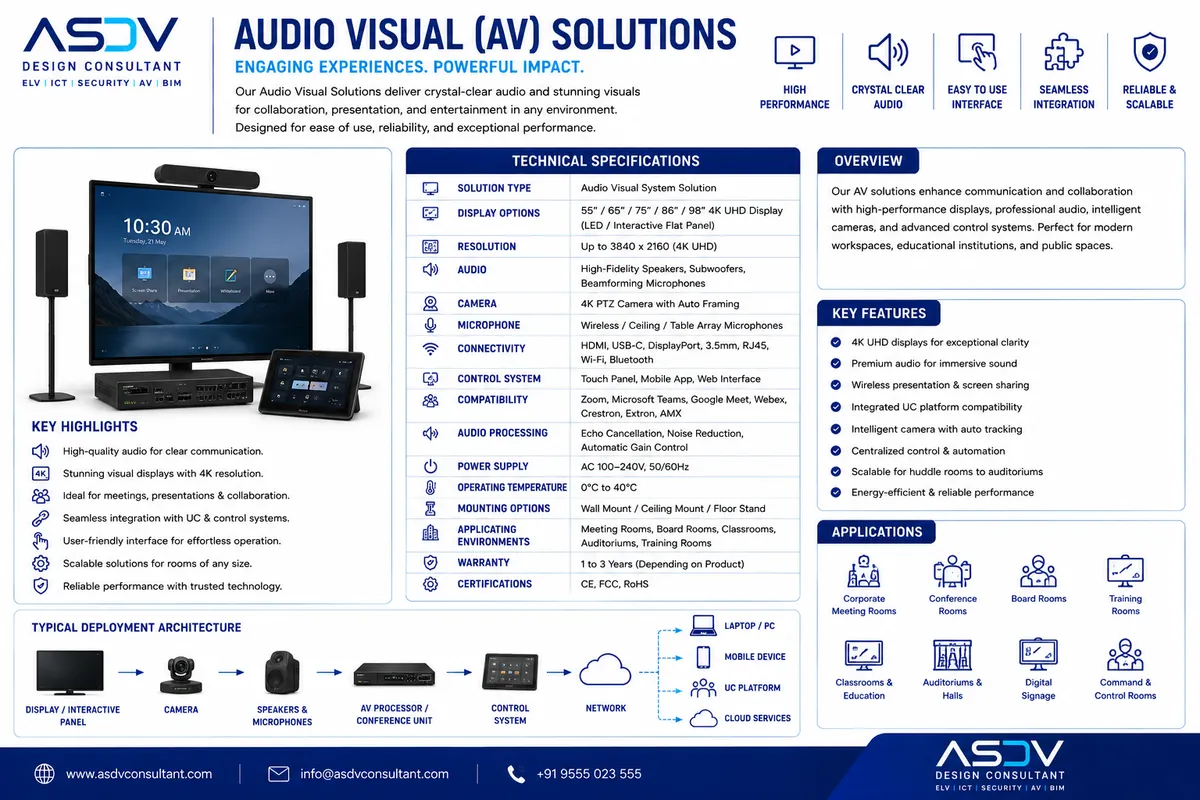
Poor meeting room audio is the single most common complaint in hybrid workplace surveys — not video quality, not screen sharing reliability, but the simple, persistent frustration of remote participants unable to clearly hear an in-room colleague who has turned away from a tabletop microphone, or whose voice is lost under HVAC noise and room reverberation. Beamforming ceiling microphone arrays solve the root cause: they eliminate the need for a speaker to be near any specific microphone at all.
Rather than relying on omnidirectional pickup or a fixed number of physical microphone capsules, beamforming arrays use dense microphone element grids and real-time digital signal processing to synthesize dozens or hundreds of steerable pickup "lobes" that continuously track and follow active talkers anywhere in the room's coverage zone, while simultaneously rejecting noise and reverberation from all other directions.
Beamforming Microphone Array Platform Comparison
| Platform | Mic Elements / Lobes | Coverage Area | DSP Processing | Integration |
|---|---|---|---|---|
| Shure MXA920 | Automatic steerable lobes (IntelliMix) | Up to ~30 sq.m per unit | Onboard IntelliMix DSP + AEC | Dante, works with any Dante-enabled DSP |
| Biamp Tesira TCM-X | Dense array, software-configured lobes | Up to ~25 sq.m per unit | Tesira DSP ecosystem | AVB/Dante, deep Tesira DSP integration |
| Sennheiser TeamConnect Ceiling 2 | 28-element beamforming array | Up to ~25 sq.m per unit | Onboard DSP + automatic mixing | Dante, AES67, third-party DSP |
| Q-SYS Ceiling Mic Array | Multi-element steerable array | Room-size dependent | Native Q-SYS Core DSP | Native Q-SYS ecosystem integration |
Technical Design: Beamforming Microphone Array Acoustic Integration
- Lobe steering & auto-mixing: DSP continuously analyzes signal energy across the microphone element grid, forming and steering pickup lobes toward active talkers within milliseconds while automatically muting or attenuating inactive zones to reduce ambient noise pickup
- Acoustic echo cancellation (AEC): Onboard AEC processing removes the room's own loudspeaker output from the microphone signal path in real time, preventing feedback and allowing full-duplex natural conversation without half-duplex "walkie-talkie" cutoffs
- Room acoustic treatment coordination: Beamforming performance is directly affected by room reverberation time (RT60); ASDV coordinates acoustic treatment (ceiling tiles, wall panels, carpet) with microphone array placement to achieve target RT60 below 0.6s for optimal speech intelligibility
- Ceiling coverage planning: Array coverage radius (typically 25–30 sq.m per unit) is mapped against room dimensions and furniture layout during design, with overlapping coverage specified for larger or irregularly shaped rooms to avoid dead zones
- Network audio transport: Dante and AES67 network audio protocols carry microphone signal to DSP processors and amplifiers over standard Ethernet, integrating with the room's broader AV-over-IP infrastructure
- Automatic gain & noise reduction: Integrated automatic gain control and AI-based noise reduction (HVAC hum, keyboard typing, paper shuffling) further improve intelligibility without manual gain riding by an operator
Spatial Audio Capture for Immersive Remote Presence
Beamforming arrays will evolve from mono/stereo speech capture into full spatial audio capture — preserving the precise directional origin of each speaker's voice and reproducing it through spatial audio playback on the remote participant's headphones or speaker array, so a remote listener perceives that the person speaking on their left in the video gallery is genuinely speaking from their left acoustically. This spatial audio layer, combined with AI-driven voice isolation, will make a remote participant's aural experience of a meeting nearly indistinguishable from being physically present in the room.