
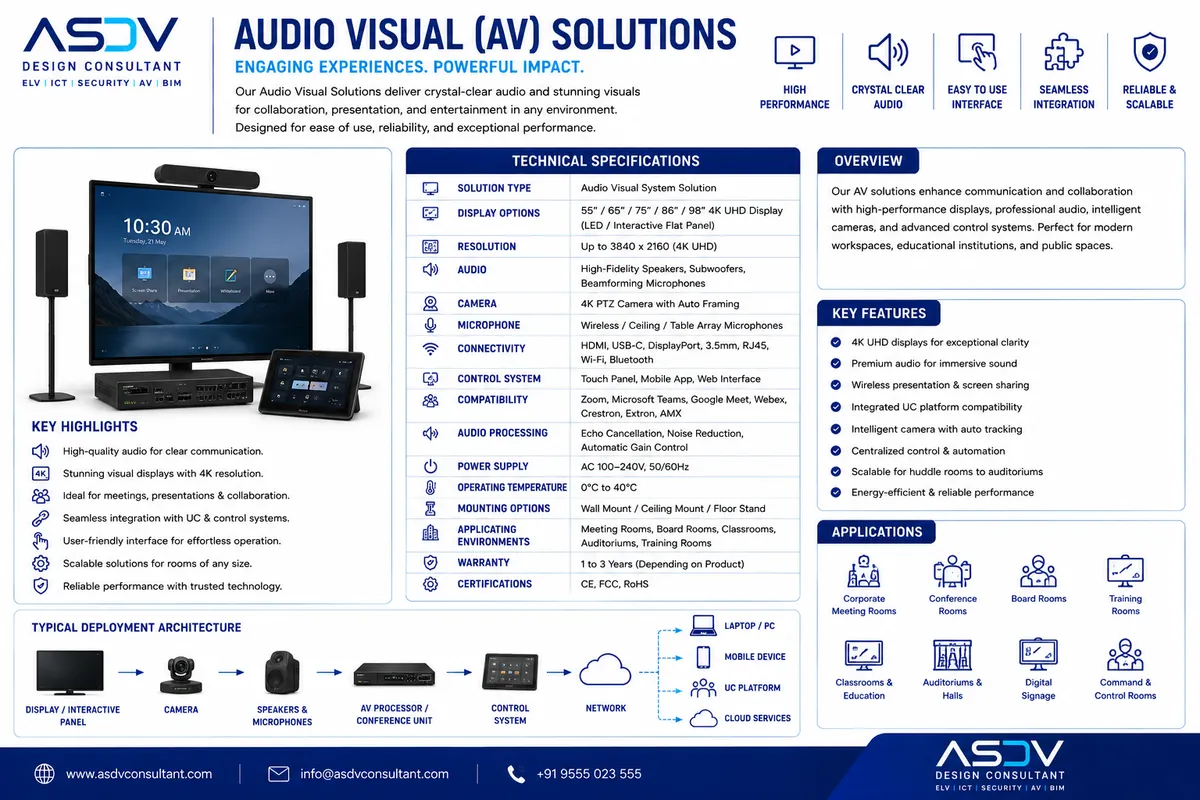
In most hybrid meetings today, there is an unspoken hierarchy: people in the room can read body language, jump into conversation naturally, and see the whiteboard clearly, while remote participants squint at a distant wide shot, struggle to find a gap to speak, and often miss side conversations entirely. This isn't a technology failure so much as a design failure — rooms were built around the assumption that video conferencing is an afterthought bolted onto an in-person meeting, rather than a first-class participation channel.
Equity-of-experience design inverts that assumption. Every technology decision — camera placement and framing behavior, microphone coverage, display sizing, even furniture layout and meeting facilitation protocol — is made with the explicit goal that a remote participant's experience of visual presence, audio clarity, and ability to contribute should be indistinguishable from an in-room participant's.
Equity-of-Experience Design Principles
| Design Element | Equity Problem Solved | Technology Approach |
|---|---|---|
| Camera Framing | Remote sees distant wide shot, can't read faces | AI auto-tracking with individual speaker close-ups |
| Audio Capture | Remote can't hear soft-spoken or off-axis speakers | Full-room beamforming array, not single tabletop mic |
| 1:1 Screen Ratio | Remote appears as small tile among many in-room faces | Every in-room participant has own device/display presence |
| Whiteboard/Content Access | Remote can't read physical whiteboard | Digital interactive display replacing physical whiteboard |
| Meeting Facilitation | Remote struggles to find a gap to speak | Explicit remote-first speaking protocols, chat monitoring |
Technical Design: Hybrid Workspace Equity-of-Experience Architecture
- Individual speaker framing: AI auto-tracking cameras configured to produce individual close-up shots of each active speaker rather than a static wide room shot, giving remote participants the same facial-expression-reading ability as someone seated across the table
- Full-coverage spatial audio capture: Beamforming ceiling microphone arrays covering the entire room (not just the table center) ensure quieter or off-axis speakers are captured at equal clarity to those seated near a traditional tabletop microphone
- "One person, one tile" philosophy: Where feasible, meeting protocol and room design encourage in-room participants to also join the video call individually on personal devices, ensuring the video gallery view treats every participant — in-room or remote — as an equal-sized tile rather than remote attendees appearing subordinate to a single room camera feed
- Digital-first content sharing: Physical whiteboards are replaced or supplemented with interactive digital displays whose content is simultaneously visible and editable by remote participants, eliminating the "can't read the whiteboard" remote disadvantage
- Acoustic & lighting parity: Room acoustic treatment and lighting design are specified to ensure consistent camera and microphone performance, since a poorly lit or acoustically harsh room degrades the remote experience disproportionately more than the in-room experience
- Facilitation protocol design: ASDV works with clients on meeting facilitation guidelines (explicit remote-first speaking turns, active chat monitoring, camera-on culture) that complement the technology investment — equity-of-experience is a combination of hardware design and organizational practice
Presence Parity Through Spatial Computing
Hybrid equity-of-experience will reach its logical endpoint with spatial computing and holographic conferencing — rather than approximating in-room presence through better cameras and microphones, remote participants will be rendered as spatially accurate holographic or avatar presences within the physical room, visible from multiple angles, with eye contact and body language cues restored. At that point, the distinction between "in-room" and "remote" participant stops being a meaningful design category altogether — every participant occupies the same collaborative space, regardless of physical location.