
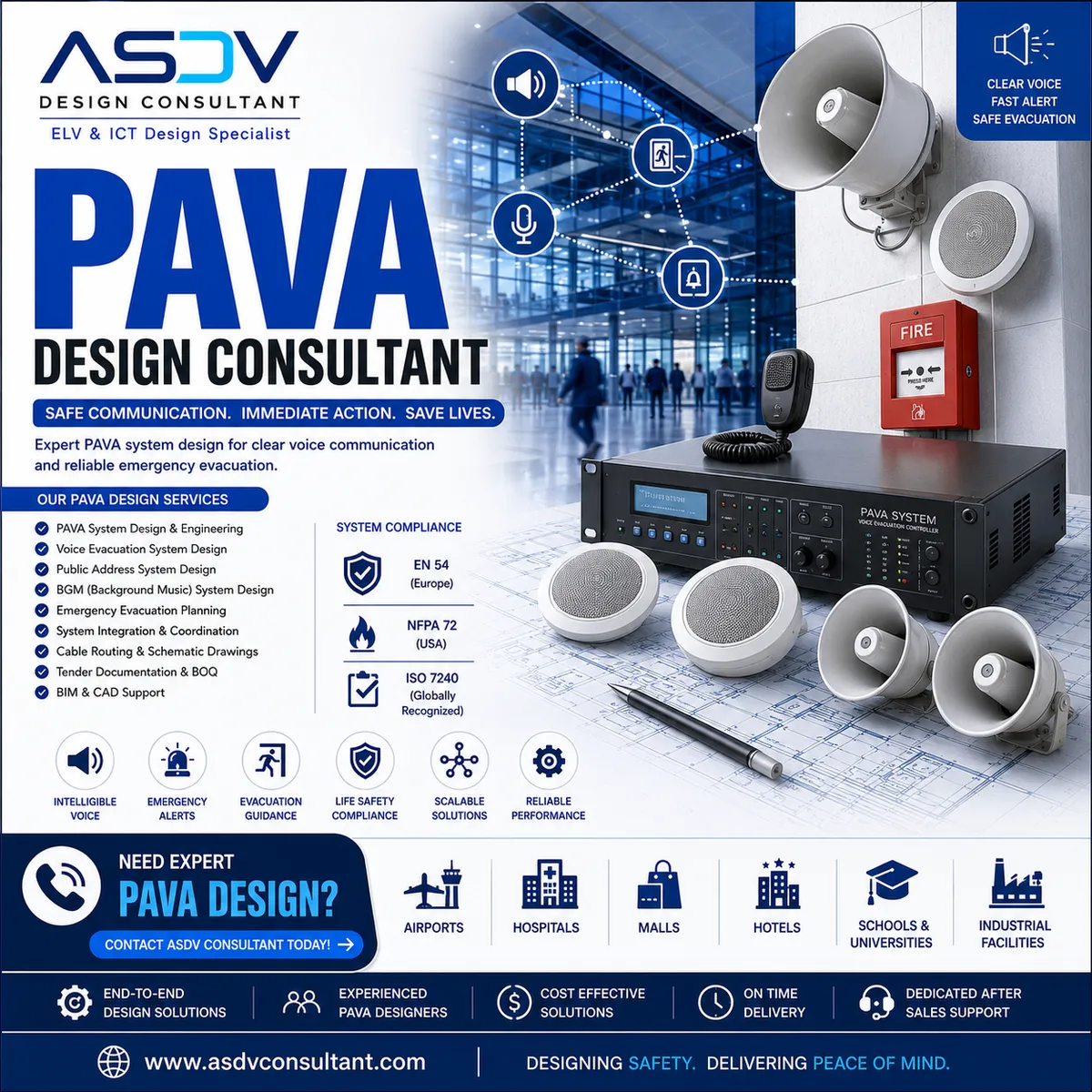
BS 5839-8 governs voice evacuation — spoken messages rather than bells or sounders — for fire emergency instruction. It sits alongside BS 5839-1: a voice alarm system still needs its detection and cause-and-effect logic designed to BS 5839-1.
Why voice evacuation, and when. In tall buildings, stadia, shopping centres and transport hubs, an all-out simultaneous evacuation is often not the safest response — phased evacuation reduces congestion on escape stairs. Voice alarm is the mechanism that makes phased evacuation practically deliverable, because a spoken message can convey zone-specific instructions a sounder cannot.
Intelligibility — the central technical requirement. Typically evidenced through STI (Speech Transmission Index) measurement, with a target of around 0.5 or higher considered the recognised threshold for acceptable intelligibility. Achieving this requires careful acoustic design — loudspeaker spacing, output level relative to ambient noise, and management of reverberant spaces like atria and large retail floors, often needing acoustic modelling rather than rule-of-thumb spacing.
System architecture and standby requirements. Voice alarm control equipment has standby power requirements broadly aligned with BS 5839-1 (typically 24 hours standby plus 30 minutes broadcast), amplifier and loudspeaker circuit monitoring, and zoning that allows different messages to different areas simultaneously.
| Conventional sounder | Voice alarm (BS 5839-8) | |
|---|---|---|
| Message conveyed | Generic alert tone | Specific, zone-targeted spoken instruction |
| Suitable for phased evacuation | No | Yes — core capability |
| Typical building types | Small-medium offices | High-rise, stadia, transport hubs, complex retail |
| Key technical requirement | Audibility | Intelligibility (STI/CIS) plus audibility |
| Relative cost/complexity | Lower | Significantly higher |
Common mistakes
The most frequent failure is treating intelligibility as a spec line item rather than an acoustic design outcome — loudspeakers spaced by rule of thumb frequently fail commissioning STI testing in reverberant spaces. A second issue is under-specifying amplifier zoning capacity for phased evacuation strategies the fire strategy actually requires.
Future outlook
We expect continued growth in voice alarm combined with mass notification integration, and acoustic modelling software becoming standard practice rather than an optional extra.