
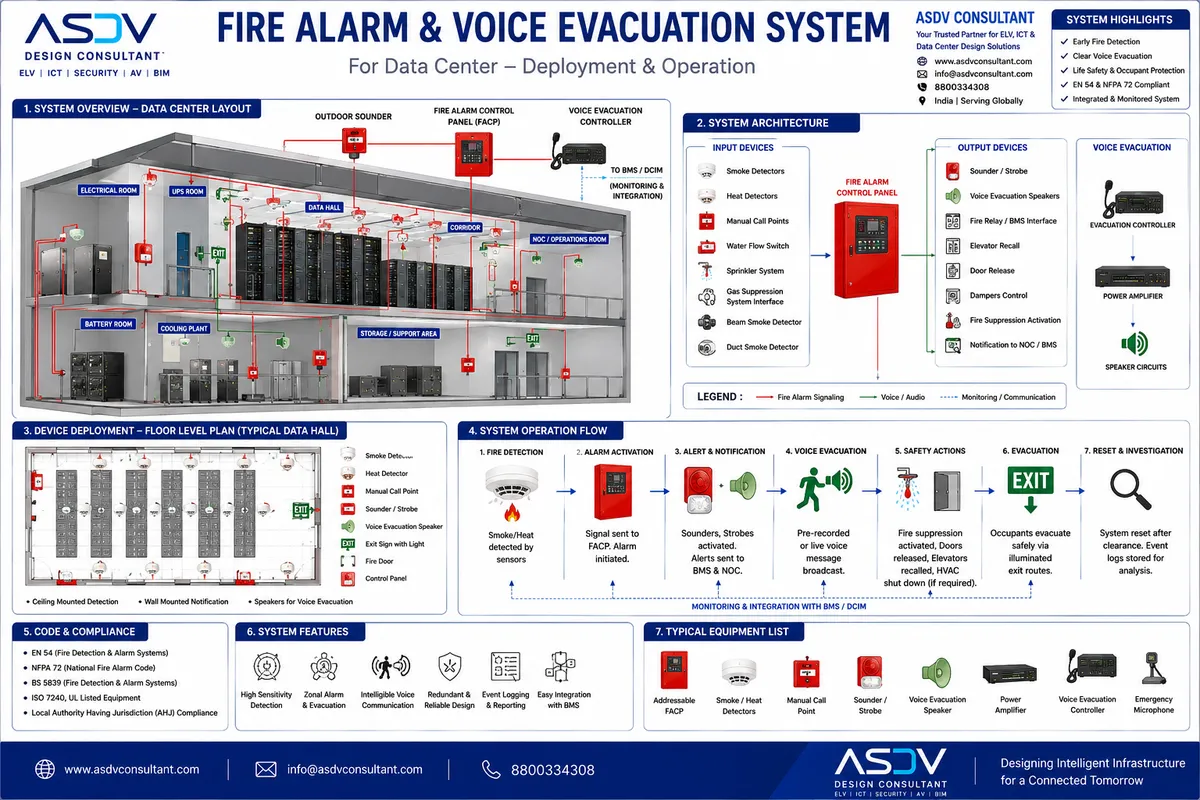
Clients and even some contractors often treat fire alarm "category" as a spec-sheet checkbox. It isn't. BS 5839-1:2017 categories describe fundamentally different design philosophies — how much of a building is covered by automatic detection, and whether the objective is protecting people, property, or both.
The M category: manual only. An M system relies entirely on manual call points and human observation — no automatic detectors. It suits low-risk, well-supervised premises where automatic detection would add cost without a proportionate safety benefit.
L4 — escape routes only. L4 places detection in circulation spaces — corridors, stairways, lobbies — so that if a fire develops anywhere and smoke migrates into an escape route, occupants are warned in time to get out via that route.
L3 — escape routes plus rooms opening onto them. L3 extends L4 by adding detection in every room that opens directly onto an escape route, on the basis that this is where an early-stage fire is most likely to compromise the escape route before it's even noticed.
L2 — as L3, plus defined higher-risk areas. L2 adds automatic detection in areas that a fire risk assessment identifies as higher risk or business-critical — server rooms, kitchens, plant rooms, archive stores. L2 is our default recommendation for speculative Grade A office developments and most mixed-use commercial buildings.
L1 — automatic detection throughout. L1 is full coverage: every room, corridor, void and roof space gets automatic detection. Appropriate for higher-risk occupancies — care homes, hotels, buildings with significant unsupervised periods.
L5 — bespoke, objective-led. Used when a specific, defined fire safety objective needs to be met that the standard categories don't capture — for example, detection specifically to protect a single high-value plant room.
P1 and P2 — property protection. P1 covers the whole premises with automatic detection aimed at limiting damage. P2 covers only defined higher-value or higher-risk areas. Property protection categories are frequently combined with a life category on the same system.
| Category | Coverage | Typical use case |
|---|---|---|
| M | Manual call points only | Very low-risk, small, supervised premises |
| L4 | Escape routes | Simple commercial, low risk |
| L3 | Escape routes + rooms opening onto them | SME offices, retail fit-outs |
| L2 | L3 + defined higher-risk areas | Grade A offices, mixed-use |
| L1 | Whole building | Care homes, hotels, unsupervised warehouses |
| L5 | Bespoke, objective-led | Specific asset or interface protection |
| P1 | Whole premises, property focus | Data centres, warehouses, archives |
| P2 | Defined areas, property focus | High-value storage within a larger building |
Common mistakes
We regularly encounter designs where the category was selected by the installer rather than derived from the fire risk assessment, resulting in mismatches. Another common error is assuming a category automatically includes manual call points: L1 to L4 include them by default, but P1, P2 and L5 do not unless specified with the suffix "/M" (e.g. P1/M).
Future outlook
As mixed-use and co-working developments become more common in the UK, we expect greater use of "hybrid" category specifications — different categories applied to different zones of the same building under a single coordinated cause-and-effect strategy.