
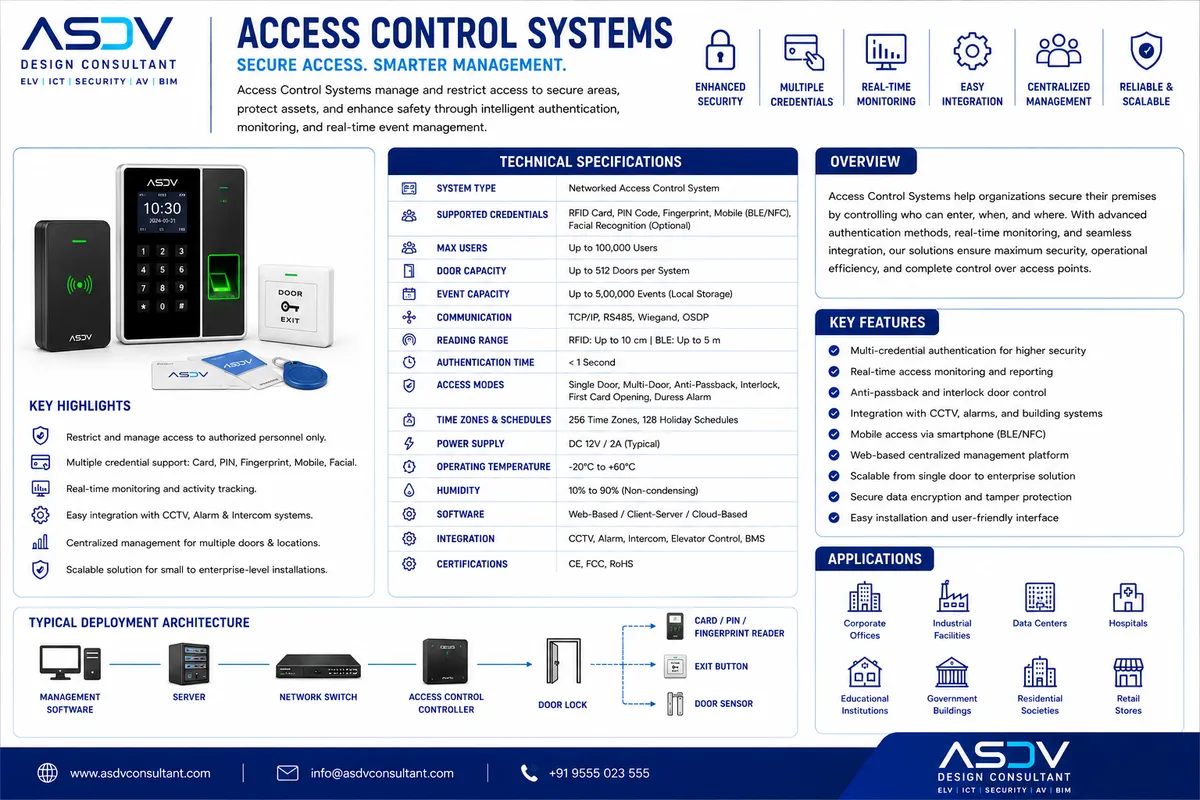
BS EN 60839 is the European (and UK) standard family covering alarm and electronic security systems, including EN 60839-11 (electronic access control systems). For UK commercial access control, the standard's grading structure shapes everything downstream — hardware selection, credential technology, and integration.
The four security grades. Grade 1 (low risk) — the intruder is expected to have little knowledge of the system and limited tools. Grade 2 (low to medium risk) — some knowledge and general tools assumed; the common baseline for standard office access control. Grade 3 (medium to high risk) — the intruder is assumed familiar with security systems and comprehensively equipped; appropriate for higher-value premises and data halls. Grade 4 (high risk) — security takes priority over all other factors; reserved for critical national infrastructure and high-security government/defence facilities.
Why grade selection matters practically. A Grade 2 system might use standard proximity or Bluetooth-enabled credentials with conventional electric strikes. A Grade 3 specification typically demands anti-tamper monitoring, encrypted credential technology resistant to cloning (MIFARE DESFire EV rather than legacy 125kHz proximity), forced-door and door-held-open monitoring reported to a monitored head end, and often dual-technology or biometric verification.
Integration with UK-specific frameworks. UK access control design sits alongside LPS 1214 (the BRE Global/LPCB Loss Prevention Standard for access control equipment) which many insurers specify directly; and PAS 24/LPS 1175 for physical door and hardware attack resistance.
| Building type | Typical grade | Key design consequence |
|---|---|---|
| Multi-let serviced office | Grade 2 | Standard encrypted credentials, basic door monitoring |
| Corporate HQ / financial services | Grade 3 | Anti-tamper, ARC-monitored alarms, audit-grade reporting |
| Data centre (colo/enterprise) | Grade 3-4 | Mantraps, biometric layer, redundant comms, LPS 1214-certified hardware |
| Residential common parts | Grade 1-2 | Cost-sensitive, focus on fob/app convenience |
| Critical national infrastructure | Grade 4 | Full CPNI-aligned specification |
Common mistakes
The most common fault is specifying Grade 3 hardware throughout a building "because higher is safer," inflating cost without addressing actual risk. We also frequently see access control specified in isolation from fire alarm interfaces — access-controlled doors on escape routes must fail safe on fire alarm activation, and this needs to be explicitly designed and tested.
Future outlook
Mobile credentials are rapidly displacing physical cards in UK Grade 2 specifications, and we expect growing convergence between access control and building-wide identity platforms.