
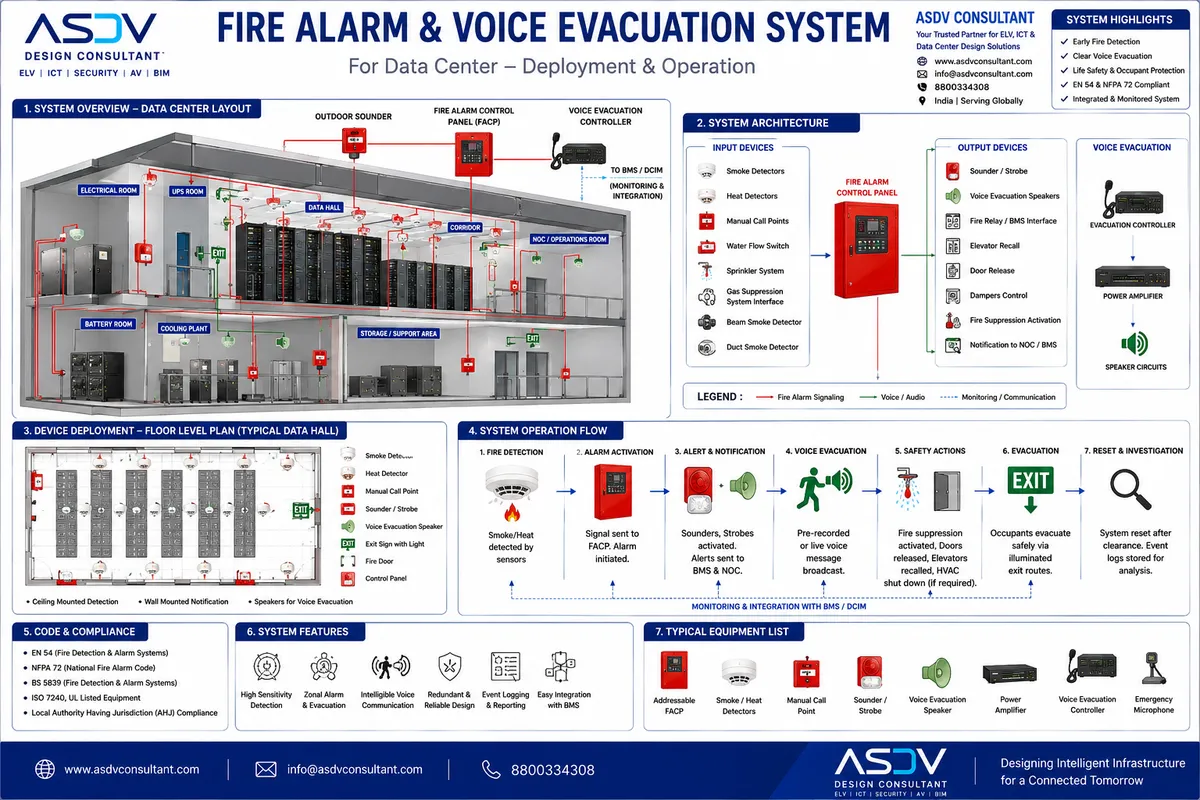
Most international design consultants entering the Saudi market have deep NFPA 72 experience. SBC 801, the fire protection volume of the Saudi Building Code, was developed drawing substantially on NFPA methodology, but it is a distinct code with structural, procedural, and interpretive differences that matter.
Where the codes align. Core engineering principles — detection spacing logic, notification appliance audibility/visibility, circuit supervision, survivability of critical circuits — are conceptually consistent because SBC 801 was written with NFPA as a primary reference.
Where they diverge in practice. First, enforcement structure: NFPA 72 is enforced by a jurisdiction's AHJ with varying strictness; SBC 801 is enforced by a single national body (Saudi Civil Defense) but with regional interpretation varying by municipality. Second, submission format: GDCD review expects specific Saudi-format deliverables — cause-and-effect matrices in a particular structure, Arabic-language labelling on certain documents, and civil defense-specific occupancy classification. Third, climate and infrastructure context: extreme ambient temperatures affect equipment selection (enclosure ratings, standby battery derating), and SBC 801 sits alongside Saudi electrical/mechanical code requirements different from NEC/IMC assumptions. Fourth, licensing: designs must ultimately be certified through a Saudi-licensed engineer/consultant.
| Dimension | NFPA 72 | SBC 801 |
|---|---|---|
| Governing body | Local AHJ | Saudi Building Code National Committee; enforced by GDCD |
| Core engineering basis | Original NFPA research | Substantially modelled on NFPA, adapted for Saudi context |
| Submission format | Varies by AHJ | Structured GDCD submission package, often bilingual |
| Regional interpretation | Varies by AHJ | Varies by municipality; local consultant experience matters |
| Environmental design context | NEC/IMC assumptions | Saudi electrical code and extreme-heat equipment derating |
| Sign-off | PE stamp per state | Saudi-licensed engineer/consultant registration required |
Practical guidance
For projects transitioning from an NFPA-based concept design into formal Saudi submission, we recommend a dedicated "codes gap" review at schematic design stage — before the design is developed further — mapping detection zoning, cause-and-effect logic, and equipment specification against SBC 801 requirements.
Common mistakes
The most expensive mistake is discovering codes-gap issues at civil defense submission rather than at schematic design. A second is assuming equipment listed under UL/FM for NFPA applications is automatically acceptable to GDCD without separate confirmation of local approval status.
Future outlook
As giga-projects bring in more international design talent, we expect the practical gap between NFPA 72 fluency and SBC 801 compliance to narrow through better bilingual guidance and standardized GDCD digital submission tools.