
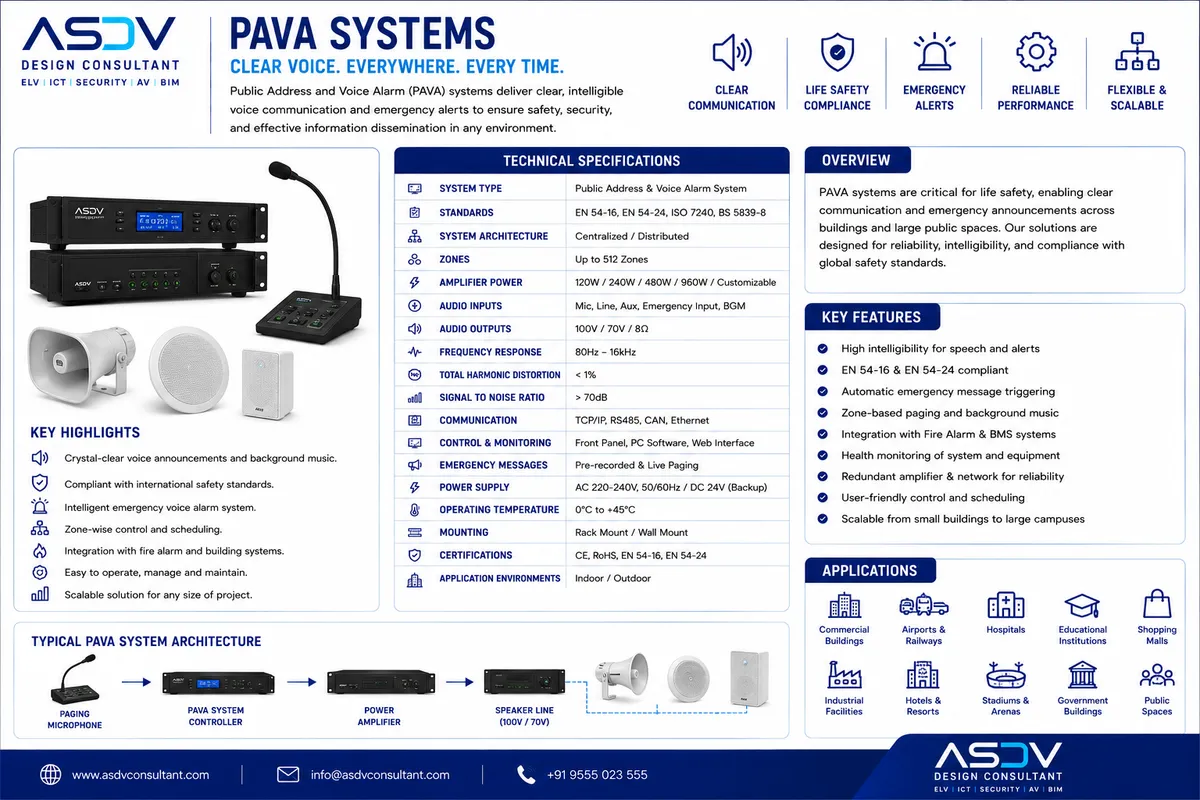
PAVA systems in Saudi public buildings carry a dual role: life-safety emergency instruction, and in mosques and cultural buildings, everyday call-to-prayer amplification and ceremonial use.
Mosque acoustics as a design constraint. Large open prayer halls with hard reflective surfaces, high ceilings and domes create long reverberation times. Achieving adequate speech intelligibility typically requires a distributed loudspeaker strategy with careful zoning and delay-line time alignment rather than a small number of high-power speakers. We design mosque PAVA systems with acoustic modelling done early, coordinated with architectural interior finishes.
Life-safety integration under SBC 801. PAVA needs to integrate with the fire alarm system with defined evacuation messaging, zone-based sequencing (critical in multi-zone campuses where phased evacuation is appropriate), and standby power consistent with fire alarm survivability requirements. Messaging typically needs Arabic and English at minimum.
Government and public building considerations. Ministries, courts and cultural venues carry PAVA requirements shaped by high visitor volumes, ceremonial priority-override paging, and close integration with CCTV and access control.
Environmental and outdoor considerations. Mosque courtyards and government plazas need PAVA coverage extending beyond the building envelope, with outdoor-rated loudspeakers withstanding heat and dust.
| Building type | Primary acoustic challenge | Key design response |
|---|---|---|
| Mosque prayer halls | Long reverberation, hard reflective surfaces | Distributed loudspeaker zoning with delay-line alignment |
| Government ministries/courts | Complex floor plans, ceremonial use | Function-based zoning, priority-override paging |
| Cultural/public venues | High occupancy, mixed use | Phased zone-based evacuation messaging |
| Courtyards/outdoor plazas | Ambient noise, extreme heat/dust | Outdoor-rated loudspeakers |
Common mistakes
The most common mistake in mosque PAVA design is under-investing in acoustic modelling, relying on speaker power alone to overcome reverberation. A second is treating outdoor courtyard coverage as a simple extension of the indoor speaker specification.
Future outlook
As giga-projects build new cultural and government infrastructure, we expect growing integration of PAVA with broader building intelligence platforms.